Free printable pickleball brackets + how they work
You’ve got eight teams, two courts and a Saturday morning. You need a bracket before the first serve.
Below you’ll find free printable pickleball brackets for single elimination, double elimination and round robin play. You’ll also find a quick guide to how each format works, how to seed teams by DUPR rating and how to make every bracket match count toward players’ ratings.
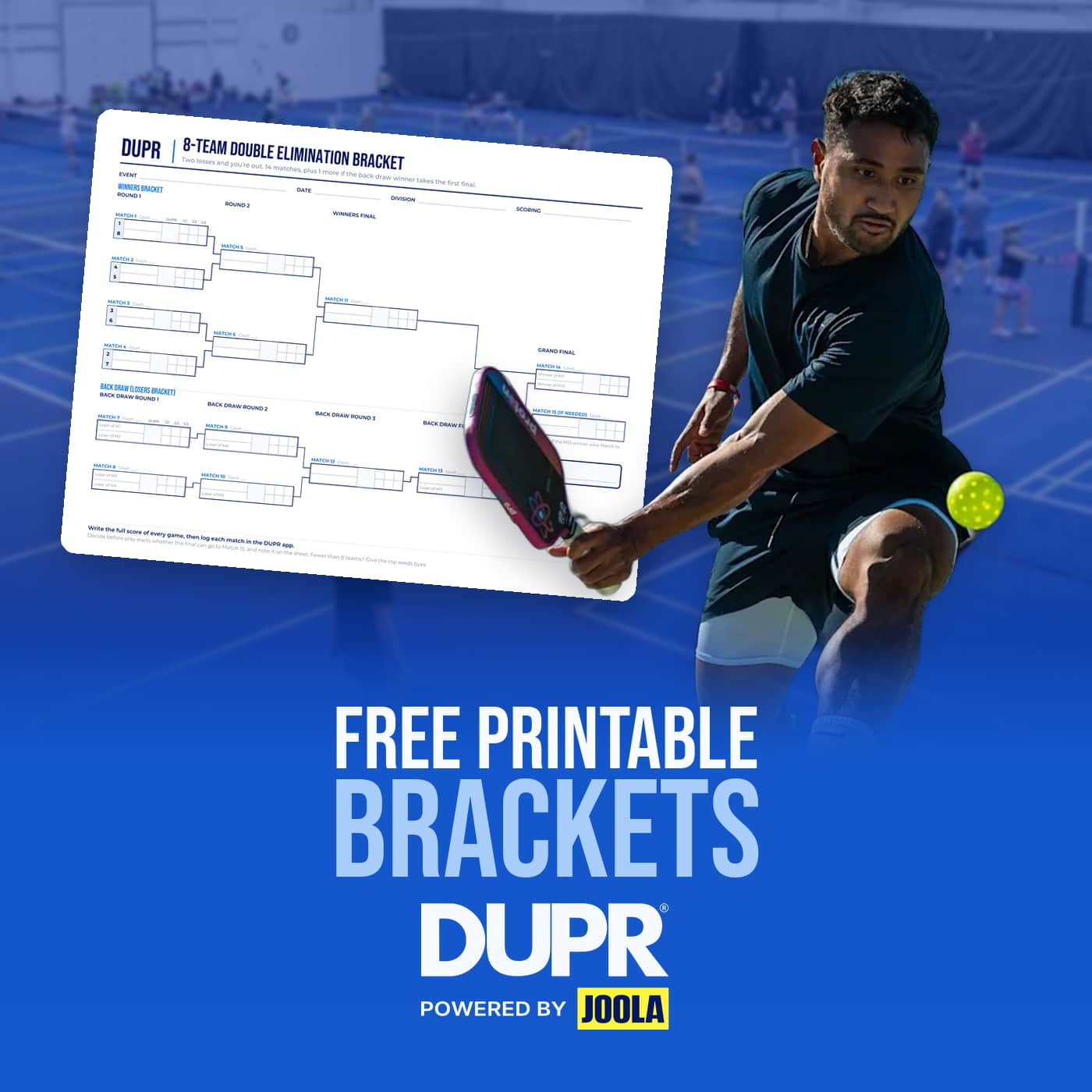
Download your free printable pickleball brackets
Pick the format that fits your group size and court time:
- 4-team single elimination bracket
- 8-team single elimination bracket
- 16-team single elimination bracket
- 8-team double elimination bracket
- 4, 5 and 6-team round robin sheets
Each sheet has space for team names, each player’s DUPR rating and the full score of every game, so you can log results when play wraps up.
How pickleball brackets work
A bracket is the map of who plays whom and in what order. Most pickleball events use one of three formats. Each one trades off speed against how much play every team gets.
Single elimination
Lose once and you’re out. Winners advance until one team is left.
This is the fastest format. A single elimination bracket always takes one fewer match than the number of teams, so 8 teams play 7 matches. It works well when court time is tight. The downside is that half the field goes home after one match.
Double elimination
Teams are out after two losses. Your first loss drops you into the back draw, a second bracket where you keep playing. The winners bracket champion meets the back draw champion in the final.
An 8-team double elimination bracket runs 14 or 15 matches, depending on whether the final needs a rematch. Some events play a second final if the back draw team wins the first one, so both teams have two losses. Decide this before play starts and write it on the sheet.
Round robin
Everyone plays everyone. Teams are ranked by wins, then by point differential if there’s a tie.
Round robins guarantee the most play, which is why clubs use them for league nights and tournaments use them for pool play before a playoff bracket. The game count climbs fast, though:
For a 4-team round robin on two courts, use this rotation:
- Round 1: Team 1 vs. Team 4, Team 2 vs. Team 3
- Round 2: Team 1 vs. Team 3, Team 4 vs. Team 2
- Round 3: Team 1 vs. Team 2, Team 3 vs. Team 4
How to seed a pickleball bracket
Seeding decides where each team starts in the bracket. Good seeding keeps the strongest teams apart until the later rounds, so the early matches stay competitive.
DUPR ratings give you an objective way to seed. Rank teams from highest to lowest. For doubles, a simple approach is to add the two partners’ doubles ratings together. Then place them in the standard 8-team order:
- 1 vs. 8 and 4 vs. 5 (top half)
- 3 vs. 6 and 2 vs. 7 (bottom half)
If the 1 and 2 seeds both win out, they meet in the final.
What to do with an odd number of teams
Fill the bracket up to the next size (4, 8 or 16) and give the extra spots to the top seeds as byes. A bye means that team skips the first round and advances automatically. With 6 teams in an 8-team bracket, seeds 1 and 2 get byes.
For bigger groups, split players into divisions by DUPR rating range. A 3.0 to 3.49 division and a 3.5 to 3.99 division will give everyone closer matches than one big draw. That’s also how many DUPR events set up their brackets.
Make your bracket matches count toward DUPR
The bracket sheet shows who advanced. The score shows how they played.
DUPR measures performance against expectation, so the margin matters. An 11–9 win against a lower-rated team tells a different story than an 11–2 win, and ratings move based on that difference. Write down the full score for every game.
After the event, log each match in the DUPR app. Results from matches run through a DUPR club carry more weight than self-posted rec games because they’re verified.
Looking for a tournament bracket instead?
If you searched for brackets because you’re playing in an event, you can find DUPR events near you by location and skill level. Most divisions are grouped by DUPR rating, so you’ll know where you fit before you register.
Tips for running a smooth bracket
- Set the scoring before play starts. Games to 11, win by 2, is standard. Announce any changes for medal matches.
- Announce tiebreakers up front. For round robins, use head-to-head first, then point differential.
- Post the bracket where everyone can see it. Tape a copy to the fence and keep a second copy at the desk as the master.
- Assign courts in advance. Write the court number next to each match so teams know where to go.
- Collect scores right after each match. Matches you can’t remember the score of can’t go into DUPR accurately.
A printed bracket and a pen can run a great event. Download the template that fits your group, seed teams by DUPR rating and record every score. If you run regular events, start a DUPR club so your results count as verified club matches.
FAQ
How many matches are in an 8-team pickleball bracket?
A single elimination bracket has 7 matches. A double elimination bracket has 14 or 15, depending on whether the final needs a rematch. An 8-team round robin has 28 games.
How does a round robin work in pickleball?
Every team plays every other team once. Standings are based on wins, with point differential used to break ties.
What is a bye in a pickleball bracket?
A bye lets a team skip a round and advance automatically. Byes usually go to the top seeds when the number of teams doesn’t fill the bracket.
How are pickleball tournament brackets seeded?
Many events seed by DUPR rating, placing the highest-rated teams so they don’t meet until the later rounds. Divisions are often grouped by rating range.
Do bracket matches count toward my DUPR rating?
Yes, when they’re logged in DUPR. Matches run through a DUPR club or tournament carry more weight than self-posted rec games.
Is DUPR free?
Yes. Your DUPR rating, match history and access to DUPR clubs, leagues and tournaments are free. DUPR+ is an optional membership with extra features.

OTRAS HISTORIAS DESTACADAS
Consulte nuestras otras historias que pueden interesarle