No matching results.
.png)

If you're serious about improving your DUPR pickleball rating and taking your pickleball game to the next level, you need a structured training plan that focuses on skill development, consistency, and strategy. Whether you're new to the game or looking to sharpen your skills, this guide will provide an easy-to-follow, realistic 4-week training plan to help you boost your pickleball ratings and become a more confident player.
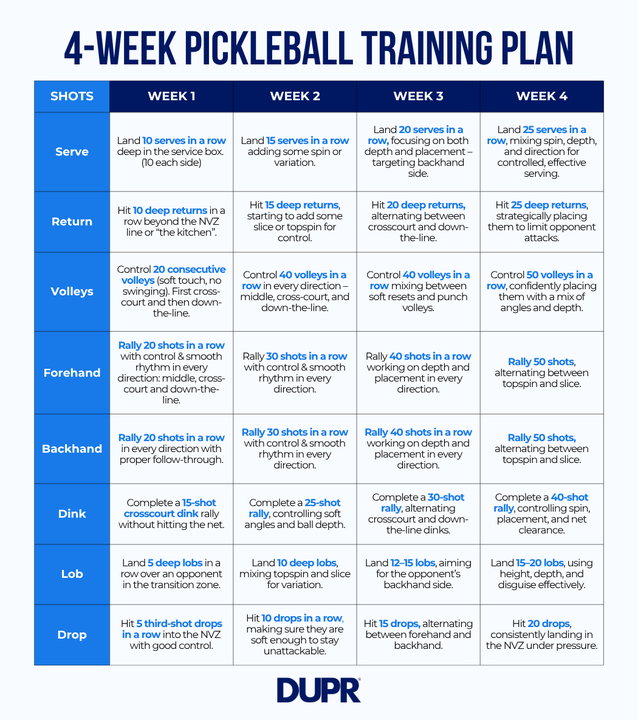
Improving your pickleball skills requires structured practice and competitive play. This 4-week training plan is designed to help amateur players build consistency, refine their shots, and develop a stronger overall game.
Each week introduces progressive training goals to challenge you while keeping improvements realistic and achievable.
✅ Week 1: Build Consistency → Focus on hitting a set number of shots in a row without mistakes.
✅ Week 2: Introduce Spin & Direction → Start adding topspin, slice, or variation in placement.
✅ Week 3: Increase Difficulty & Precision → Target specific areas of the court.
✅ Week 4: Develop Full Control → Spin, depth, and angles should now be intentional.
While training is essential, don’t forget that playing matches is the key to boosting your DUPR rating. The DUPR app allows you to track your rating and find DUPR-affiliated tournaments to compete against players at your level.
The more you play, the more accurate your rating becomes, making it fair for everyone. Every player has a chance to improve their rating by overperforming — whether you're the favorite or the underdog.
📌 Set a Realistic Goal – Your target should challenge you but remain achievable. If 10 reps are too easy, aim for more; if it’s too tough, adjust accordingly. Consistency is key!
📌 Manage Your Mindset – Pickleball is as much mental as it is physical. Stay patient, manage frustration, and focus on playing under pressure.
📌 Enhance Physical Conditioning – Work on mobility, coordination, strength, and endurance to improve movement and shot execution.
📌 Practice with Purpose – Every shot in training should mimic match scenarios. Hit with intention, not just repetition.
📌 Play More Matches – Training helps, but matches determine your rating. Play official DUPR tournaments and focus on scoring as many points as you can while keeping your opponents’ score low. Every point counts!
Even though technical and strategic challenges are essential, there are other factors to consider:
When competing against players of similar skill, your mental toughness can be the deciding factor in securing the "W."
By following this 4-week training plan, you’ll develop consistency, control, and confidence on the court. But remember, practice alone won’t boost your DUPR rating — you need to compete and perform well in matches. Every point matters!
✅ Track your progress in the DUPR app, available on Google Play and in the Apple Store.
✅ Check the DUPR Events Dashboard for upcoming tournaments.
✅ Focus on playing your best every point — scoring more leads to greater rating gains.
The more you play, the more accurate your rating becomes—and every point helps shape it. So train hard, compete smart, and start leveling up your pickleball game today!
The fourth annual Collegiate National Championship brought the heat to Life Time Peachtree Corners in Atlanta, GA. With over 600 players from 64 schools, it was the largest collegiate pickleball event in history! A $40,000+ prize purse was on the line, and teams showed up ready to battle it out.
The Championship match featured two Texas titans: Texas Christian University (TCU) with a team DUPR of 20.805 and The University of Texas at Austin (UT) with a team DUPR 20.902.
The final went down like this:
UT took the crown, led by Natalie Liu, Eli Trumeter, Zoeya Kahn, and Jack Munro. This marks their first team tournament victory in program history!
Despite having pro player, Jack Munro on the roster for the 2023 Texas Super Regional, they had never clinched a Super Regional title. At the 2023 Nationals, UT went 1-4 in group play without Jack. Even with him back in the lineup, they fell to Utah Tech in the Round of 16 at the 2024 Nationals. The Universtiy of Texas at Austin and Utah Tech have now faced off in the playoff bracket at back-to-back Nationals—each time, the winner of that matchup has gone on to win the National Championship.
In their quarterfinal, semifinal, and final matches, Texas followed the same pattern every time: they lost women’s doubles, then bounced back to win the next three doubles matches, clinching each victory before a DreamBreaker was needed.


Texas Christian University secured an impressive second-place finish. Newcomer Ellie Douglas, who had never competed in a pickleball tournament before this event, provided the boost TCU needed to reach the championship match. The team has shown strong consistency over the years, reaching the semifinals in 2022, the quarterfinals in 2023, and the Round of 16 in 2024, making this run to the finals a major step forward.

Semifinalists Florida Atlantic University (FAU) and Grand Canyon University (GCU) both showcased the rising depth and competitiveness of the collegiate pickleball scene.
For FAU, it was another heartbreaking loss. Despite entering the bracket as the No. 1 seed by DUPR and f No. 1 team after group play, they fell short once again, losing in the semifinals in a DreamBreaker for the second straight tournament.
GCU, on the other hand, had their best Nationals performance to date. After going 1-2 in group play in 2022, improving to 3-2 in 2023, and suffering a Round of 32 exit in 2024, their run to the semifinals this time around marks a huge leap forward for the program.

.png)
Check out the full bracket to see the results of all teams from the tournament.

For the past three years, the National Championship was dominated by a trio of powerhouse programs—UNC, UVA, and Utah Tech—often referred to as the “Blue Bloods” of college pickleball. But 2025 marked a turning point. None of the three reached the semifinals, and only Utah Tech advanced as far as the quarterfinals.
UNC was knocked out in the Round of 32 by GCU and suffered their first-ever group play loss at Nationals—also to GCU. UVA fell to Samford in the Round of 16, while Utah Tech’s run ended against Texas in the quarters.
Because of their top finishes, UT and TCU have officially qualified for the Major League Pickleball (MLP) Mid-Season competition, marking the first time collegiate pickleball teams will go head-to-head with the pros in the Challenger Level bracket.
Get ready to see how college stacks up on the big stage.
For the second year in a row, the Collegiate All-America Teams were announced, honoring the top 24 players across the country selected based on:
Each All-America Team features four players from the East and four from the West, split by the Mississippi River. On Friday night, the 1st Team East and 1st Team West battled in the East vs. West Game and this time, East flipped the script with a dominant 4–0 sweep after losing by the same margin last year.

The atmosphere? Electric. Life Time Peachtree Corners gave us indoor and outdoor courts, championship-caliber vibes, and a full fan experience, especially on Championship court.
Reign Storm was in the house with giveaways, ice-cold clean energy, and a DJ! Osaka brought the style with screenprint-your-own exclusive merch, and Frank Works delivered on-court comfort with their high-performance shoes. Also, a big thanks to our sponsor Six Zero for helping us Go Next Level with their great gear and paddles!
.png)

Hundreds entered. Only 12 were chosen.
Before the tournament even kicked off, a lucky group of students got the opportunity to train with pro player Parris Todd. From technique breakdowns to intense drills, plus a photo op, it was a session they'll never forget.

Stay up to date with all future DUPR Collegiate events and highlights on our website at https://www.dupr.com/collegiate-league and follow along on the @duprpb and @collegiatepickleball instagram.
You may think your pickleball game comes down to skill and strategy in the court–but your nutrition can be the deciding factor in your performance. A well-fueled body can sustain energy levels, maintain focus, and enhance recovery, while poor nutrition can lead to low energy and stamina, slower reaction times, and costly errors.
If you're struggling to close out tight matches or finding yourself fatigued late in the day, your diet could be the culprit. In fact, bad nutrition could be the main contributor to a loss, damaging your DUPR pickleball rating and holding you back from reaching your full potential on the court.
Here’s a guide to help you implement a strategic approach to nutrition–before, during, and after play so you always compete at your best.
Your pre-match meal plays a crucial role in preparing your body for the demands of competition. Eating the right balance of macronutrients will help ensure sustained energy levels and mental sharpness. Proper pre-match nutrition supports glycogen storage, muscle function, and hydration, all of which are critical for peak performance, which may lead to boosting your pickleball ratings.
During matches, your body continues to burn glycogen, and dehydration can set in quickly, leading to fatigue, slowed reaction time, and decreased cognitive function. Proper in-match nutrition helps sustain your endurance, power, and focus, ensuring you stay sharp until the final point.
Your goal for between-match nutrition is to maintain energy without causing digestive distress. Stick to easily digestible, familiar foods that won’t weigh you down but will keep you sharp and ready for your next pickleball tournament:
Ideal Snacks Between Matches:
Ignoring in-match nutrition can lead to low energy levels and mental fatigue—both of which can cost you critical points that will affect your pickleball ratings, and, ultimately, the match.
After each match, focus on replenishing energy stores and supporting muscle recovery. Proper recovery nutrition ensures that you maintain a high level of play throughout the tournament, rather than declining in later rounds.
Ideal snacks post-match:
Beyond match-day nutrition, your daily intake can have a significant impact on performance, endurance, and recovery. Optimizing your long-term nutrition is crucial for enhancing pickleball performance, improving your pickleball ratings, supporting recovery, and maintaining overall health. Incorporating evidence-based dietary strategies can help you meet the physical demands of the sport and achieve your performance goals.
Carbohydrate Recommendations for Training Levels:
Protein Intake for Muscle Maintenance and Recovery
Hydration for Performance and Everyday Health
Daily Fluid Recommendations
Electrolytes, particularly sodium and potassium, should be replenished through sports drinks or salty snacks if you're sweating excessively.
If you're serious about improving your DUPR rating and competing at the highest level, your nutrition needs to be a priority in tandem with your training. If you struggle in long matches or fade late in tournaments, optimizing your nutrition before, during, and after play can help you compete at your highest level.
A bad diet can be the reason you lose a match you should have won. By consistently applying proper nutrition strategies, you can enhance your endurance, sharpen cognitive function, and accelerate recovery, giving you the best shot at success every time you step onto the court.
AIM7 app’s innovative technology allows you to:
Take the first step to a healthier, stronger you. Download the AIM7 app today, it’s FREE, and start your journey to better health and fitness.
La Real Federación Española de Tenis (RFET) y Dynamic Universal Pickleball Rating (DUPR) han alcanzado un acuerdo histórico que posiciona al Pickleball como un deporte de referencia en España. Este acuerdo introduce el sistema de clasificación de DUPR, reconocido mundialmente por su precisión en evaluar el nivel de habilidad de los jugadores de Pickleball a través de una escala global de 2.000 a 8.000.
Este sistema no solo facilita la participación en competiciones nacionales e internacionales, sino que también permite a los jugadores monitorear su evolución y encontrar oponentes adecuados para mejorar su juego. La precisión del Pickleball Rating de DUPR se incrementa con cada partido registrado, reflejándose en un aumento del 'reliability score' o índice de confiabilidad—una métrica que evalúa la consistencia y exactitud de los datos de los partidos ingresados a la plataforma, garantizando que las clasificaciones reflejen fielmente el verdadero nivel de habilidad de cada jugador.
Yasin Harrús, presidente del Comité Nacional RFET-Pickleball, expresó:
“Con la firma del presente acuerdo con DUPR, intentamos dar un impulso exponencial a nivel nacional e internacional a la competición oficial y reglada, otorgando un aliciente más a las competiciones federadas organizadas desde la estructura organizativa de la RFET y el conjunto de sus territoriales. Un acuerdo para dar un valor añadido a la licencia federativa y sus competiciones”.
César Clemente García, vicepresidente de DUPR, expresó:
"En España, donde la pasión por los deportes de raqueta es intensa, el acuerdo con RFET es un paso significativo para elevar el nivel de Pickleball a nivel global, permitiendo a los jugadores españoles integrarse plenamente en la comunidad internacional y competir bajo el sistema de clasificación más preciso que existe”.
Además, la implementación del sistema de DUPR facilita a los directores de torneos y jueces la organización de eventos, optimizando la experiencia competitiva. Tanto los partidos oficiales de la RFET, de todas sus territoriales, recreativos en clubes, como los oficiales en torneos de DUPR contribuyen a mejorar la clasificación de los jugadores. Aunque los torneos oficiales tienen un mayor impacto en el algoritmo Elo utilizado por el sistema de DUPR, cada victoria en partidos recreacionales también suma, mejorando el pickleball rating de los jugadores y acercándolos a sus objetivos deportivo.

Sobre DUPR
DUPR (Dynamic Universal Pickleball Rating) es el sistema de clasificación de pickleball y plataforma tecnológica líder a nivel global, confiado por los principales clubes, torneos y ligas del mundo. Su sistema dinámico unifica el Pickleball en términos de edad, género y ubicación geográfica mediante el análisis de resultados de partidos, evaluando con precisión a todos los jugadores en una escala de 2.000 a 8.000. DUPR es el sistema oficial de clasificación de la United Pickleball Association (UPA), PPA, Major League Pickleball (MLP), Pickleball.com, Life Time, The Picklr, National Team Pickleball League y la National Pickleball League, además de ser propietario y operador de las ligas Minor League Pickleball y Collegiate Pickleball. Los jugadores y operadores pueden visitar www.dupr.com para registrarse y obtener más información.
We’ve had 19 events give out bids to the 2025 Collegiate National Championship, which is remarkable due to the short duration of the season! Between those 19 events, we’ve had 118 unique schools participate, and 1,895 total players. As we prepare for the largest tournament in collegiate pickleball history, we look back on how the 2025 season went, and what to know for Nationals.
270 players from 25 different schools competed in the 3rd largest collegiate pickleball event (to date) in Atlanta, GA on March 1st-2nd. Hundreds of spectators came to watch the competition unfold on Saturday and Sunday. In the Finals, the defending Georgia Super Regional champions (Florida) went up 2-0 in the best of 5 series against UNC. However, UNC took the victory from the jaws of defeat and won the last 3 games to upset Florida.
It was a battle for bids in the Midwest, as only 3 of the 11 schools attending had one at the time of the tournament. Ohio State and Wisconsin were the #1 and #2 teams by DUPR going into the tournament, and they met in the finals with Ohio State prevailing. With 150 players, this is the 5th largest DUPR Collegiate super regional. Largest DUPR collegiate super regional not in the states of VA and GA.
Virginia Tech won their first Super Regional, and only dropped 1 game the entire tournament! Between Cornell winning a bid, and Princeton winning the challenger bracket, it was a good tournament for Ivy League schools. There was an exciting dreambreaker in the semifinals between Delaware and UNCC to determine who plays Virginia Tech, with Delaware prevailing.
USC dominates, only dropping one game during the tournament, which was in their 3-1 victory over SDSU in the finals. GCU had two teams that lost in the semifinals, spoiling the possibility of an all-GCU finals. USC, GCU, and Arizona State all brought 3 teams to the event, raising the energy level in all of their matches.
Format
There will be 1st Team, 2nd Team, and Challenger brackets, with the 1st Team Bracket crowing the champion of the 2025 season. It’ll be group play on Friday, with playoffs on Saturday and Sunday.

This is the 4th annual Collegiate National Championship! Here are the past winners and results:
Over $40,000 will be given out at this event, with $15,000 for the winning team!
You can follow along the action at home with games being livestreamed to the DUPR YouTube channel this weekend. We will also have a prediction bracket contest, stay tuned to the DUPR Instagram account for when that is live on Friday night.
The energy in St. George is different this week—and for good reason. Utah Tech's pickleball team, the reigning Collegiate National Champions, is gearing up for another shot at glory. As the Trailblazers prepare to defend their title, there’s one thing that’s clear: this squad isn’t just resting on last year’s success—they’re building on it.
Ask any of the players, and they'll tell you the same thing: the foundation of their success hasn’t changed much. "We’re all competitive and goal-driven when it comes to our personal development," one team member shared. "We’re also really close off the court, and that chemistry shows when we’re playing and training together."
That tight-knit bond, paired with relentless work ethic, continues to define Utah Tech’s approach. The team spends countless hours training together, pushing each other, and keeping the standard high—because they know that staying at the top is even harder than getting there.
Heading into this year’s tournament, the Trailblazers are sharpening their edge. “Consistency is everything,” says the team. One key area of focus has been high-percentage shots—minimizing errors and maximizing scoring opportunities. But it’s not just physical preparation that matters.
“We’ve also been working on the mental side of things. DUPR Nationals get crazy—every school is watching, cheering, sometimes heckling. We’re training ourselves to stay locked in, stay composed, and block out the noise.”
Being the defending champs brings a mix of swagger and scrutiny. “We’re definitely confident—we know what we’re capable of,” a player admitted. “But there’s pressure, too. Everyone wants to see the champs fall. We’re using that as fuel. We want to go back-to-back.”
This mix of high confidence and grounded awareness could be exactly what gives the Trailblazers their edge. They know what it takes to win—and they’re ready to rise to the occasion once again.
Looking back at last year’s championship run, the players credit their victory to a few essential ingredients: rock-solid consistency, excellent coaching, team-first mentality, and focused practice sessions that mimic the intensity and unpredictability of tournament play.
That experience gave them more than just a trophy—it reshaped their mindset. “We’re determined. We know how to win. And we love to have fun doing it. That balance of competitiveness and joy is what makes us great, both as a team and as individual players.”
As the Trailblazers head into this year’s Collegiate National Championship, one thing is certain: they’re not just defending a title—they’re chasing another one. So whether you're cheering from the stands or watching from afar, get ready. Utah Tech is coming in hot, and they’ve got every intention of blazing the trail all the way to another championship win.
Make sure to follow all the action from Collegiate Nationals on Instagram at @duprpb and @collegiateickleball for the latest scores, highlights, and behind-the-scenes coverage.
Looking to build more consistency in your shots? Drilling is key—but not just any drilling. Drilling with intention and using realistic setups can elevate your game in ways casual hitting never will. One of the most effective and engaging ways to do this? Three-player drills. Listen to these tips from Pro player Bobbi Oshiro.
Whether you're a seasoned competitor or just getting serious about improving, incorporating multi-player drills will challenge your decision-making, timing, and court awareness.
This is one of my favorite drills for developing consistency under pressure. It replicates real-game scenarios and keeps all three players actively working on key skills.
This isn’t just about hitting balls back and forth—it’s about game-like repetition.
By drilling with three players, you introduce more movement, more strategy, and more realism. And that’s what translates to better performance in real matches.
Don’t just drill to get reps—drill with purpose. Pick a focus for each session and push yourself (and your drilling partners) to replicate match situations as closely as possible.
Ready to level up your consistency? Grab two friends, hit the courts, and try this 2-on-1 drill next time you train.
A lift dink is one of the most essential defensive shots in pickleball, especially when you’re off balance or pushed into a tough position. But while it may seem simple, there’s one technical mistake that can throw your entire game off: overusing the wrist.
Listen as Pro Player, Tyson McGuffin breask down the “why” behind lift dinks, what proper technique looks like, and how to avoid common mistakes.
Whenever you're off balance, pushed back, or playing from a compromised position, the lift dink shot becomes your best option. It helps reset the point and keeps you in the rally when aggression isn’t the right play. The goal? Consistency, control, and depth.
One of the biggest issues I see in players of all levels is relying too much on the wrist during a lift.
Take a look at the difference:
More consistent lifts, better resets, and smarter shot placement that helps you stay in the point—even under pressure.
Next time you’re drilling or warming up, keep your hand positioning calm, your wrist connected to the shoulder, and focus on that clean, smooth contact. Your lift dink will thank you!