_1.png)
Join 2 million DUPR rated pickleball players in playing matches, building community, and improving as a player.

.avif)


.avif)
DUPR syncs with all major event and club platforms. Results are sent directly to DUPR to keep your rating accurate and up-to-date. Register for events at your level at DUPR Events.
.avif)


.png)
.png)
.png)




.png)

.png)

.png)



%20(1).png)


.png)
.png)


.png)


.png)
.png)
.svg)



.png)
%20(1).png)
.png)


%20-%20Edited.png)











.png)


.png)

.png)


.png)

.webp)
.png)
.png)
.png)


.png)
Anyone can have a DUPR rating. One match result is all it takes, and with 10-20 match results you will have an even more accurate rating.


Self-report easily in the app, or let your club handle it—thousands of clubs already send results straight to us.

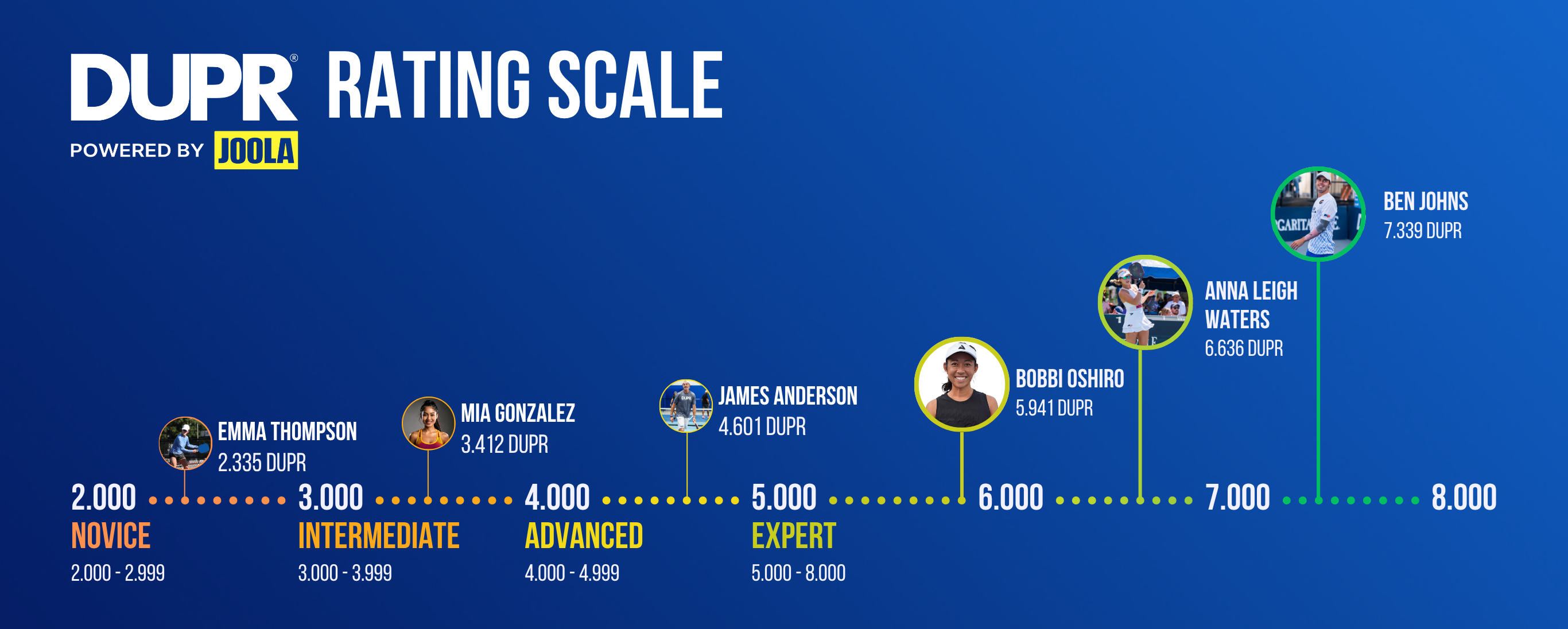
With DUPR’s rating, all new players start as NR (Not Rated) and progress through a scale ranging from 2.000 to 8.000. Your rating updates automatically every time a result is shared.
.png)
INTRODUCING DUPR+
Huge discounts on top pickleball brands. Exclusive tournament access. Ad-free app experience.
.svg)


.png)


Telling Pickleball’s greatest stories through the lens of data.
DUPR ratings range from 2.000 to 8.000, with new players starting as NR (Not Rated). Your rating is calculated from your playing history and updates as you play and submit eligible results.
Rating ranges:
%20(1).avif)
There are several ways to get a DUPR rating:
The more reliable match data you build, the more confidently DUPR can measure your playing level over time.
A 3.0 player is considered an intermediate-level pickleball player. Your DUPR rating reflects your individual playing level and can change as you play more matches.
A DUPR Club is a digital community on DUPR that helps clubs, organizers, and players organize matches and events, submit results, and build reliable player ratings. Clubs can use DUPR to create more balanced competition and connect players with opportunities to play at the right level.
Discover events, meet players, enjoy discounts on gear, and level up your game.
GET YOUR DUPRGet exclusive offers, latest news, and training tips directly to your inbox
Sign up to be the first to know about exclusive deals offered with the launch of centerline athletics!



Discover how DUPR’s new algorithm adjusts ratings based on performance vs. expected scores. Learn why you can gain points after a loss or drop after a win—and what this means for your rating moving forward.


%20(1).jpg)
%20(2).jpg)
.png)

%20(1).webp)
%20(1).webp)