No matching results.
Search results
July 29, 2025
National Junior Pickleball Launches Coach-Assigned DUPR Ratings for Junior Players
The 8–18 age group is one of the fastest-growing segments in pickleball, with over 14,000 middle and high schools primed to support youth play and competition.
Las Vegas, NV - July 29, 2025 - National Junior Pickleball (NJP), the premier competitive platform for youth pickleball in the U.S., has announced a groundbreaking partnership with MyJourney Pickleball (MJP), the developer of DUPR Coach to ensure every junior player enters NJP events with a trusted and accurate rating. Through the launch of Coach-Assigned DUPR Ratings, junior athletes will now have the opportunity to be rated by credentialed DUPR Coaches via the My DUPR Coach app. This program establishes a new standard for youth-level competition and player development.
This initiative marks a major milestone in the evolution of junior pickleball. At the heart of NJP’s mission is the belief that every player, whether it’s their first tournament or they’re still chasing the podium, deserves to compete in a fair, skill-based environment. The Coach-Assigned DUPR Rating is a key step toward making that vision a reality.
“This partnership reflects our commitment to making sure every junior has the chance to compete against peers at their skill level, using the most trusted rating system in the sport,” said Courtney Loughridge, Founder and CEO of National Junior Pickleball. “With MyJourney Pickleball and DUPR, we’re giving families a reliable way to prepare for events, grow in the sport, and connect with a larger community of junior players.”
Through this collaboration, MyJourney Pickleball will provide NJP players access to credentialed Master DUPR Coaches who will assess submitted film and assign Coach-Assigned DUPR Ratings through the My DUPR Coach app. This process allows non-rated players to become rated in advance of tournaments, ensuring accurate matchmaking, smoother seeding, and a more competitive, enjoyable experience for all.
“This is a major step forward for the sport of pickleball,” said Tito Machado, CEO of DUPR. “The Coach-Assigned DUPR gives juniors a path to get rated before they even step into their first match. It also helps coaches guide development, parents and players track progress, and events maintain the integrity of competition.”
This partnership reflects a shared mission to grow the game the right way: through youth, through coaching, through community, and through DUPR.
“National Junior Pickleball is critical to the future of pickleball, representing the 8–18 age group that makes up a large and rapidly growing segment of the millions entering the sport,” said Katie Nimitz, President of MyJourney Pickleball. “With DUPR Coach, credentialed coaches can now assign a DUPR Rating to junior players anywhere in the world, simply through uploaded match film. It’s remote, scalable, and purpose-built to support their development. We’re proud to help bring this level of access and opportunity to the next generation of players.”
National Junior Pickleball has redefined what it means to be a junior competitor. These events are more than tournaments. They are communities of like-minded players and families building friendships that last well beyond the final match. With the addition of Coach-Assigned DUPRs, those connections are now backed by the sport’s leading rating system, giving juniors the structure, clarity, and competitive experience they deserve.
About National Junior Pickleball
National Junior Pickleball (NJP) is the leading tournament series dedicated exclusively to youth pickleball players ages 8–18. NJP provides a positive, competitive environment that supports player development at every level—from first-time participants to elite junior athletes. With regional and national events across the U.S., NJP is building a true pathway for junior athletes to grow in the sport. NJP fosters a community grounded in sportsmanship, inclusion, and lifelong love for the game.
About MyJourney Pickleball
MyJourney Pickleball is the developer of DUPR Coach and the My DUPR Coach app, empowering coaches to perform detailed skill assessments and assign official Coach-Assigned DUPRs. The platform supports player development while unlocking new revenue opportunities for coaches and clubs.
About DUPR
DUPR (Dynamic Universal Pickleball Rating) is the premier global pickleball rating system and technology platform, trusted by the world's leading clubs, tournaments, leagues, and players. DUPR's dynamic rating system unifies pickleball across age, gender, and location by analyzing match results to accurately evaluate all players across a 2.000 - 8.000 scale. DUPR is the official pickleball rating of leagues, tournaments and clubs around the world, including United Pickleball Association (UPA), PPA, Major League Pickleball (MLP), Pickleball.com, Life Time, The Picklr, National Team Pickleball League, National Pickleball League. It also owns and operates Minor League Pickleball and Collegiate Pickleball, two of the biggest amateur leagues in the sport. Players and operators can visit www.dupr.com to sign up and learn more.
Community
Partners
July 25, 2025
Pickleball Transition Tips with Bobbi Oshiro
Getting stuck in the transition zone after your return? You’re not alone. It’s one of the most common struggles in pickleball, no matter your DUPR rating. Most players know that the team that reaches the Non-Volley Zone (NVZ) first usually takes control of the point. Thanks to the double-bounce rule, returners often have the advantage to get there first. But too often, you end up stranded halfway, scrambling to reset instead of attacking.
Maybe your return was too short, or maybe the server ripped a deep, heavy ball that pushed you back, just like the one the world’s No. 1 pro recommends in our Pro Serving Tips article.
The good news? Pro pickleball player Bobbi Oshiro has a simple way to fix it.
1. Pause with a Split Step
Instead of blindly running to the kitchen after your return, stop and perform a split step right before your opponent makes contact with their shot.
Why?
- It gives you balance.
- It resets your positioning.
- It buys you time to react to wherever the ball is going next.
Bobbi Oshiro explains, “A common mistake is rushing to the NVZ after your return, which often leads to unforced errors or pop-ups because you’re off balance and out of position. That split step helps you stay grounded and ready.”
2. Aim for a Deeper Return
Your return shot is your best friend when trying to transition forward. Hitting your return deep does two big things:
- Keeps your opponents farther back, giving you more time to move up.
- Makes it harder for them to hit a strong third shot.
Because of the double bounce rule, the serving team is obligated to let your return bounce on their court side, so take advantage of that!
“Don’t be afraid to hit with a little more height over the net. A deep return buys you those extra steps and puts you in control of the rally, ” Bobbi said.
3. Don’t Forget the Fourth Shot
Most players focus heavily on their return, but Bobbi Oshiro stresses that the fourth shot is just as important because it sets the tone for the rally:
- If your return was deep and you reached the NVZ, your next shot keeps the pressure on.
- If your return was short, your fourth shot can still help you reset and stay in the point.
Key Takeaway from Bobbi Oshiro
Stop rushing:
- Split step for balance.
- Hit deep returns for time.
- Value your fourth shot.
With these tips, you’ll stop feeling “stuck in transition” and start winning more points, helping you boost your pickleball ratings.
Interested in learning more pro tips? Check out Bobbi Oshiro’s Road To Pro Guide.
No items found.
July 25, 2025
From College Courts to the Big Stage: Zack Card’s MLP Debut
Florida Atlantic University’s own Zack Card is no stranger to the court, but even for a seasoned collegiate athlete, stepping into the national spotlight at a Major League Pickleball (MLP) event offered a whole new kind of intensity.
We caught up with Zack to hear about his experience at the MLP Mid-Season Tournament, where his team, after qualifying through the Collegiate National Championship, faced off against some of the biggest names in pickleball. Zack shared how the FAU squad rose to the challenge under pressure, and what lessons they're bringing back to collegiate pickleball this fall.
“It’s an experience like no other.”
For Zack, the opportunity to compete at the professional level was more than just a career milestone; it was validation to continue his journey.
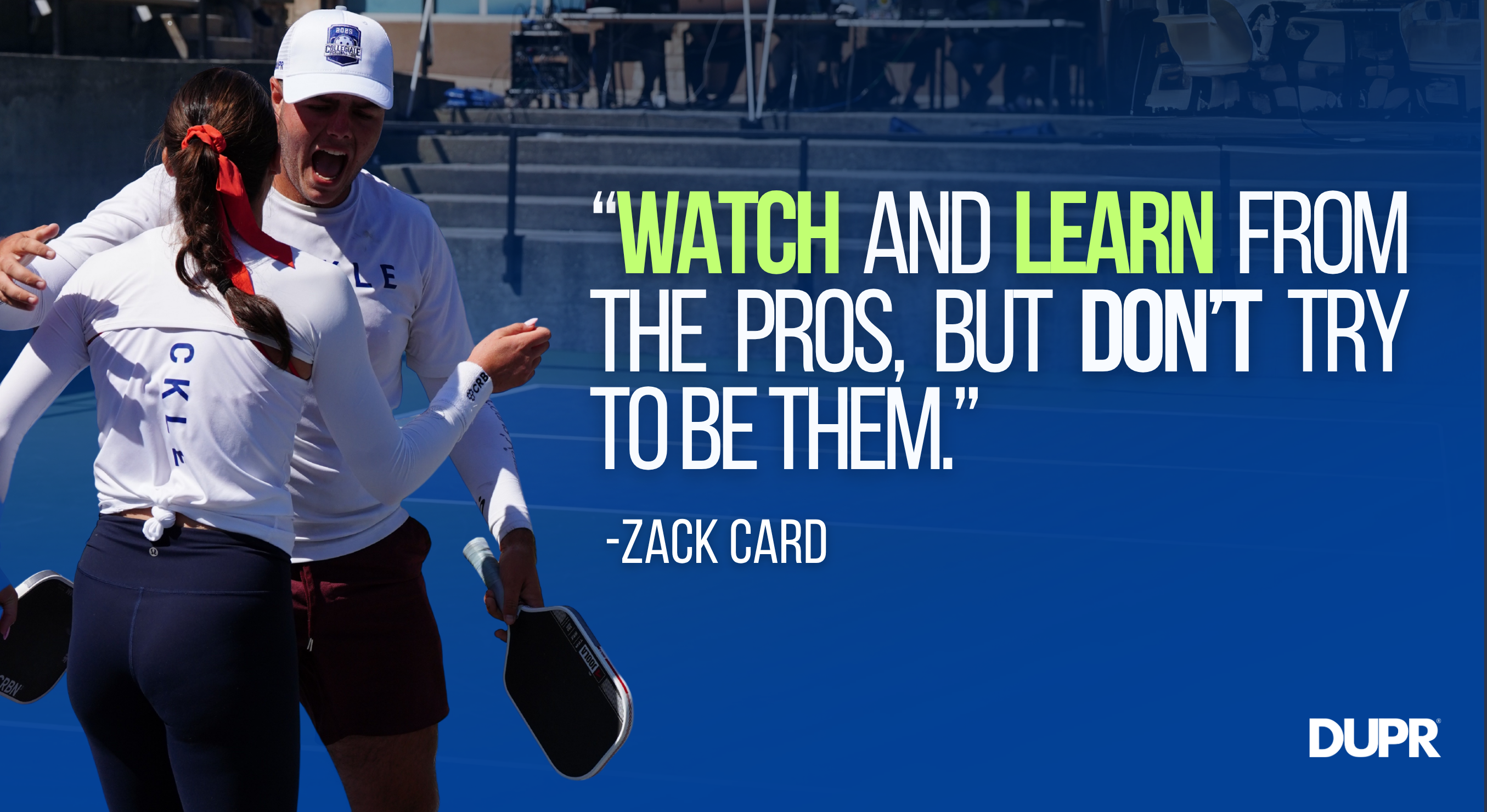
"I’m so glad I can continue to play and represent my school in a sport that’s growing exponentially, especially at the college level,” Zack said.
Pressure and Performance: Lessons from MLP
The FAU team went head-to-head with challenger squad Florida Smash, ultimately falling 1–3 in the overall matches, with Zack's match being the last one of the four. When asked if he felt pressure to prove himself, Zack admitted:
“I did put a lot of pressure on myself at the MLP event, which is unfortunate because it prevented me from giving my best possible performance. I usually try to go into events with no expectations, which helps relieve pressure, but I failed to do that at MLP."
Many athletes can relate to this kind of moment. It's a true “make or break” test when stepping onto the professional stage for the first time. Zack’s reflection on how he handled the pressure reveals a strong sense of self-awareness and personal growth under high-stakes conditions.
The mental game plays a major role, and often, it’s the mindset that makes the difference against the opposing team. Find out more about how to build mental strength on the pickleball court!
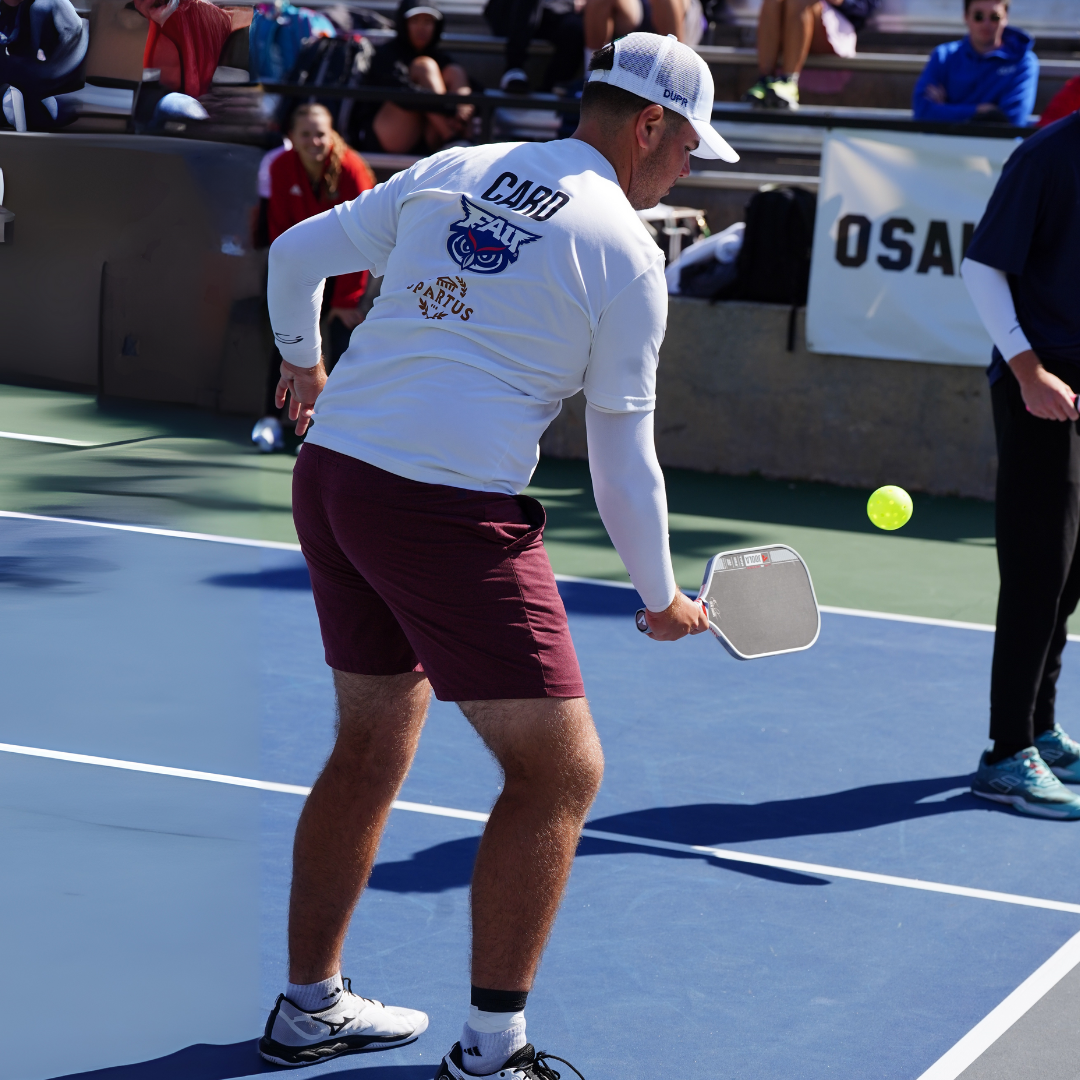
From Campus Courts to the Biggest Stage
The speed and intensity of the MLP environment surprised even a player as seasoned as Zack.
“The level at MLP is a lot different than college pickleball. I practice with top-level players, so that part wasn’t new, but the pressure changed everything. The game at MLP is much faster and more relentless. In college, players have to slow things down because they can’t create the same level of offense.”
Once the excitement, hype, and atmosphere of the big leagues faded, Zack finally had time to reflect, and a powerful realization hit him on the flight home.
“The second I took my seat on the plane going back home, I thought, ‘I can’t ever let this [the pressure and overthinking] happen to me again.’ I learned a lot from that tournament, and I’ll carry those lessons with me in everything I do on and off the court.”
Looking Ahead to the Fall Season
Zack believes the MLP experience won’t just shape him; it’ll elevate the entire FAU team.
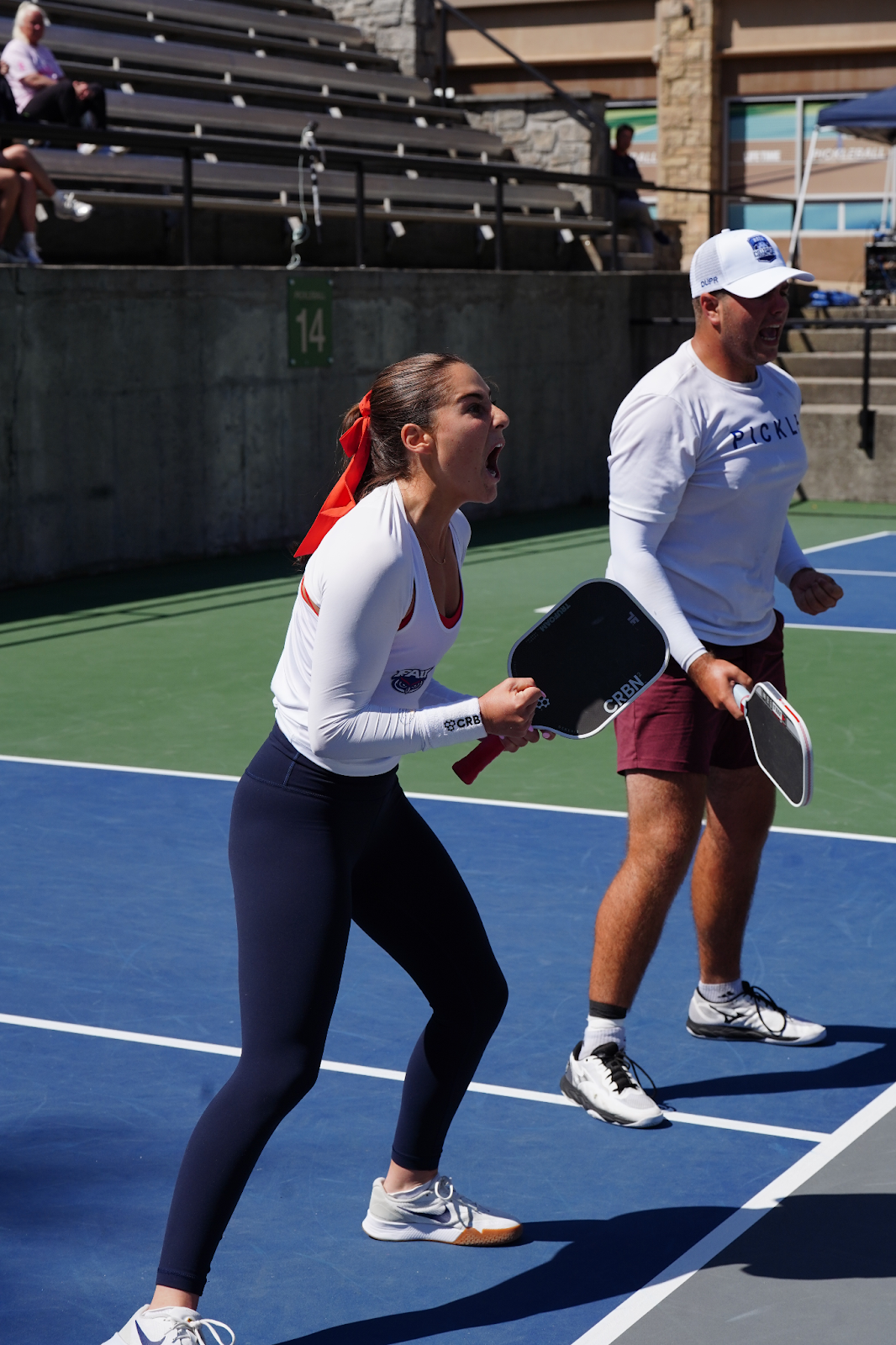
“This experience will absolutely help our college team this fall. I think we’re all going into the season with a better attitude and a deeper understanding of what it takes mentally to perform in big situations like these.”
Advice for Aspiring College-to-Pro Players
Zack’s advice to other college players dreaming of going pro? Stay true to yourself.
“Become the best player you can be, not the best version of someone else. Know your strengths and weaknesses. Maximize what you're good at and minimize your weak spots. Trying to copy someone else’s game actually hurts your own. Watch and learn from the pros, but don’t try to be them.”
Zack Card’s journey is a reminder that success isn’t just about talent; it’s about growth, self-awareness, and learning to rise under pressure. As pickleball continues its rapid rise at the collegiate level, athletes like Zack are showing the world what the next generation of competitors looks like: passionate, focused, and ready to evolve. Keep up with Zack’s journey at the FAU Pickleball team this fall season!
Community
DUPR Athletes
College
July 22, 2025
Vulcan V-PRO FLIGHT Named Official Ball of DUPR
July 22, 2025 — Delray Beach, FL — DUPR (Dynamic Universal Pickleball Rating) announced today that the Vulcan V-PRO FLIGHT is now the Official Ball of DUPR across all its verticals and events, including High School Pickleball, Collegiate Pickleball, Minor League Pickleball (MiLP), as well as more than 8000 DUPR clubs and facilities all over the world.
This new partnership sets a standard across the sport, as all DUPR events and events operated by DUPR’s partners leagues, tours, clubs and event organizers will be required to use the Vulcan V-PRO FLIGHT pickleball. This reinforces DUPR’s commitment to consistency, quality, and the highest level of competitive integrity.
“DUPR is built on accuracy and trust. We only align with partners who meet that standard,” said Tito Machado, CEO of DUPR. “Vulcan has proven to be the best ball in the game, and this partnership raises the bar for every player who steps on the court.”
Vulcan’s V-PRO FLIGHT technology is regarded as best-in-class, delivering elite performance, durability, and accuracy. Already trusted as the Official Ball of Major League Pickleball (MLP), Vulcan now strengthens its position as the leading brand in pickleball ball technology.
“We’re proud to become the Official Ball of DUPR,” said Jeremy Nef, President of Vulcan Pickleball. “DUPR is the backbone of competitive pickleball, and this partnership reinforces our commitment to supporting players at every level — with the most advanced ball on the market.”
Together, DUPR and Vulcan are shaping the future of competitive pickleball.
About Vulcan
Vulcan Pickleball is the premier equipment brand in pickleball and the creators of the V-PRO FLIGHT pickleball. The V-PRO FLIGHT is the official ball of DUPR, High School Pickleball, Collegiate Pickleball, Minor League Pickleball, and Major League Pickleball. Trusted by recreational players and professional pickleball players alike, the V-PRO FLIGHT is “The Official Ball of Pickleball”. Learn more at vulcanpickleball.com
About DUPR
DUPR (Dynamic Universal Pickleball Rating) is the premier global pickleball rating system and technology platform, trusted by the world's leading clubs, tournaments, leagues, and players. DUPR's dynamic rating system unifies pickleball across age, gender, and location by analyzing match results to accurately evaluate all players across a 2.000 - 8.000 scale. DUPR is the official pickleball rating of leagues, tournaments and clubs around the world, including United Pickleball Association (UPA), PPA, Major League Pickleball (MLP), Pickleball.com, Life Time, The Picklr, National Team Pickleball League, National Pickleball League. It also owns and operates Minor League Pickleball and Collegiate Pickleball, two of the biggest amateur leagues in the sport. Players and operators can visit www.dupr.com to sign up and learn more.
Media Contact:
DUPR
Kyrill Hartog
VP Marketing & Communications
kyrill@mydupr.com
Vulcan
Jimmy Miller
Director of Club & Partnerships
jimmy@vulcanpickleball.com
Partners
Community
July 21, 2025
Unknown to Unstoppable: Alex Crum Takes Down #1 Pro Player- Twice
My name is Alex Crum.
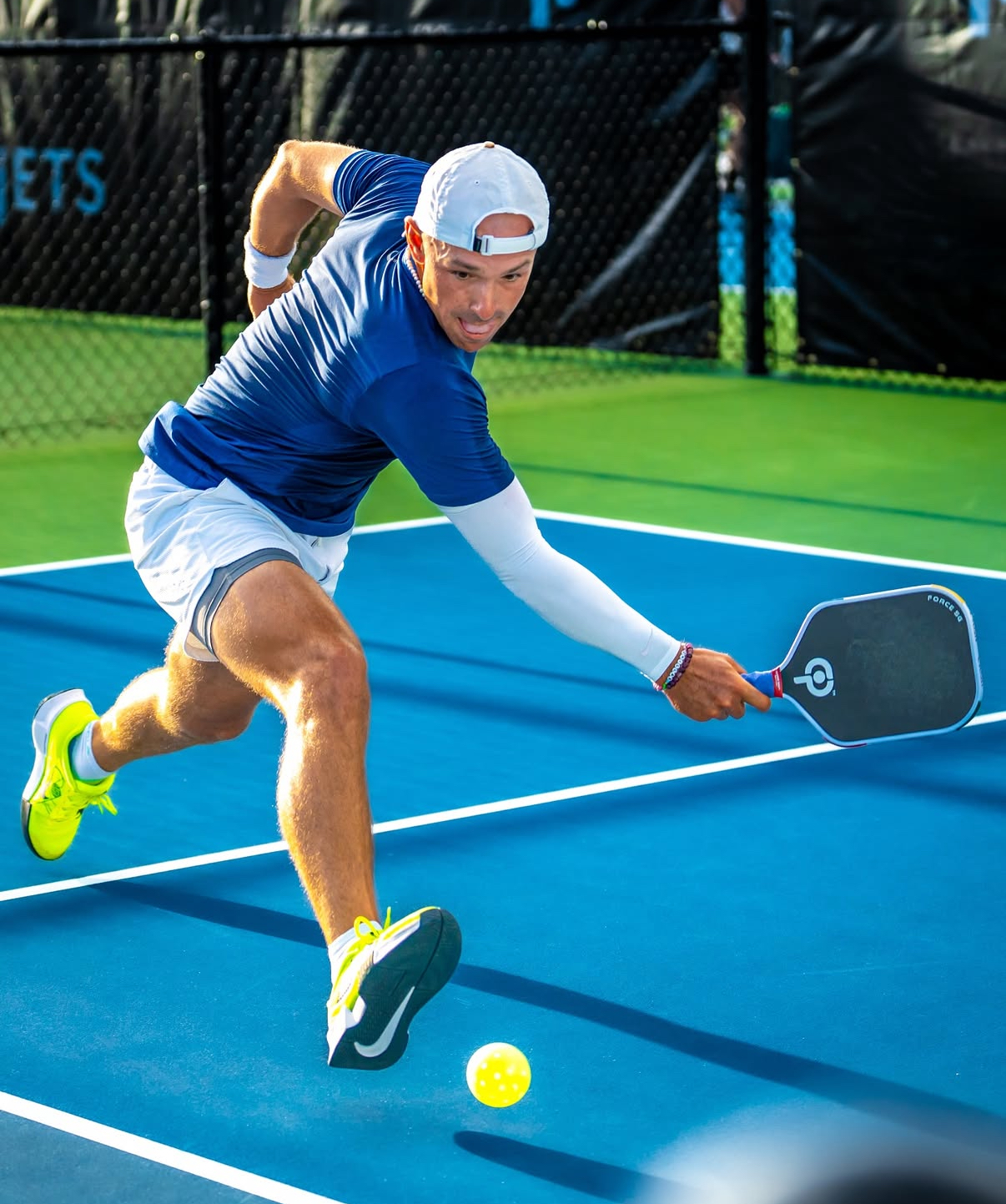
Two months ago, I beat the #1 ranked player on the PPA Tour.
Eight days later, I beat the #1 ranked player on the APP Tour.
My life changed.
The First Swing That Shifted Everything
Exactly two years ago, I picked up a pickleball paddle for the first time and my life took a complete new direction.
Never had a sport felt so natural to me. I felt I had total control over the ball after my first swing.
As a lifelong tennis player, there is of course a natural skillset translation that exists for all tennis players, but for me this felt exacerbated . My 5’11 frame was no longer a disadvantage. My mediocre tennis serve instantly became a weapon on the pickleball court. This felt like the perfect game for me.
After beating a top 60 touring pro a few days after first strike, I was convinced that within months I would take the Pickleball world by storm.
I did not.
Reality Check in Cincinnati
At my first tournament—the PPA in Cincinnati—I lost in the first round of qualifying. In about ten minutes. Maybe I wasn’t that guy after all.
after all.
Back on Track
One month later, I won the USA Pickleball National Indoors, beating some pretty decent competition along the way and felt there was perhaps a small chance that maybe I could be that guy I once envisioned.
Balancing Work and Competition
Since then, I’ve trained and competed sporadically. I've spent the last two years working full-time as a tennis coach at country clubs across the country. I love teaching and connecting with people. But nothing compares to the adrenaline I feel every time I get to compete.
I was jealous of the players who got to do it every weekend. I kept telling myself: one day, I’ll have my breakthrough. One day, I’ll be able to train and play full time.
That day came.
One month ago, I signed a contract with the PPA Tour.
My life changed again.
What’s Next
I will be joining my PPA schedule with some football games, where I’ll head to the tailgates and play with everyone. There will be music, pros, and DUPR coaches giving out DUPR ratings. Starting in August, this will be my job. I’ll travel the country competing in a sport that has already given me so much in such a short time. Now, it’s my turn to give everything I have back.
Check out the 2025 Collegiate Tailgate Tour schedule to see when I’ll be at a campus near you and join the fun!
Pickleball Tips
Community
DUPR Athletes
July 18, 2025
Where Do Pickleball Pros Serve and Why
A Strategic Guide to Take Control From the First Shot
The serve kicks off every point; but it’s not just about getting the ball in. Where you place your serve can shape how the rest of the rally unfolds.
Because of the double bounce rule, returners have a built-in edge. They get to take the kitchen right away, while the serving team has to wait for the return to bounce at least once before approaching it. But that doesn’t mean you’re stuck playing defense.
A well-placed serve (within the serving rules) can buy you time, throw off your opponent’s rhythm, and set you up to take control of the point, right from the start.
So let’s break down where the best pro players in the world serve, why they do it, and how you can use those same strategies to level up your game.
Serving Isn’t Just “Getting the Ball In”
Too many players treat the serve as a neutral start. Pros don’t. They treat it as a setup; one that can create gaps, short returns, or lock opponents into awkward positions. Where you place your serve should depend on your strengths, your opponent’s weaknesses, and what you want to do next.
Where to Serve and What It Sets Up
1. Wide Serve (Angle to the Sideline)
- Goal: Pull the returner off the court.
- Why it works: Creates space in the middle of the court. If the net player shifts over to cover the gap, it leaves the down-the-line shot wide open.
- Bonus tip: The wider you stand on the baseline, the sharper angle you’ll get.
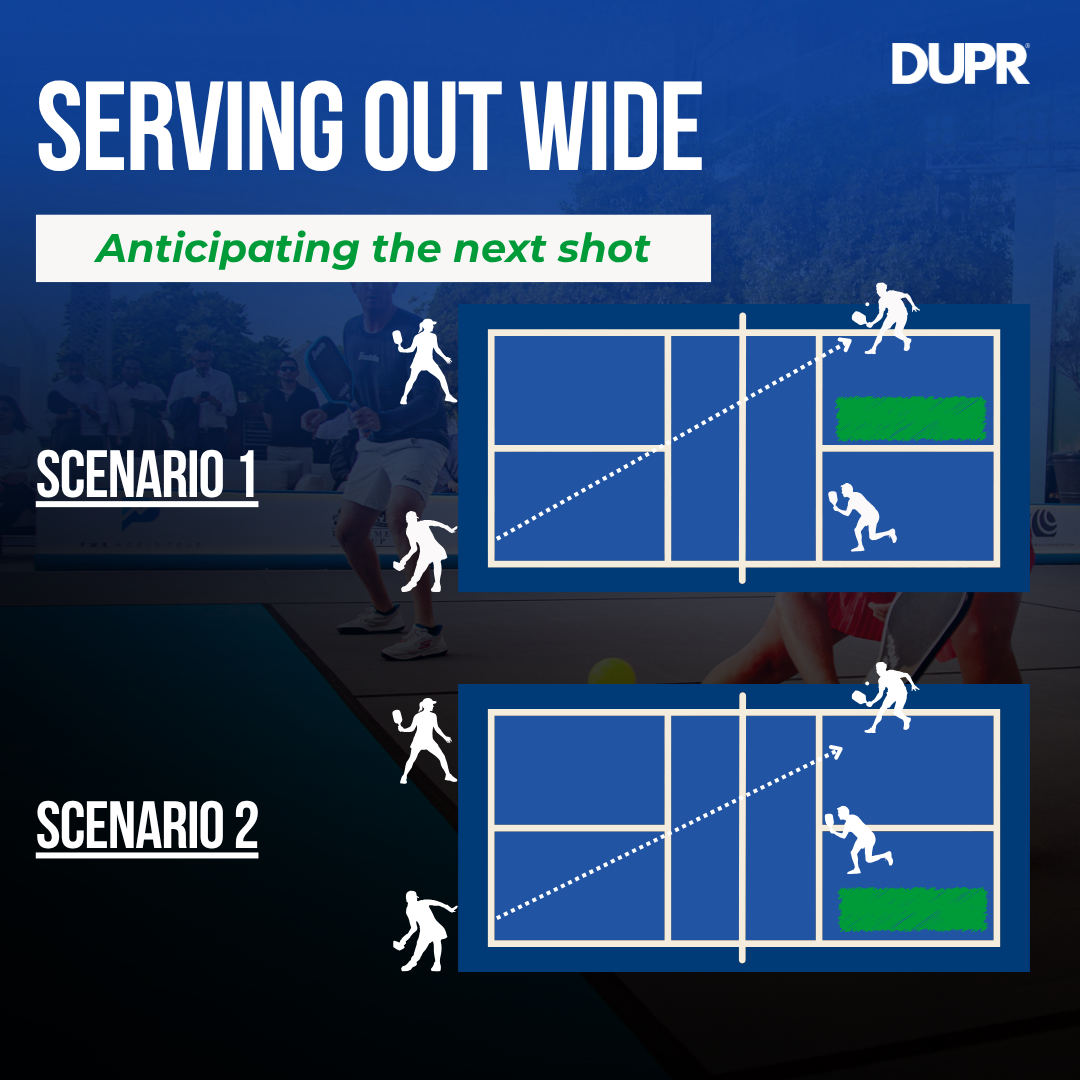
When you serve out wide, you force the returner off the court; but what happens next depends on their partner at the net. If the net player shifts to cover the middle (which is the smart move), it leaves the down-the-line shot open for you to attack. But if they stay hugging the sideline to protect against that shot, they give up a huge space in the middle.
Either way, you create a gap. You just need to recognize where it is and be ready to exploit it on your third shot.
Bobbi Oshiro (DUPR 5.9) shares:
“The wide out serve is a tough target to hit so not many returners anticipate it.” Bobbi said. “It puts the returner out of position for the next shot when trying to make it up to the kitchen and it gives me an easier third shot to their feet.”
Check out Bobbi’s article on how to become a pro pickleball player, where she includes her schedule, training plan and more valuable tips.
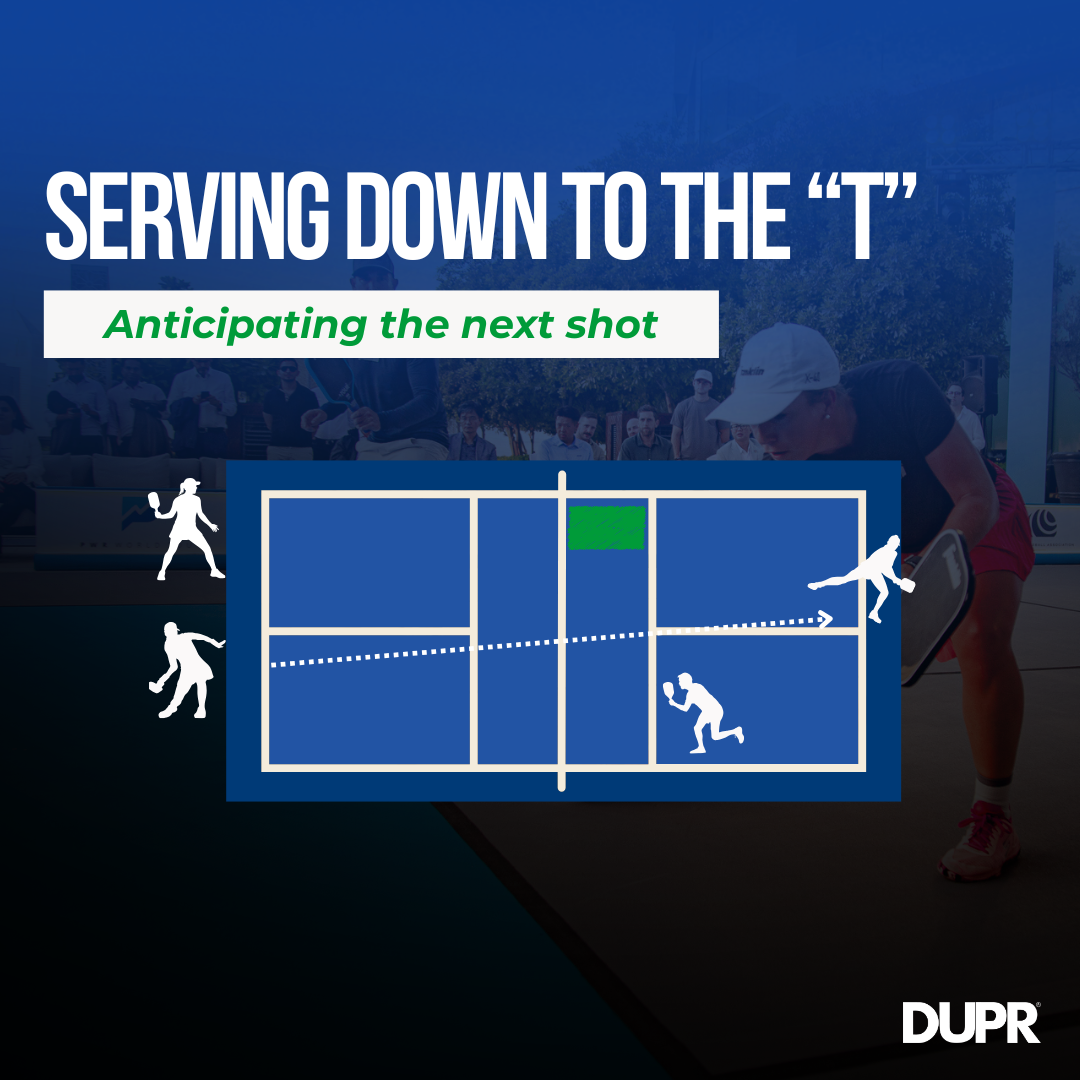
2. Down the T
- Goal: Pin the returner deep in the middle or stretch their reach across their body.
- Why it works: Keeps the returner more central, which means their crosscourt angles are limited. Sets you up to control the next ball with a third shot drop.
- Pro combo: If you're comfortable dropping wide or want your partner to attack with an Erne, this is the perfect setup.
Bobbi Oshiro adds:
“On the left side of the court, I love hitting big down the T. It gets them moving and opens up their backhand side for my third shot drop.”
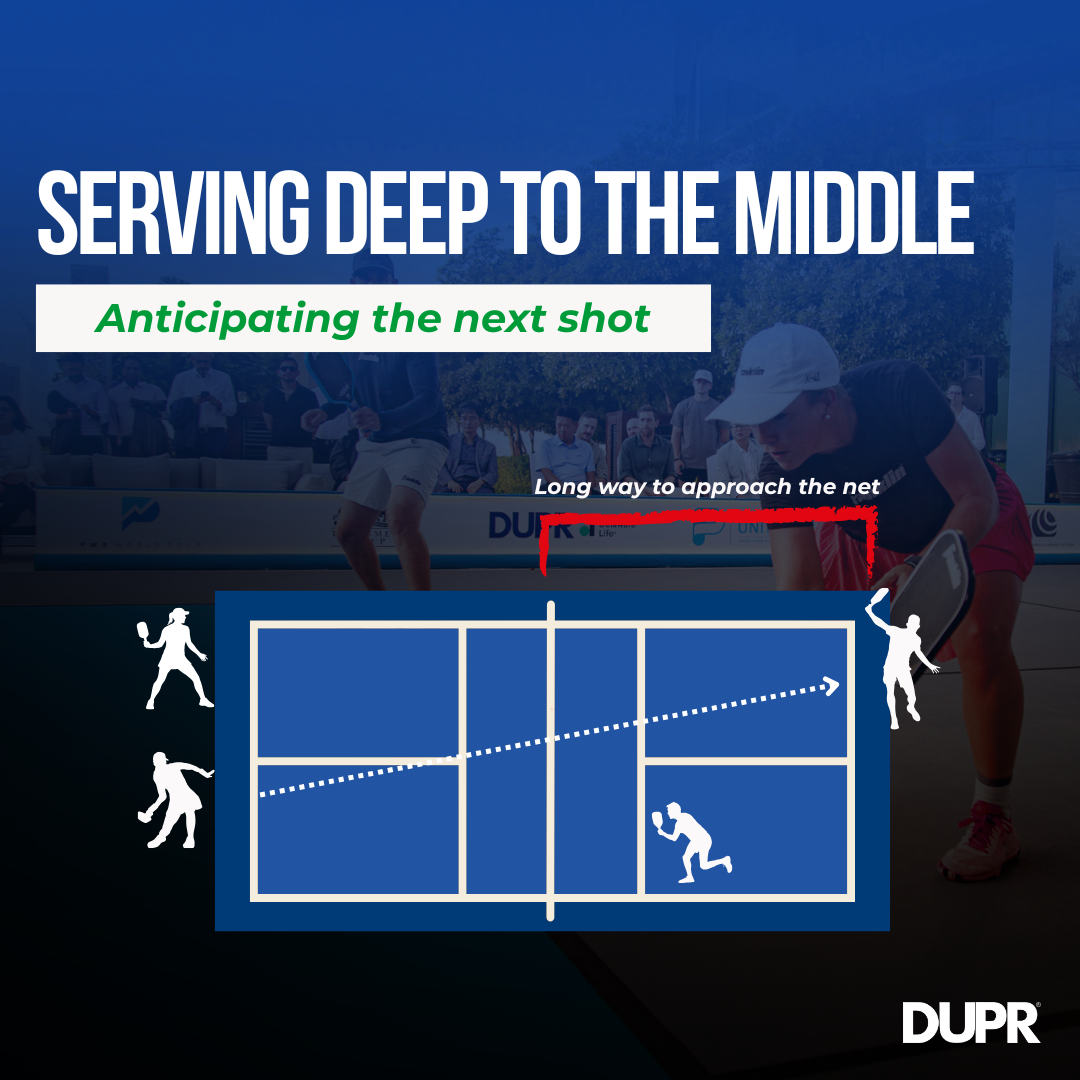
3. Body or Middle Serve
- Goal: Jam your opponent and reduce their options.
- Why it works: When you hit deep and at the body, your opponent has a harder time stepping into the shot. They’re forced to take a step back and return more defensively, buying you time to move forward.
- Result: Slower, shorter returns that you can jump on with an aggressive third shot.
Pro Serving Tips
Noe Khliff (DUPR 6.588)
“Wide serves are my go-to. They open up the court so I can use angles more effectively on the third shot.”
Bobbi Oshiro (DUPR 5.909)
“From the right side, I love serving sharp out wide. It’s unexpected and gets the returner moving out of position, which sets up an easier third shot. From the left, I like going big down the T. Both can draw short returns and give you the edge early.”
Madalina Grigoriu (DUPR 5.522)
“Serve wide when teams are stacking and switching. It disrupts their timing and forces them into bad returns.”
Where Does The #1 Pickleball Player in the World Prefer to Serve?
Federico Staksrud (DUPR 7.076) – World #1
“I hit a deep topspin serve to the backhand. It pushes players back and often results in a weak return.”
Serving deep, especially to the backhand, is one of the simplest ways to force errors and buy yourself time to control the next shot. If it’s good enough for the world’s best, it’s worth it for you to try it out in your next pickleball tournament.
Start serving with purpose, and you’ll start every rally one step ahead.
Pickleball Tips
DUPR Athletes
Community
DUPR Ratings
July 17, 2025
Global Pickleball Federation Announces DUPR as Its Official Rating System
One Global Sport. One Global Rating.
In a historic move for international pickleball, the Global Pickleball Federation (GPF), world governing body for pickleball, has officially named DUPR (Dynamic Universal Pickleball Rating) its official rating system.
This partnership marks a pivotal moment in the history of pickleball’s global development, uniting GPF’s four continental federations, member nations and GPF owned and operated events for the first time, under one trusted and universally adopted rating system.
A Shared Vision for Global Pickleball Growth
The GPF serves as the international federation for the Continental Federation of Africa (CAP), Pickleball Federation of the Americas (PFA), Oceania Pickleball Federation (OPF), Asia Pickleball Association (APA) as well as twelve European member countries and growing. DUPR is the preferred rating for the GPF, solidifying a truly global framework for fair and consistent competition.
The GPF’s non-profit board of directors is led by active stewards of our sport, deeply invested in the future. The founders and leaders of pickleball in Australia, Canada, Chile, Ghana, India, Ireland, Mexico, The Philippines, Poland and the United States serve as legacy members on the GPF board.
Players, coaches, and organizers will benefit from:
- One Standardized Rating:
DUPR’s trusted 2.000–8.000 scale brings clarity and consistency to all levels of play, from amateur matches to elite competition.
- Smarter Player Development:
Whether you're a recreational player or a national team prospect, DUPR provides real-time, match-based ratings that reflect actual performance; not just wins and losses.
- Simplified Event Organization:
Federations and clubs worldwide can now use DUPR to accurately seed brackets, set divisions, and streamline tournament play.
“We’re thrilled to partner with DUPR as we work to elevate and unify pickleball worldwide,” said GPF President Javier Regalado. “Having a single, trusted rating system in place across continents is a positive step toward unifying pickleball, eliminating some of the confusion and fragmentation that inhibits growth.”
A Step Closer to Olympic Recognition
This alignment also supports GPF’s long-term mission to instill best practices and standards, ultimately achieving International Olympic Committee (IOC) recognition for pickleball and future inclusion in the 2032 Brisbane Olympics. Last month, a GPF delegation officially entered its application for IOC recognition in Lausanne, Switzerland.
“Under GPF and DUPR’s historic alignment, international players of all ages, gender and location are united under one technology platform to grow the great sport of pickleball.” added DUPR CEO Tito Machado.
ABOUT GLOBAL PICKLEBALL FEDERATION (GPF)
The GPF is the world governing body for pickleball, serving as a not-for-profit organization focused on the integrity and development of pickleball globally – from grassroots to recreational and high-performance levels. GPF’s unifying function, structure, and board are aligned with pickleball’s established continental federations and a valued volunteer network engaged in growing the sport worldwide. The GPF’s ethical framework and by-laws will ultimately lead the sport of pickleball to International Olympic Committee recognition and inclusion in the 2032 Brisbane Olympics. The constant interplay between the GPF with its respective continental and national federations ensures uniform rules, regulations, standards, and the ability to swiftly implement best practices. For more info, visit https://globalpickleballfederation.org/
ABOUT DUPR
DUPR (Dynamic Universal Pickleball Rating) is the premier global pickleball rating system and technology platform, trusted by the world's leading clubs, tournaments, leagues, and players. DUPR's dynamic rating system unifies pickleball across age, gender, and location by analyzing match results to accurately evaluate all players across a 2.000 - 8.000 scale. DUPR is the official pickleball rating of leagues, tournaments and clubs around the world, including United Pickleball Association (UPA), PPA, Major League Pickleball (MLP), Pickleball.com, Life Time, The Picklr, National Team Pickleball League, and National Pickleball League. It also owns and operates Minor League Pickleball and Collegiate Pickleball, two of the biggest amateur leagues in the sport. Players and operators can visit www.dupr.com to sign up and learn more.
Partners
DUPR Ratings
Community
July 16, 2025
How To Start a Pickleball Club at Your College
Thinking about starting a pickleball club at your university? You’re not alone. With over 300 colleges in the U.S. already on board, the sport is booming, and your school could be next. Whether you're looking to play for fun, build a competitive team, or just grow the pickleball community on campus, this step-by-step guide will walk you through how to make it happen.
Step 1: Check Your School’s Club Requirements
Every college has its own process for approving new student organizations, so your first move is to find out what your school requires.
A quick search like “[Your School Name] how to start a club” will usually point you in the right direction.
Key things to look for:
- Registration deadlines
- Required leadership roles
- Minimum number of members
- Whether you need a faculty or staff advisor
Quick Note: Most colleges distinguish between “student organizations” and “club sports.” You’ll usually need to register as a student organization before applying for club sport status, so start there to save time.
Once you’ve submitted everything and your application is approved, congrats! You’ve got an official pickleball club on campus. Now it’s time to build it.
Step 2: Recruit Consistent Members
In the early stages, it’s all about momentum. Use whatever equipment and space you have access to and get creative with recruiting.
Here are some great ways to find players:
- Visit pickleball classes on campus and invite students
- Show up at intramural tournaments and talk to participants
- Participate in your school’s club fair
- Build a simple website or social media presence so people can find you online. Choose a username or domain clearly linked to your school and pickleball club.
- Post flyers and add a QR code linking to the social media account or talk to players at local pickleball courts
- Reserve tennis/pickleball courts on campus or ask local facilities for discounted court time
Create a group chat or email list to keep everyone connected and informed. Be proactive: if someone shows interest, invite them personally. Make new players feel welcome by pairing them with others at their level and offering to teach the basics. This is what builds community and keeps them coming back.
Step 3: Grow Your Club
Once you have a core group, it’s time to scale.
- Set Weekly Practice Times: Establish consistent meetups to create structure. It also gives you a clear answer when someone asks, “When can I join?”
- Build Your Equipment Supply: Start collecting paddles, balls, portable nets, and hoppers. Ask experienced players or alumni if they can donate gear. You can also contact local businesses for sponsorships or fundraising support.
💡 Special Tip: Create a DUPR Digital Club to manage your members and track match results. It gives your club a professional presence and makes it easier to organize games, display your location, and help players improve with accurate ratings.
Start your Digital Club for FREE here.
Step 4: Compete with Other Schools
Once you have enough players and equipment, take things to the next level: college competition.
- Connect with nearby schools that have clubs
- Use social media or the DUPR club directory to find opponents
- Organize scrimmages or join round robins and tournaments
- Start incorporating drills to strengthen your team’s skills
- Invite local coaches or high-level players to run clinics
Starting a pickleball club at your school is one of the most rewarding ways to make an impact, meet new people, and grow the game. It doesn’t take much to get started. All you need is a few players, some paddles, and a little passion.
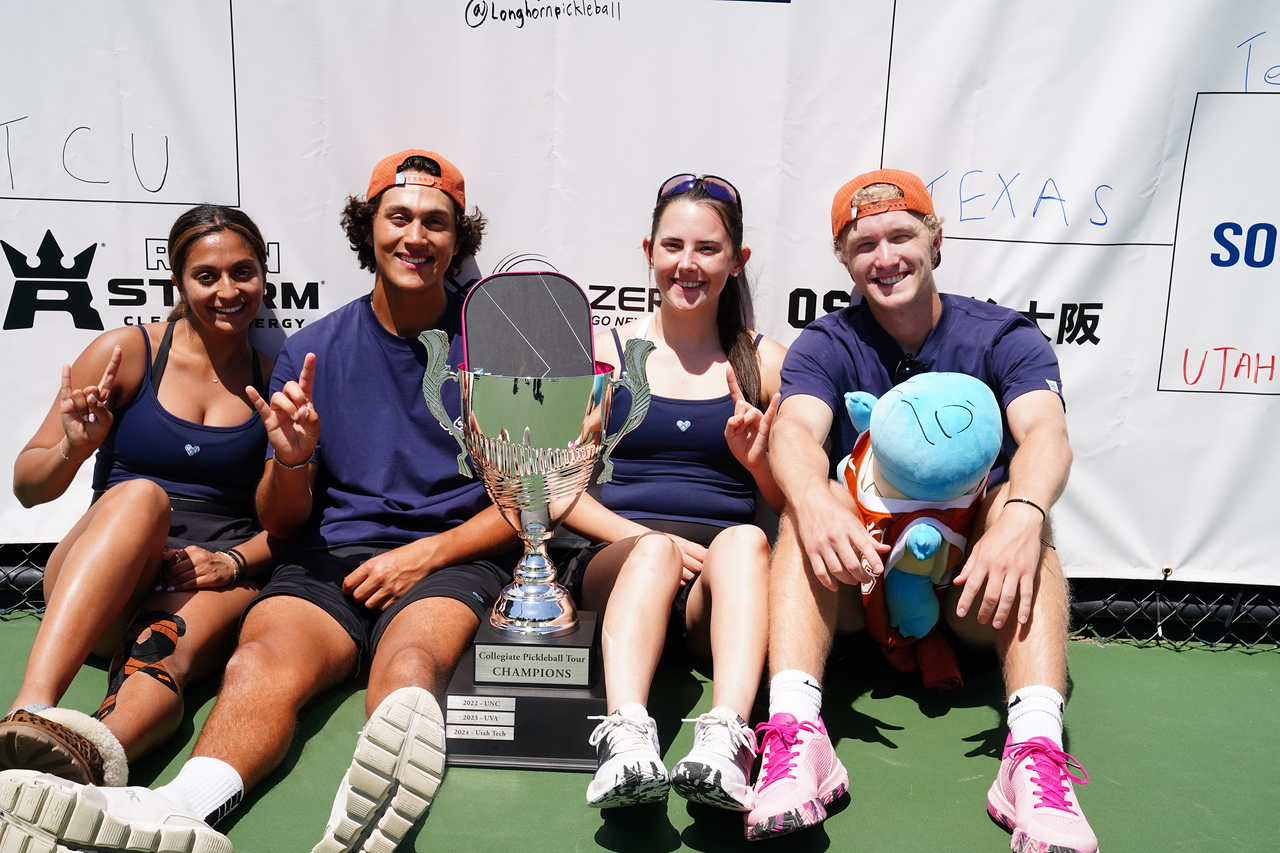
Check out the Collegiate Pickleball Tournament (CPT) calendar to find upcoming events. CPT matches are co-ed and formatted for teams of 2 men and 2 women. Schools can bring multiple teams, and top performers may even earn scholarships or bids to the Collegiate National Championship in April.
Want even more help? Download our 24-page Collegiate Pickleball Club Guide, written by past and present club presidents. It’s full of detailed strategies, sample meeting templates, fundraising ideas, and practice plans that worked at real schools.
📩 Have questions? We’ve got answers. Email us at college@mydupr.com
Let’s get your school on the map. 🏓
College
Community