No matching results.
Search results
June 3, 2025
What Is a Regional Showdown in Minor League Pickleball?
A Regional Showdown is a team-format tournament for amateur players, played under the The Dink Minor League Pickleball (MiLP) structure. These events bring together four-player teams (2 women and 2 men) to compete using the fast-paced and inclusive MLPlay™ format.
Minor League Pickleball is an innovative team competition with unique twists on traditional matchups, scoring, and tiebreakers. In each match, teams compete in four games:
- Women’s Doubles
- Men’s Doubles
- Mixed Doubles
- Mixed Doubles
Each game is played to 21 points, win by 2. If the match is tied 2–2 after four games, it goes to a Dreambreaker™ where one person from each team plays singles against the other team’s player, switching players every four rallies until someone gets to 21 and wins by two points.
Who can play?
Anyone with a DUPR account can participate! Teams are broken into divisions based on their combined DUPR rating of all 4 players.
Why Regional Showdowns Matter?
Regional Showdowns are a key part of the path to The Dink MiLP Championships. Here’s why:
- They are official Minor League Pickleball team tournaments open to amateur players of all ages and skill levels
- Every match helps build your DUPR match history and increase your reliability score
- You earn valuable points toward the National MiLP Leaderboard, which helps determine who qualifies for the National Championship.
But most importantly: Winning your division at a Regional Showdown earns your team a Dream Ticket — an automatic invitation to compete at The Dink Minor League Pickleball Championships!
So even if you don't win it all, playing gives you more matches, more data, and more chances to scale up your DUPR pickleball ratings. It’s a win-win.
What is the Championship?
The MiLP Championship, previously called the National Championship, is the pinnacle of the amateur team season. It brings together Dream Ticket winners, top leaderboard teams, and invited State Pro League and MLP-affiliated teams from around the world to compete for national glory and $100,000 in prize money.
With divisions for every DUPR level, the event is designed to reward teamwork, performance, and progress over the course of the season. And it all starts with your region.
2026 Regional Showdowns
- May 22-25: MiLP at MLP Regional Showdown - Dallas, TX
- May 29-31: MiLP at MLP Regional Showdown - Columbus, OH
- June 12-14: MiLP at MLP Regional Showdown - Austin, TX
- June 26-28: MiLP at MLP Regional Showdown - New York, NY
- July 17-19: MiLP at MLP Regional Showdown - San Diego, CA
- July 24-26: MiLP at MLP Regional Showdown - Chicago, IL
- July 26: Midwest Regional Showdown - Kansas City, MO
- August 14-16: MiLP at MLP Regional Showdown - Newport Beach, CA
- August 15-16: Southeast Regional Showdown - Orange Park, FL
- November 13-15: Northwest Regional Showdown - Lynnwood, WA
Why You Should Sign Up
If you’re looking to:
- Rise in the MiLP Rankings Leaderboard
- Build your DUPR reliability score
- Improve your pickleball ratings
- Earn a Dream Ticket to the Championships
- Or just compete with your friends
… then a Regional Showdown is a no-brainer.
Spots go fast. Check the schedule, grab your team, and take your shot.
See you on the court.
The Dink MiLP
June 2, 2025
What Is the 10-Second Rule in Pickleball?
If you’ve played pickleball tournaments, you know that tempo matters. One small—but important—rule that helps keep things moving is the 10-second rule.
So, what is it?
The 10-Second Rule in Pickleball consists of the following: Once the score is called, the server has 10 seconds to start the serve. That’s it. No long pauses, no endless bouncing the ball—just call it and go. The rule exists to keep the game fair and flowing, especially in competitive settings.
Why does it matter?
This isn’t just a nitpicky rule. In high-level play—or any match that counts toward your pickleball ratings—those little delays can break rhythm and shift momentum. Pickleball rules keep things clean and consistent.
Here’s what it helps with:
- ✅ Keeps the pace up – Nobody likes standing around.
- ✅ Stops mind games – No stalling to throw off your opponent.
- ✅ Makes it fair – Everyone follows the same countdown.
What if you take too long?
If you wait more than 10 seconds after the score is called, it’s a fault. You lose the point. And in a tight match? That can hurt—especially when your DUPR rating is on the line.
How to avoid a violation:
- Have a go-to pre-serve routine. Keep it short and repeatable.
- Stay tuned in—listen for the score to be called.
- No official clock, so get a feel for 10 seconds and stay within it.
It might seem like a small detail, but respecting the 10-second rule shows discipline—and it can make a real difference in how your match unfolds. Whether you’re trying to improve your pickleball ratings or just play better pickleball, sticking to this rule is part of showing up like a serious competitor.
Pickleball Rules
May 30, 2025
New Eligibility Requirements for the 2025–26 Collegiate Pickleball Season
Heading into the 5th season of collegiate pickleball, we couldn’t be more proud of the growth and momentum this community has built. From just a handful of schools to a nationwide tour with dozens of events, collegiate pickleball is thriving.
Each year, we make key updates to support players, improve event structure, and elevate the sport. Whether you're chasing higher pickleball ratings or building team chemistry, the 2025–26 season is packed with new opportunities to grow and compete.
Below, we break down the changes in eligibility rules, regional tournament structure, and how your team can earn a spot at Nationals.
Let’s dive into what’s new this season 👇
Credit Hour Requirement Update
Starting in the 2025–26 season, we’re adjusting the credit hour requirements for undergraduate players to better reflect the evolving level of competition. Our goal is to ensure student-athletes are maintaining academic commitments while still representing their schools with pride.

This change promotes a level playing field while staying true to the mission of collegiate pickleball: competition and academic excellence.
Campus Regionals Expansion
Campus Regionals continue to be a critical part of the Collegiate Pickleball Tour, helping new and returning schools compete for a shot at Nationals. In 2024, we hosted 16 Regionals, and in 2025 we hosted 14—even with a shortened season.
In 2025–26, we’re dedicating 30 of the 64 total Nationals bids to Campus Regionals—aiming for 15 Campus Regionals each semester. These tournaments will follow the Collegiate Pickleball Tour Format, creating a clear and unified path to the Collegiate National Championship.
👉 Want to host a Campus Regional? Click here to learn more.
Season Format Breakdown
In the 25-26 season, we're planning 20 official collegiate pickleball tournaments per semester, each offering bids to Nationals.
More details to come as we continue to lock down tournament dates and locations.
Interested in hosting a collegiate event? Learn more here!
Here’s how the season is shaping up:
Fall 2025 — Bid Breakdown
- Collegiate World Championship (Dallas, TX at UPA Worlds): 6 bids
- 4 Super Regionals: 3 bids each (12 total)
- 15 Campus Regionals: 1 bid each (15 total)
Spring 2026 — Bid Breakdown
- Collegiate National Championship: 64 total team spots
- 4 Super Regionals: 3 bids each (12 total)
- 15 Campus Regionals: 1 bid each (15 total)
Other Bid Opportunities
- 2 bids awarded to teams with the most Dual Match wins
- 2 wildcard bids selected by the CPT committee
Why These Changes Matter
As more universities invest in club pickleball programs, we’re seeing the competition level rise across the board. These updates to eligibility rules, Campus Regionals, and bid distribution are designed to:
- Support student-athletes on and off the court
- Provide more clear and fair access to Nationals
- Streamline the road to the Collegiate Pickleball National Championship
If you are a college pickleball player trying to boost your pickleball ratings through competitive play—this season is full of opportunities.
Stay Updated
Follow @collegiatepickleball on Instagram and bookmark our site for event announcements, registration deadlines, and more updates as we lock in tournament dates and locations.
Want to host a campus regional? Apply here.
College
May 30, 2025
What is a Nasty Nelson?
Just the name itself can stir up quite some chaos on the pickleball court. A Nasty Nelson is the kind of shot that can flip the momentum of a game, leaving opponents flustered and teammates grinning at the well-executed disruption. But what exactly is a Nasty Nelson, and why does it carry such a mischievous reputation?
Just ask Mariana Paredes, who famously pulled off a Nasty Nelson at 10-4 match point to clinch a gold medal at the US Open. In her post-match interview with The Dink, she said, “I saw an opportunity and took it. Nothing wrong with that!” Bold? Definitely. Controversial? Maybe. But moments like that are exactly why the Nasty Nelson continues to spark debate on pickleball courts everywhere.
The rudest shot in pickleball?
In pickleball, the serve is your first chance to set the tone, control the pace, and occasionally catch your opponents off guard. A Nasty Nelson does exactly that—it’s a serve aimed intentionally at the non-receiving partner, trying to hit them before the ball bounces. If it hits the non-receiver player, it results in an immediate fault on the receiving team—one of the few ways to score outright off a serve.
It’s not illegal under the official pickleball rules, but it’s definitely unconventional—and depending on who you ask, maybe even a little unsportsmanlike. If you’re chasing better pickleball ratings, a well-timed Nasty Nelson might score you a point… but it could also cost you a friend.
When to execute a Nasty Nelson?
Some players use the Nasty Nelson strategically, especially in official pickleball tournaments where every point counts. If the opposing partner isn’t paying attention or stands too close to the kitchen, they’re a prime target. Others argue that it goes against the spirit of the game, preferring serves that challenge the receiver through placement and spin rather than deception.
Why is it called Nasty Nelson?
Tim “The Puppet Master” Nelson is the guy behind the shot everyone loves to argue about—the Nasty Nelson. He’s a top-level pickleball player known for his bold (and sometimes sneaky) style of play. The shot was named after him for a reason—he used it often, and with zero shame. He’s also famous for doing a little puppeteer hand motion after pulling it off, just to rub it in a bit more.

Should you use it?
Like any shot in pickleball—whether it’s a third shot drop, ATP, or Erne—the Nasty Nelson is a tool. Whether you use it or avoid it depends on your style of play.
One thing’s for sure: if you're serious about climbing the pickleball ratings ladder or competing in Minor League Pickleball events, understanding shots like this gives you an edge—even if it’s just to defend yourself against the opponent trying to pull one over on you.
So next time you’re on the court, stay alert during the serve. You never know when a little bit of “nasty” might be headed your way.
Pickleball Rules
Pickleball Tips
May 29, 2025
What Is a Dream Ticket Team in The Dink Minor League Pickleball?
If you’ve been competing in The Dink Minor League Pickleball (MiLP) or planning your path to The Championships (formerly called National Championship), you’ve probably heard the term “Dream Ticket.” But what exactly does it mean?
Let’s break it down.
🎯 What Is a Dream Ticket?
A Dream Ticket is an automatic invitation to compete at The Championships (formerly called National Championship). It’s awarded only to gold medalist teams—those who win their division at a State Championship or Regional Showdown.
Earning a Dream Ticket means your team doesn’t need to rely on national leaderboard points or wild card bids. You’ve punched your ticket to Nationals, no questions asked.
Who Qualifies as a Dream Ticket Team?
To qualify as a Dream Ticket Team:
- Your team must win 1st place (Gold) in your division at an official State Championship or Regional Showdown.
- Only one Dream Ticket is awarded per division. That means only the gold medalist team qualifies. Teams cannot split or form multiple entries; just one ticket, one team, one shot at Nationals.
- A Dream Ticket team must include at least two original players from the team that won at the qualifying event.
Can You Substitute Players?
Yes—but with restrictions.
Dream Ticket teams may replace up to two players if necessary (e.g., due to injury or scheduling conflicts). However:
- Your team’s DUPR aggregate rating at registration will determine which division you compete in at Nationals.
- If your full original team attends Nationals, you’ll compete in the same division in which you earned your Dream Ticket.
- Substitutions can affect your division eligibility—so choose replacements wisely.
Why Dream Tickets Matter
Dream Tickets are a recognition of top-tier amateur play and one of the most direct ways to secure your shot at $100,000+ in prize money and national recognition.
They’re also one of the few guaranteed pathways to The Championships:
- Dream Ticket winners
- Top players on the National Leaderboard
- Invited State Pro League and MLP-affiliated teams
Ready to qualify? Find your next State Championship or Regional Showdown and start building your team.
The Dink MiLP
May 28, 2025
World Team Pickleball (WTP), DUPR, and DUPR Coach Team Up for Innovative Combine Events at TTC Clubs
World Team Pickleball (WTP), DUPR, and DUPR Coach are joining forces to deliver an unparalleled, tech-driven player development experience designed to elevate the sport to new heights. This collaboration combines the precision of the DUPR pickleball ratings system, the impact of Coach-Assigned DUPRs, and the WTP Combine, an extended session that gives players a more reliable DUPR rating while immersing them in WTP’s distinctive competition format. Together, the accuracy of DUPR and the depth of the WTP Combine form the industry’s first all-encompassing player assessment pathway, all hosted at two TTC Clubs in Newport Beach. As an official DUPR Assessment Center in California, TTC Clubs are uniquely positioned to offer this cutting-edge experience to players of all levels seeking meaningful growth, measurable progress, and a more accurate DUPR rating.
Get ready for an event unlike any other. The WTP x DUPR Coach Combine will be held at two top-tier TTC Club locations in Newport Beach, California, offering a one-of-a-kind dual assessment experience that blends precise skill evaluations with high-energy competition. As an official DUPR Assessment Center, TTC Clubs deliver verified DUPR matches, expert coaching, and a pathway to improvement rooted in both data and gameplay. Combined with the WTP Combine’s signature format, this event promises a true pickletainment experience that’s as fun as it is impactful!
Event Details:
Friday, June 20th
Location: TTC Newport Beach, The Tennis & Pickleball Club at Newport Beach
11 Clubhouse Drive, Newport Beach CA 92660
Time: 5:30 PM – 8:30 PM
Dress Code: Pickleball & Tennis attire
Fee: (Free to TTC members)
Non-Members Standard: DUPR Coach Session: 45 minutes $35.00
Non-Members Premier: DUPR Coach Session + WTP COMBINE: 90 minutes total $65.00
- DUPR Coach Session will result in a Coach-Assigned DUPR rating.
- The DUPR Coach + WTP Combine session offers the best of both worlds, providing players with a reliable DUPR rating and a completed WTP Combine profile. This unique session evaluates key skill sets, includes DUPR-recorded games to 11 points, and creates new opportunities for players of all levels to be scouted, drafted, and even earn money by competing in WTP events.
The Friday night social features live music, open play, and Challenge Courts. No cover charge with this offer, and full bar and buffet available at additional charge.
👉 Sign Up for the Newport Beach Event here
Saturday, June 21st
Location: The Newporter Club, sister club of TTC Newport Beach
1111 Jamboree Road, Newport Beach CA 92660
Time: 11:30 AM – 2:30 PM
Dress Code: Pickleball & Tennis attire
Fee: (Free to TTC members)
Non-Member Standard: DUPR Coach Session: 45 minutes $35.00
Non-Member Premier: DUPR Coach Session + WTP Combine: 90 minutes total $65.00
- DUPR Coach Session will result in a Coach-Assigned DUPR rating.
- The DUPR Coach + WTP Combine session offers the best of both worlds, providing players with a reliable DUPR rating and a completed WTP Combine profile. This unique session evaluates key skill sets, includes DUPR-recorded games to 11 points, and creates new opportunities for players of all levels to be scouted, drafted, and even earn money by competing in WTP events.
👉 Sign Up for the Newporter Club Event here
"This is one of the best movements to grow the future of pickleball, making the game more interactive and enhancing the player experience, while supporting full service clubs that offer food and beverage. For the first time, we're blending data-driven coaching with the thrill of competitive play, all under one roof. It's not just a COMBINE, it's a launchpad for every level player, beginners to more serious players." Sean Bollettieri, Commissioner of World Team Pickleball and TTC Clubs’ founder.
About World Team Pickleball (WTP)
World Team Pickleball (WTP) is redefining pickleball with its high-energy, team-based events designed to bring players together for a unique, pickletainment experience. WTP enables every player to get drafted and earn money. WTP model is driving to elevate the player experience and boost the club’s events department, by implementing food, beverage, and entertainment. WTP’s mission is to increase participation in Pickleball and to elevate the player experience, all while getting awarded and cheered on. Learn more at www.worldteampickleball.com.
About WTP Combine
Discover the groundbreaking WTP Combine. The most efficient way to earn your DUPR rating. This innovative experience seamlessly blends skill set evaluations with recorded match play to deliver an accurate, trusted rating. But it’s more than just a score. It’s your gateway to the World Team Pickleball (WTP) platform, where players of all levels have the chance to get drafted, compete, and earn real money. Whether you’re a rising star or a seasoned competitor, the WTP Combine is your launchpad to the next level.
About TTC Clubs
The Tennis & Pickleball Club at Newport Beach, TTC Newport Beach was the first private Pickleball Club in the world. The venue has hosted all the major events from APP, PPA, MLP, APS, CAPA, and WTP events. Most importantly, it has built one of the largest Pickleball communities in the country and expanded in Southern California to two premier pickleball venues in Newport Beach, newest one being The Newporter Club in Newport Beach with 22 pickleball courts and a Social Golf course, along with another beautiful private club in south Orange county, TTC Coto de Caza Pickleball & Tennis Club. With nearly 100 regulation private courts in Orange County, the amenities facilities, and programming, TTC is at the forefront of community engagement. As an official DUPR Assessment Center in California, and WTP Combine center, TTC Clubs provide players with the opportunity to receive accurate, data-driven DUPR ratings. Learn more at www.newportbeachttc.com.
About DUPR
DUPR (Dynamic Universal Pickleball Rating) is the premier global pickleball rating system and technology platform, trusted by leading clubs, tournaments, leagues, and players worldwide. The dynamic rating system unifies pickleball across age, gender, and location, accurately evaluating players on a 2.000 - 8.000 scale. With the ability to generate Provisional DUPR Ratings through DUPR Coach, players and coaches alike can access more accurate ratings and insights, unlocking new levels of player development and competition. Learn more at www.dupr.com.
About DUPR Coach
DUPR Coach empowers pickleball coaches to assign Coach-Assigned DUPR Ratings for players worldwide. Powered by MyJourney Pickleball, DUPR Coach helps coaches deliver accurate skill assessments, track player progress, and unlock new revenue streams. This innovative tool is transforming the way coaches, clubs, and players approach player development. To learn more or become a DUPR Coach, visit www.duprcoach.com/coach-cert.
Community
May 27, 2025
The 2025 Dink Minor League Pickleball National Championship: Where the Best Amateur Players in the World Compete
The biggest team event in amateur pickleball is back. The 2025 Dink Minor League Pickleball (MiLP) National Championship is officially set for December 3-7.
Thousands of amateur players across the United States and around the world compete all year long for a chance to qualify. The best of the best will descend upon Pickler Universe in Dallas to fight for national glory and a piece of the $100,000 prize pool.
A Global Stage for Amateur Pickleball Talent
This isn’t just a national event — it’s a global stage. Players from over a dozen countries are battling through their own national pathways for the chance to represent their country. It’s a truly international showcase, powered by DUPR ratings and driven by talent, teamwork, and ambition.
The Path to Nationals: Leaderboards, Dream Tickets & More
The 2025 Season runs from October 15, 2024, through October 20, 2025. During this time, players of all ages and skill levels compete in official MiLP tournaments to earn leaderboard points and Dream Tickets by performing well at events such as:
- State Championships across Oklahoma, Arizona, Illinois, Colorado, and more
- Regional Showdowns in Texas, New Jersey, Florida, California, and beyond
Anyone with a DUPR account can compete in State Championships and Regional Showdowns. But at Nationals, it's invite-only.
Who Can Play at Nationals?
- Dream Ticket teams: Teams that win gold at a State Championship or Regional Showdown earn a Dream Ticket — an automatic invitation to Nationals. Each team must include at least two original players from the qualifying event and will compete in the same division they qualified in (unless player substitutions affect their DUPR aggregate).
- Top-ranked players from the 2025 National DUPR Leaderboard will receive an invitation to assemble their teams
- State Pro League and MLP-affiliated teams via Wild Card bids
Confirmed State Pro Leagues include:
- All Florida Pro League
- Michigan Pickleball League
- Oklahoma Premier Pickleball League
- Wichita Premier Pickleball League

MLP Teams competing at Nationals:

Logos of major league pickleball teams competing at MILP National Championships 2025, part of DUPR’s Minor League Pickleball
- Atlanta Bouncers
- Brooklyn Pickleball Team
- Columbus Sliders
- Dallas Flash
- DC Pickleball Team
- Phoenix Flames
- St. Louis Shock
- Texas Ranchers
Note: Any player who competes in an official Minor League Pickleball event during the 2025 season is eligible to play at Nationals, as long as they join a team that receives an invitation.
With registration opening in August 2025, there's still plenty of time to play, earn points, and climb the National DUPR Leaderboard. Those who qualify will receive an official invitation to register and compete for a shot at the national title.
From Rec Play to Pro
Many of today’s top professional players — including Jack Munro, Connor Garnett, and Kate Fahey — got their start in Minor League Pickleball. With divisions spanning from DUPR 12 to DUPR 22, Nationals is where rising talent proves they’re ready for the next level.
New for 2025:
- Gendered 3v3 Divisions for men’s and women’s teams
- An Open Division with no rating cap — anyone can compete regardless of their DUPR
- Adjusted team aggregate caps exclusively for Nationals to maintain fair, competitive play
MiLP DUPR Divisions for the 2025 National Championship
Divisions include:
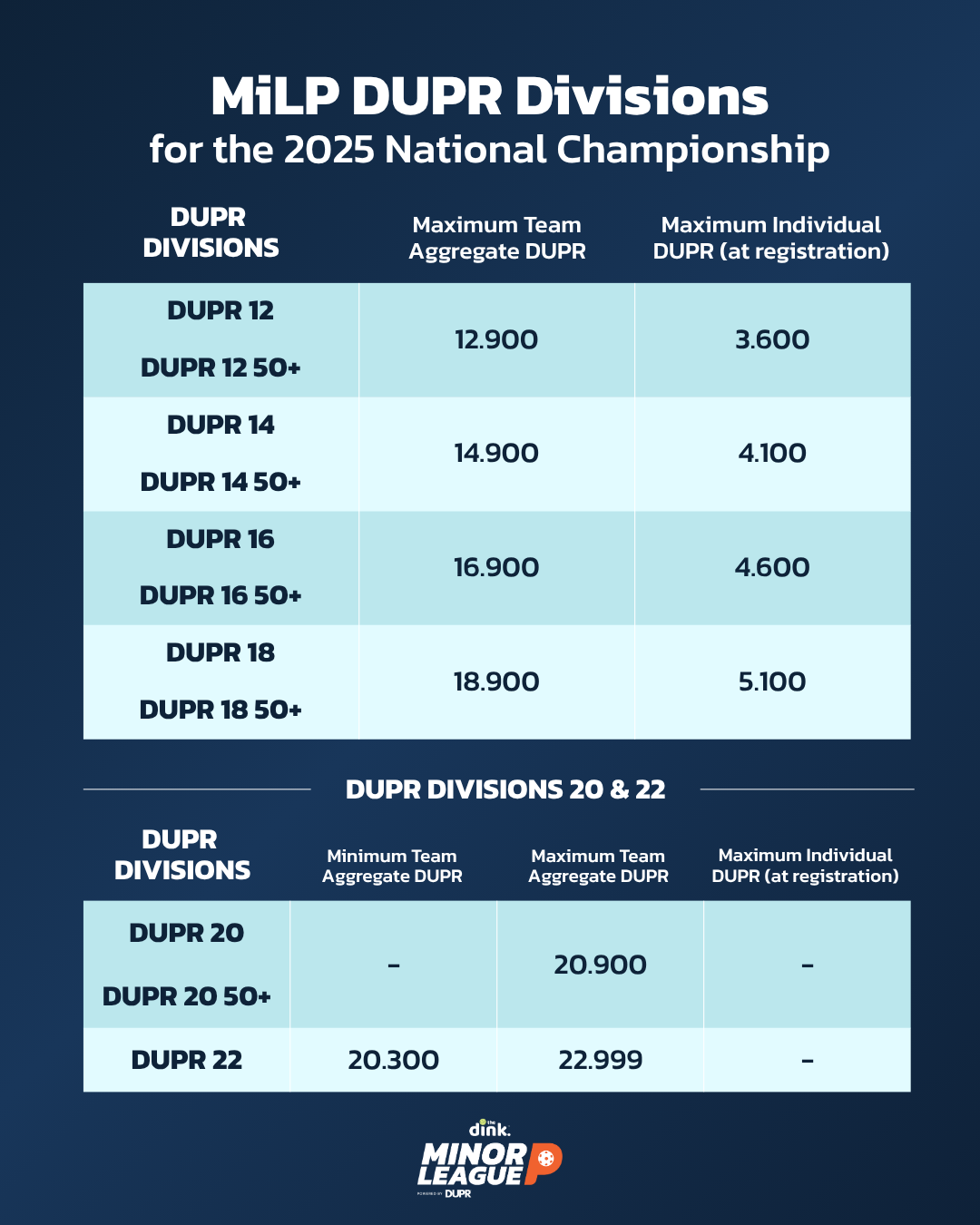
The division aggregate maximum ending in .900 only applies for Nationals. The regular aggregate maximum ending in .300 will stay in effect for all other Minor League Pickleball events.
MiLP v3 National Championship Divisions
The Dink MiLP v3 National Championship is open to any player who competes in official v3 and/or v4 tournaments during the 2025 season. All players from 2025 MiLP National Championship 4-person mixed teams — whether open age or 50+ — are eligible to participate. Registration for the v3 Championship will be on a first-come, first-served basis.

Schedule for the 2025 National Championship:
Wednesday, December 3rd:
- 50+ Divisions Round Robin (12, 14, 16, 18, 20)
- DUPR Coach
Thursday, December 4th:
- 50+ Divisions Playoffs (12, 14, 16, 18, 20)
- DUPR Coach
Friday, December 5th:
- v3 Tournament (Round Robin and Playoffs)
Saturday, December 6th:
- Open Age Divisions Round Robin (12, 14, 16, 18, 20, 22)
Sunday, December 7th:
- Open Age Divisions Playoffs (12, 14, 16, 18, 20, 22)
Points & Prize Money
MiLP rewards more than just winning — it rewards consistency. Players earn leaderboard points at every event, with 1st place teams receiving 1,000 points (or 2,000 points at Regionals). Points are awarded through 16th place and updated monthly on the National DUPR Leaderboard.
When it comes to prize money at Nationals, there's a lot on the line:
- 4-person mixed teams (MiLP): Prize money will be awarded to the top three teams in each division.
- MiLP v3 divisions: Only first-place teams will receive prize money.
💡 Exact prize amounts for each division and placement will be announced closer to the event.
Stay tuned for more updates as we get closer to the 2025 National Championship — including division details, registration instructions, and prize breakdowns. In the meantime, make sure to review the official rules and guidelines before signing up to ensure you’re fully prepared to compete.
The Dink MiLP
May 23, 2025
What Is an Erne in Pickleball?
If you've watched high-level pickleball or scrolled through highlight reels, you've probably seen a player leap toward the sideline, slam a volley near the net, and land dramatically outside the court. That move? It's called an Erne.
What Is an Erne?
An Erne is a legal volley hit near the net, outside the non-volley zone (kitchen). It’s typically executed by jumping over or running around the NVZ. A player can even run through the NVZ—as long as the player doesn’t strike the ball until both feet have landed completely outside the zone. You can even volley the ball while in the air, as long as you never touch the NVZ or its lines. This aggressive move allows players to take the ball early and close to the net while staying fully within the rules.
This aggressive shot is named after Erne Perry, a pickleball player who frequently used the move in tournament play.

Why Is the Erne Legal?
According to official pickleball rules, you can't volley a ball while standing inside the non-volley zone (NVZ) However, you can legally enter the NVZ—as long as both feet make contact with the ground outside the zone before hitting a volley.
There are a few ways to legally execute an Erne:
- Jump over the sideline and land outside the NVZ
- Run through the NVZ and land with both feet outside before making contact
- Stay airborne and strike the ball before landing, as long as you never touch the NVZ or its lines
✅ The key: if you’ve touched the NVZ then you cannot volley the ball until both feet make contact fully outside the NVZ.
How Does an Erne Work Strategically?
The Erne is a high-risk, high-reward shot. Here’s why it’s effective:
- Surprises opponents by taking time away
- Cuts off dinks or slow cross-court shots near the sideline
- Forces weak returns or outright winners
However, if timed wrong, it leaves you out of position and vulnerable. That’s why it’s usually used by advanced players rated 4.0 and above.
How to Practice an Erne?
- Anticipate the shot: Look for predictable cross-court dinks or pop-ups near the sideline
- Position early: Get to the edge of the NVZ before the ball crosses the net
- Time your move: Lunge or jump to hit the ball at its peak
Stay legal: If you’ve touched the NVZ, avoid volleying the ball until both feet make contact outside the NVZ.
The Erne is one of the most exciting and bold moves in pickleball. It’s not easy to pull off, but when done right, it adds pressure, flair, and momentum to your game. Whether you're aiming to climb your DUPR rating or just shake things up in rec play, the Erne is a move worth learning.
Pickleball Tips