No matching results.
Search results
May 24, 2026
How to Hit the Perfect Flick with Pro Player Richard Livornese Jr.
Think a 5.0 pickleball rating is out of reach? Think again.
You don’t need to hit harder; you need to play smarter.
Most players think the flick is just a fast poke. You reach, you push your paddle forward, and you hope the ball goes where you want. It works sometimes. But it is not a real flick, and against better players, they will see it coming every time.
Pro player Richard Livornese Jr. has spent a lot of time breaking this shot down. In a recent YouTube video, he breaks down exactly what separates a beginner flick from the kind JW Johnson uses to curl balls into corners from anywhere on the court.
The difference between a poke and a real flick
The poke is where most players live. You load up slightly, push the paddle forward, and snap your wrist. You get power. The ball gets out. Job done.
The problem is control. When you push straight behind the ball, all of your power goes forward and there is no spin. Flat balls sail long. They are also easier to read and easier to counter.
The real flick adds a brush. Instead of driving straight through the ball, you come around it. That motion splits your power in two directions: some goes into speed, and some goes into spin. The more you brush around the ball, the more spin you generate and the more the ball shapes in flight.
Livornese points to JW Johnson as the best example of this. Watch Johnson flick and the ball does not just go fast. It curls. It drops. It lands exactly where he wants it. That is the brush at work.
Why brushing the outside of the ball is everything
Here is where most players go wrong even after they learn to brush. They start brushing the back of the ball, which pushes it sideways and sends flicks tailing off target. It feels like a technique problem. It is actually a contact point problem.
Livornese's fix is simple: always hit the outside of the ball.
When you tilt your paddle slightly forward and make contact on the outside at roughly a 45-degree angle, you generate side spin. Side spin is control. It is what allows you to flick cross court, down the line, at the body, short angle, or deep corner, all with the same motion.
If you are only brushing the back of the ball, you are limited to one or two directions. If you are hitting the outside of the ball, you have up to twelve spots on the court you can target. That range is what makes a flick dangerous.
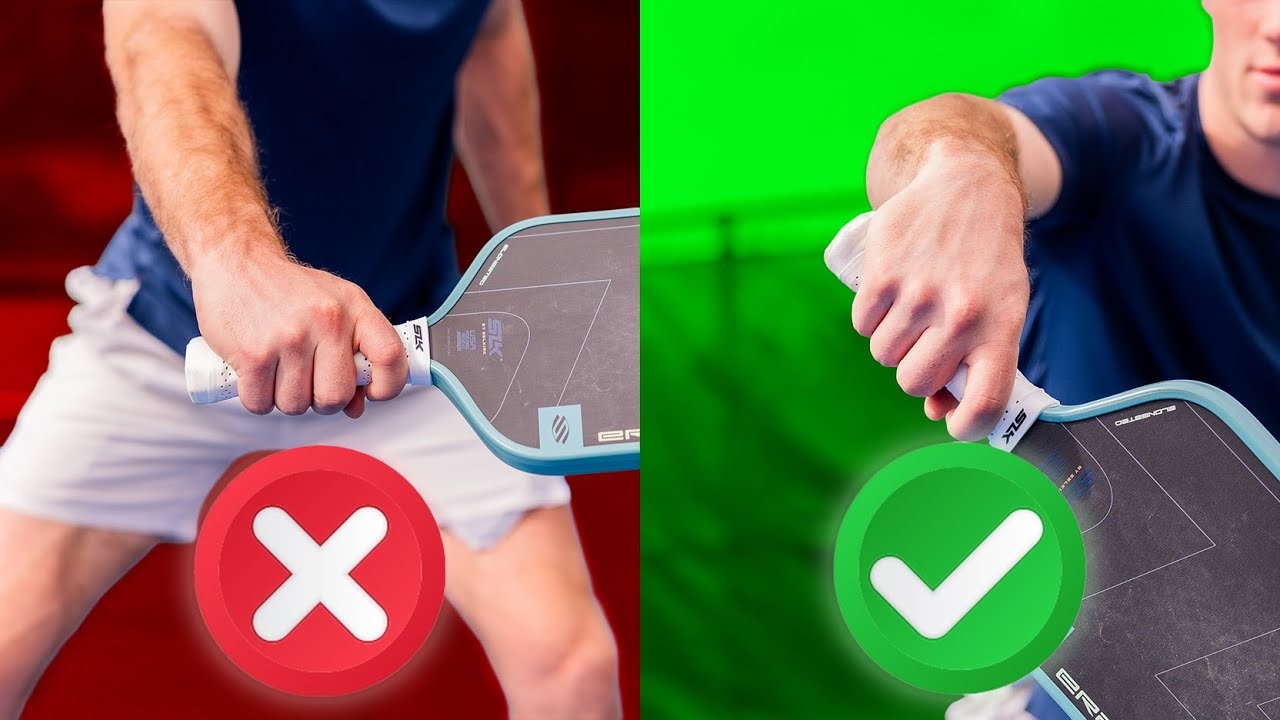
Here is what that contact looks like in practice:
- Tilt the paddle slightly forward at contact
- Brush on the outside of the ball at a 45-degree angle
- Let the spin curl the ball toward your target
- Do not push straight through
Keep the motion small and the wrist loose
The third piece is the one players overlook most. The flick is not a big shot. There is no windup, no shoulder, no loading up. It is all wrist.
Livornese describes it as going from here to here. Paddle starts in a relaxed ready position. Wrist hinges up. That is the entire motion.
To get into the right position before you flick:
- Push your hips back slightly and hinge at the waist
- Get your paddle out in front of you
- Start loose, not tight
- Flick up through the ball, not forward
The less arm you use, the faster and more consistent this shot becomes. Think of it as the opposite of a roll, where the shoulder drives the motion. The flick lives in the wrist. When you get that right, the shot starts to feel easy.
How to practice this in your next session
Livornese suggests starting slow and focusing on contact before worrying about pace. Hit a few flicks at half speed and pay attention to where your paddle is making contact. Are you hitting the back of the ball or the outside? You will feel the difference immediately.
Once you have the contact point, add the brush and watch the ball start to shape. Then work in direction. Try flicking cross court, then down the line, then at the body. The goal is to eventually have every target available to you from the same motion.
When this shot clicks, it becomes one of the most useful weapons in doubles. Livornese calls it his favorite shot in pickleball and the easiest way he knows to create offense, especially from the left side.
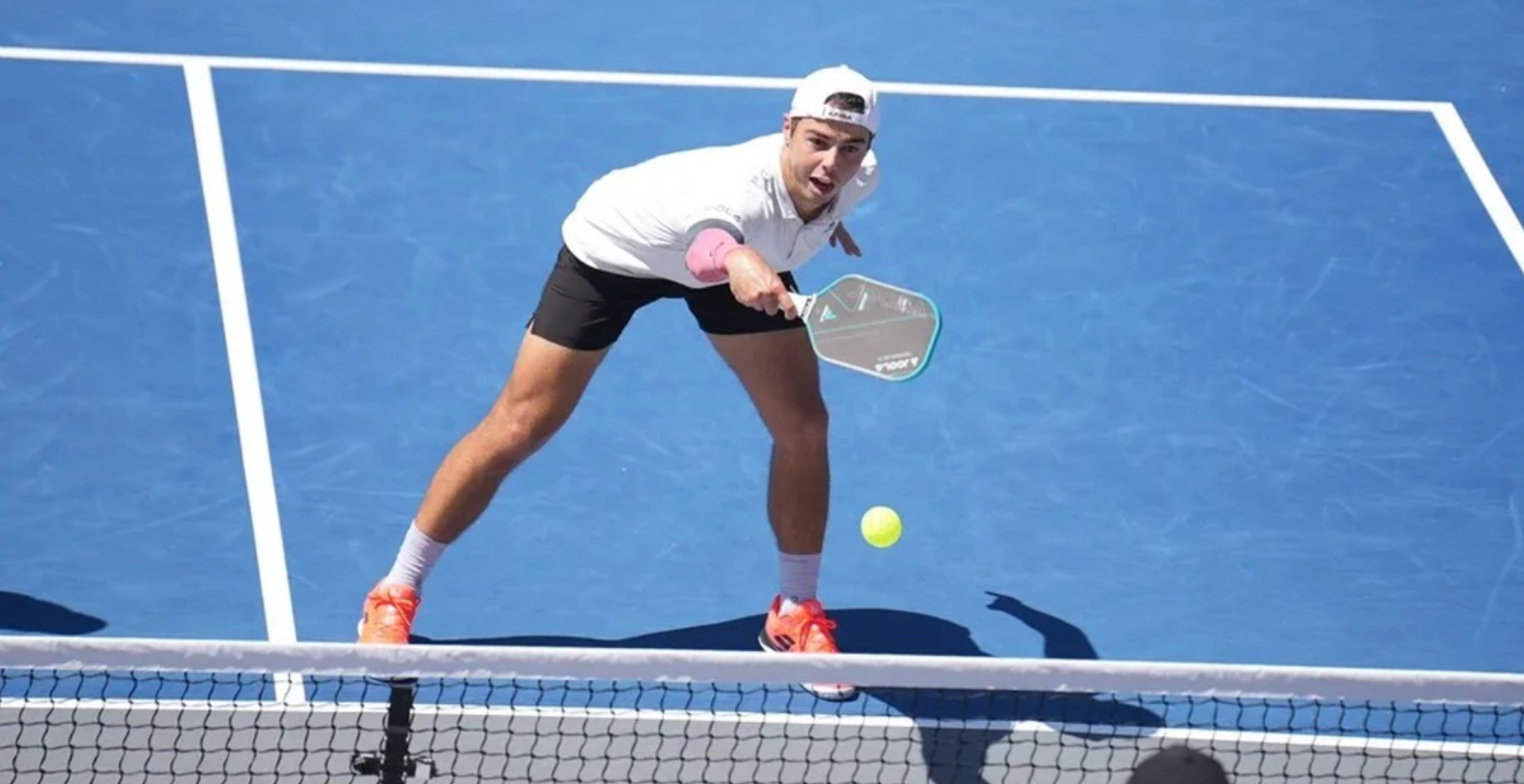
Put the flick to work and track your progress with DUPR
The flick is one of those shots that can shift a match quickly. When you can go anywhere on the court from the same motion, opponents have no read on you and that translates directly into more points won.
Mastering the flick will help you win more exchanges at the kitchen and naturally boost your DUPR rating. If you found these tips helpful, there is plenty more to learn—explore pro player Bobbi Oshiro’s blog on flicks, subscribe to Richard Livornese's Jr. YouTube channel, and follow DUPR’s Beyond the Baseline series.
Pickleball Tips
DUPR Ratings
May 21, 2026
How Pickleball Erases the Generational Gap
Something special happens on pickleball courts every single day. A 22-year-old athlete and a 65-year-old retiree square off at the kitchen line, fully locked in. They are battling in a long dink rally with an intensity that makes you forget the forty-year age gap between them. No one is taking it easy. The score is tight. And both players are exactly where they want to be.
In a world that often divides people by age, pickleball brings them back together. It is one of the rare sports where age takes a back seat to skill and strategy.

A lot of that comes down to how the game is built. The court is smaller, the pace rewards precision over power, and smart play wins more often than raw athleticism. A younger player might have explosive speed and a powerful drive. An older player counters with sharp shot selection, patience, and a court IQ that only comes with experience. On a pickleball court, those two styles push each other to be better.
What happens when those groups share a court is pretty powerful. Younger players learn that finesse matters more than force. Older players rediscover what it feels like to compete for something. And somewhere in the middle of a rally, age stops being relevant at all. DUPR's new features, including age-based Subscores and Career High, make it easier than ever to track how players perform across different formats and age groups, so cross-generational competition is not just fun, it is measurable. The conversations that happen after the match, at the net or over coffee, often go well beyond pickleball. Careers, family, life. That kind of connection is hard to find anywhere else. It starts by simply deciding to find a court.

Most sports end up sorting people by age without even trying. Basketball courts are generally dominated by young players. Golf courses attract an older demographic. Pickleballickleball does not work that way. A forty-year age difference is not unusual. It is just another Tuesday. The sport's fastest-growing group is adults under 35, but its backbone has always been players over 50. Champions Series has built its entire structure around keeping those older players competing at the highest level. And on the younger end, junior initiatives are making sure the next generation has every opportunity to grow in the sport.
Pickleball will not solve every generational divide. But it gives people a reason to show up, compete, and actually get to know each other. Clubs that have leaned into community know exactly what that looks like. And if you are ready to be part of it, getting started is easier than you think. The players who keep coming back week after week are proof that something real is happening out there.
For more information on player ratings, age-based Subscores, and tracking your pickleball progress, go to https://www.dupr.com/.
Community
DUPR Athletes
May 20, 2026
MiLP Took the Stage at the EPIC World Championship
Minor League Pickleball took the world stage at the EPIC World Championship, held May 2nd and 3rd at the Kallang Tennis Center in Singapore. The Dink Minor League Pickleball event was hosted inside the Championship, bringing two divisions, DUPR 14 and DUPR 18, to one of the most internationally competitive settings the sport has ever seen.
With players representing 15 countries, Australia, Canada, China, Germany, Hong Kong, Indonesia, Japan, Korea, Malaysia, New Zealand, the Philippines, Samoa, Singapore, Chinese Taipei/Taiwan, and the United States, this was the most diverse competition in MiLP history. Every single medalist team represented a different country.
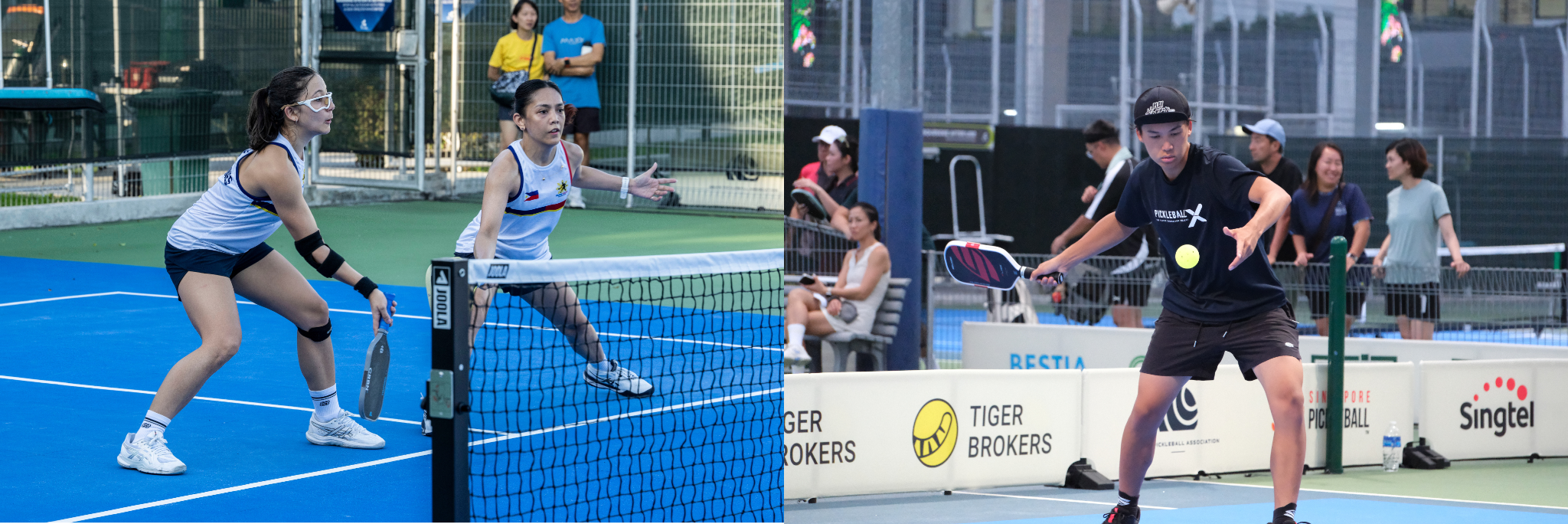
DUPR 18 Results
Malaysia's 002 Gladiators claimed gold, with Muhammad Aiman, Zhafree Siddiq, Neem Shamsuddin, and Jasmine Almaguer competing through two days of high-level play. Norman Wong was also part of the team but was subbed out due to injury. Silver went to Team Taiwan with Yang Chin Wen, Po Chiao Chen, Chen Si, and Su Li Ting. Japan's Pickleball X took third with Takumi Matsuda, Naomichi Oya, Mahiro Fukuhara, and Hinano Fukunaga.
DUPR 14 Results
In the DUPR 14 division, Singapore's Cho Leh! topped the podium with Goh Yeou Jie, Daryl Yee, Tay Hui Xin, and Choo Mun Lin. Hong Kong's Hapi earned silver with Tsz Chiu Lam, Tyress Yau, Lo Leong Yi, and Cindy Lai Ping NG. China's Slampickle CNSZ PBB took bronze with Liang Qian, Derrick Li, Wenmin Huang, and YaZhi Mo.
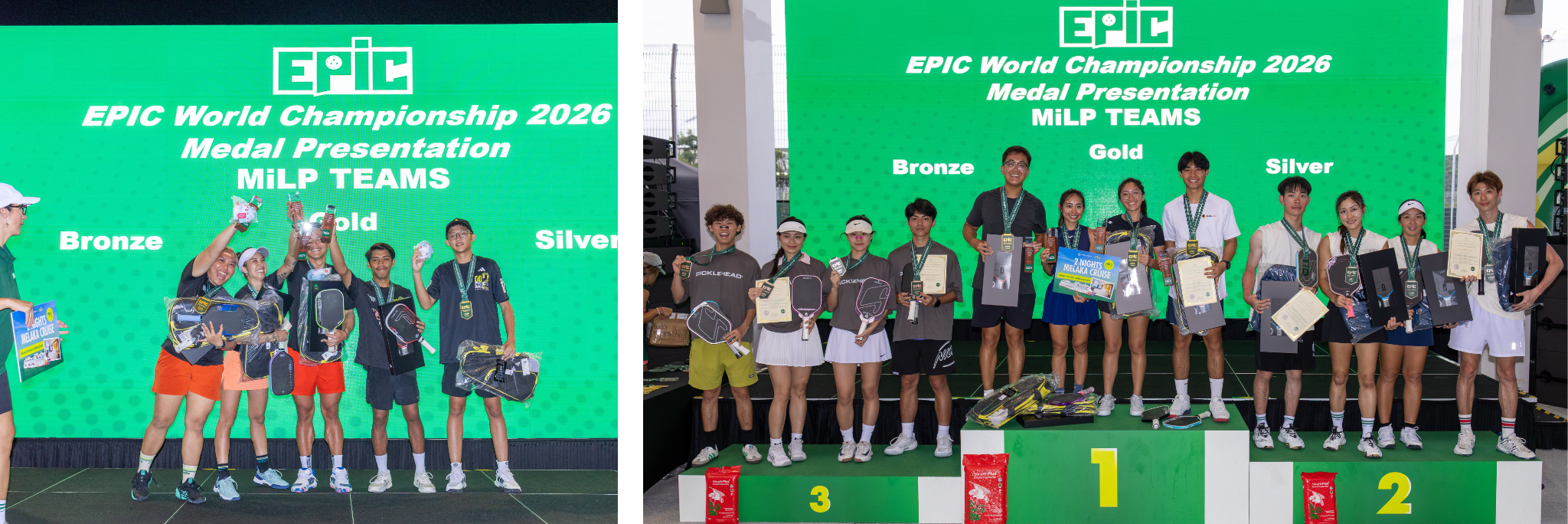
Dream Tickets Earned
The winners of both DUPR 14 and DUPR 18 earned a Dream Ticket to the 2027 The Dink Minor League Pickleball Championships. Congratulations to Cho Leh! and 002 Gladiators. See you in 2027.
For more on the EPIC World Championship, visit epicworldchampionship.com
Community
DUPR Athletes
Pickleball Tournaments
May 16, 2026
What Is the Kitchen in Pickleball? Everything You Need to Know!
If you have ever watched a pickleball match, you have probably heard someone shout "stay out of the kitchen!" and wondered what that means. The kitchen is one of the most important areas on a pickleball court, and understanding it is essential for every player, whether you are picking up a paddle for the first time or grinding your way toward a higher DUPR rating.
What Is the Kitchen in Pickleball?
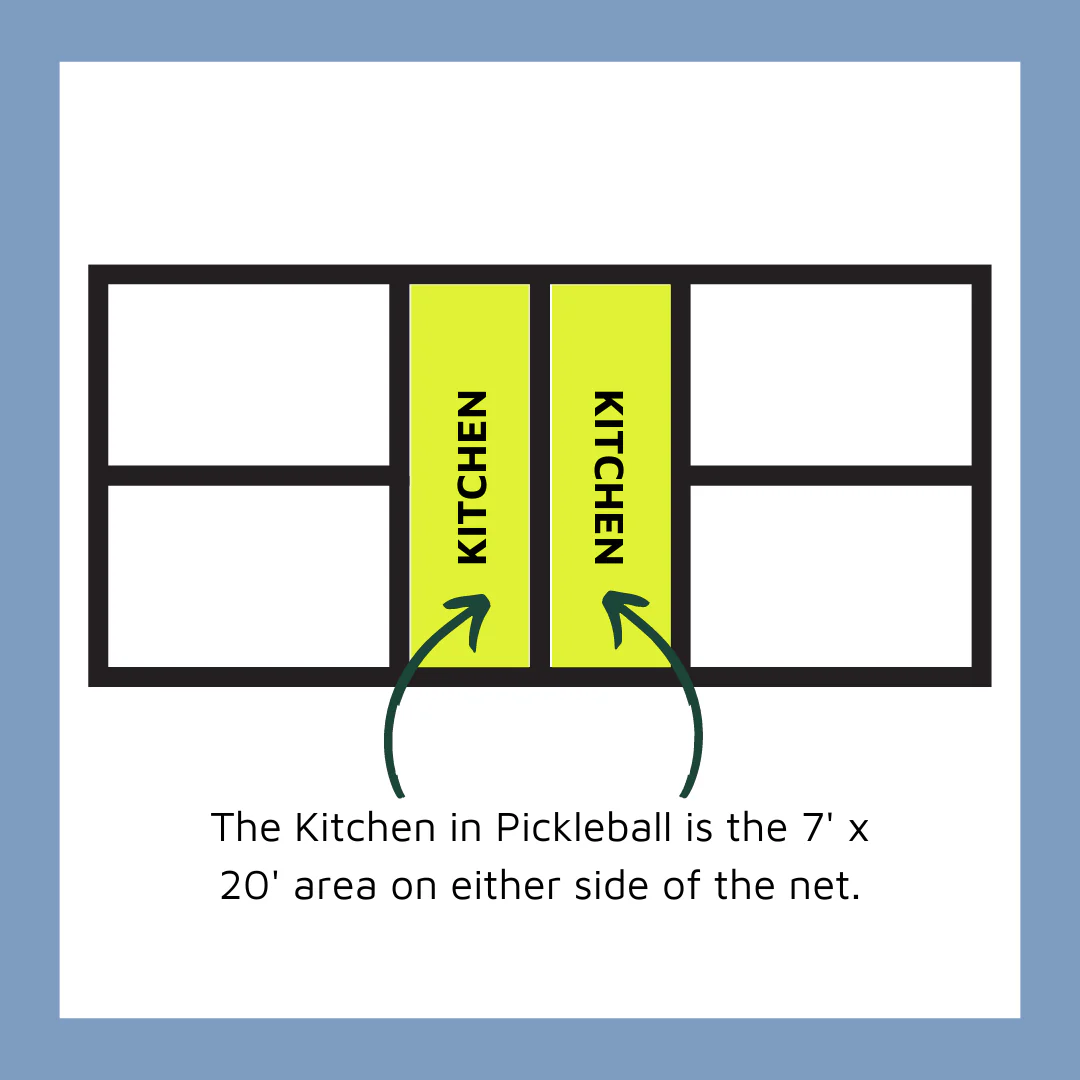
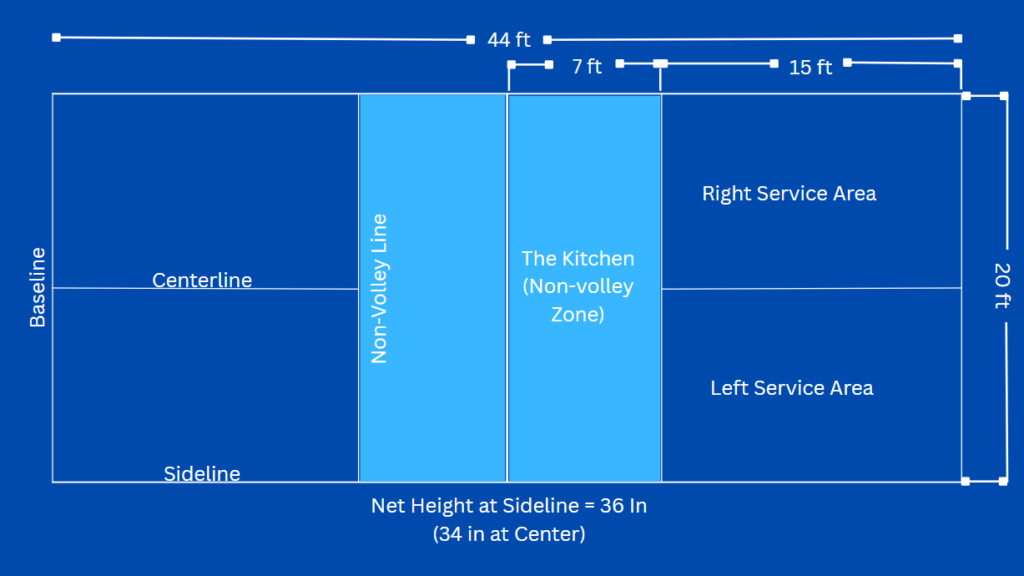
The kitchen is the informal name for the Non-Volley Zone (NVZ), a seven-foot area on both sides of the net that extends the full width of the pickleball court. It includes the lines around it. According to official pickleball rules, you cannot volley the ball, meaning hit it out of the air, while standing in the kitchen or on the kitchen line. That one rule shapes virtually everything about how the game is played.
Kitchen Rules Every Pickleball Player Must Know
Knowing the kitchen rules inside and out is what separates recreational players from competitive ones at pickleball tournaments.
You cannot volley while standing in or on the kitchen line. Even if your feet are behind the line when you make contact, if your momentum carries you into the kitchen afterward, it is a fault. This is called a momentum fault, and it catches players off guard more often than you would think.
You can stand in the kitchen anytime you want, as long as you are not volleying. If the ball bounces in the kitchen first, you are free to step in and hit it. This is where the dink, one of pickleball's most strategic shots, comes into play.
You can also lean over the kitchen without stepping in. Because the non volley zone is a ground-level rule, reaching your paddle over the zone is legal as long as your feet stay behind the line.
Team momentum matters too. In doubles play, if your partner's movement causes either of you to enter the kitchen illegally during a volley, your team loses the rally. For a full breakdown of all kitchen rules pickleball players need to know, DUPR has you covered.
Why the Kitchen Changes Everything
The kitchen is not just a rule, it is the strategic heart of pickleball. Because neither player can volley from inside the non volley zone (NVZ), both sides are pushed to play at the kitchen line and engage in patient, precise dink exchanges. This is why pickleball rewards finesse and court IQ just as much as athleticism. A powerful drive means nothing if you cannot handle a well-placed dink rally at the net.
This dynamic is also why pickleball is uniquely cross-generational. The kitchen neutralizes raw power and rewards smart shot selection, meaning a seasoned 60-year-old and a 25-year-old with a big swing can compete on completely equal terms.
How Kitchen Play Affects Your DUPR Rating
Your DUPR rating reflects your true skill level across every match you play, and kitchen mastery is one of the clearest markers of skill. Players who consistently win dink battles, avoid kitchen faults, and control the non volley zone tend to outperform expectations in pickleball tournaments and climb the ratings faster. If you want to understand how your performance translates into rating movement, DUPR's Impact feature lets you see exactly how match scorelines affect your rating before you even play.
The Bottom Line
The kitchen is where pickleball is won and lost. Master the rules, respect the line, and learn to love the dink. Whether you are just starting out or preparing for your next tournament, brushing up on pickleball rules is always time well spent. And when you are ready to track your progress and compete with players at your level, DUPR is here to help every step of the way.
Pickleball Rules
Pickleball Tips
May 6, 2026
How to Protect Your Knees and Stay on the Court: A Science-Backed Pickleball Training Guide
By: Susie Reiner, PhD
Knee pain can take you out of a match faster than any opponent. If you play pickleball regularly, you’ve probably felt it. A little stiffness after a long session. A tweak during a wide lunge. Maybe something that lingers longer than it should.
The numbers back it up. Nearly 7 in 10 players report some kind of injury over the course of a year, and the knee is the most common area affected, making up about 29 percent of injuries (1,2).
It’s not hard to see why. Pickleball demands rapid deceleration, lateral shuffling, lunging, and reactive direction changes. Every one of those movements puts stress on the knee, especially when your strength and control don’t match what the game demands.
Most of these injuries don’t come from collisions; they happen during normal play. That means your movement quality, strength, and coordination are doing most of the work in protecting your knees (3).
The good news is that you can train for this. When you build the right physical qualities, your body handles those demands better, and you build resilience that translates directly to the court.
Let’s break down what the research says and the exercises you should be doing.
Train Smart, Stay on the Court: What the Research Says About Injury Prevention
The strongest evidence in sports science points to one clear approach. Programs that combine strength, balance, and movement training consistently reduce injury risk.
Otherwise known as neuromuscular training (NMT), or programs that combine strength, balance, and plyometric work into a single integrated approach, can lower risk of injury by 25%-40%, with even larger reductions for ACL injuries in athletic populations (5–7).
The reason? These programs improve how you move: you land with more control, you stop more efficiently, your knee stays in a better position instead of collapsing inward under load.
For pickleball players, the smartest approach to training reflects the actual demands of the sport.
Strength Training: Your Foundation
Strength gives your body the ability to handle force. When the muscles around your knee are strong, they absorb more of the load, so the joint doesn’t take it all on its own (4).
Focus on movements like:
- Split squats
- Reverse lunges
- Step-ups
These build strength in your quads, glutes, and hamstrings, which all help stabilize the knee during play.
Hamstrings play an especially important role. They help keep your lower leg from sliding forward under your knee, which protects your ligaments when you stop or change direction (8).
Stronger athletes also hold their form longer as fatigue sets in (9). That becomes a big advantage late in matches.
Single-Leg Training: Aligning With Sport Demands
Most of pickleball is played on one leg. Lunging to the kitchen, recovering from a wide shot, reacting to a sudden exchange, and all of it demands stability and force production on a single side.
Single-leg exercises include:
- Single-leg squats
- Step-downs
- Lateral lunges
- Single-leg Romanian deadlifts
These movements help you stay balanced and controlled in those moments. Training on one leg also reduces side-to-side differences, which can lower the risk of knee injury (4).
The result: your knee stays stable in the moments that actually matter on the court.
Prime your body. Protect your knees. AIM7 delivers personalized pre-play warm-up routines designed to enhance performance and prevent injury, plus customized strength-training programs tailored to your fitness history, time, and equipment. Use code DUPRVIP for free lifetime access — a $200 value. [Click here to download the app.]
Plyometrics and Deceleration: Train How You Stop
Most knee injuries don’t happen when you’re moving; they happen when you’re stopping. Deceleration and landing put massive force through the joint, and if your body can’t absorb that force in alignment, the knee pays the price.
Plyometric exercises give you a structured way to train these qualities:
- Snap-downs
- Drop landings
- Lateral bounds
With proper coaching and technique feedback, these drills sharpen landing mechanics and lower peak joint loading (3,6).
Adding simple stop drills, like short sprints into a controlled stop, helps mimic what happens during a rally. The goal is to spread force across your hips and legs instead of letting it all hit your knee.
Balance and Proprioception: Control Your Movement
Pickleball is unpredictable. Your balance is constantly tested in ball placement, opponent positioning, and your own court coverage. When you incorporate balance training in your routine, you sharpen your proprioception (your sense of where your body is in space), so you’re ready for whatever the rally throws at you.
Single-leg balance progressions and perturbation drills (in which a partner or band disrupts your stance) build the neuromuscular control at the heart of every effective injury-prevention program (7). When your body knows how to react, your knee doesn’t get put in bad positions.
Agility and Change of Direction: Reacting Quickly
Agility is what bridges the gap between weight-room strength and on-court performance. Lateral movement, change-of-direction work, and reactive drills force you to apply your strength and coordination in real time.
For pickleball, that means lateral shuffle patterns, cone-based directional drills, and reactive movements triggered by visual or verbal cues. The unpredictability exposes control and coordination issues that don’t show up in slower, pre-planned work.
Build these skills, and you’ll move more efficiently and hold your control when the match heats up.
Core and Hip Control: Supporting Knee Alignment
Your knee rarely fails on its own. Weak hips or poor core control can pull your knee out of alignment during movement, placing undue strain on it.
Build core and hip stability with exercises like:
- Glute bridges
- Dead bugs
- Hip abduction work
- Bird dogs
Better hip and trunk control means less knee collapse and more efficient force transfer through your lower body (4). So you can rely on larger, more stable muscles to power your movements rather than let the knee take the brunt of the force.
The entire kinetic chain matters: instead of training your knees in isolation, strengthen the muscles farther up the chain for better stability.
Your Knee-Injury Prevention Toolkit
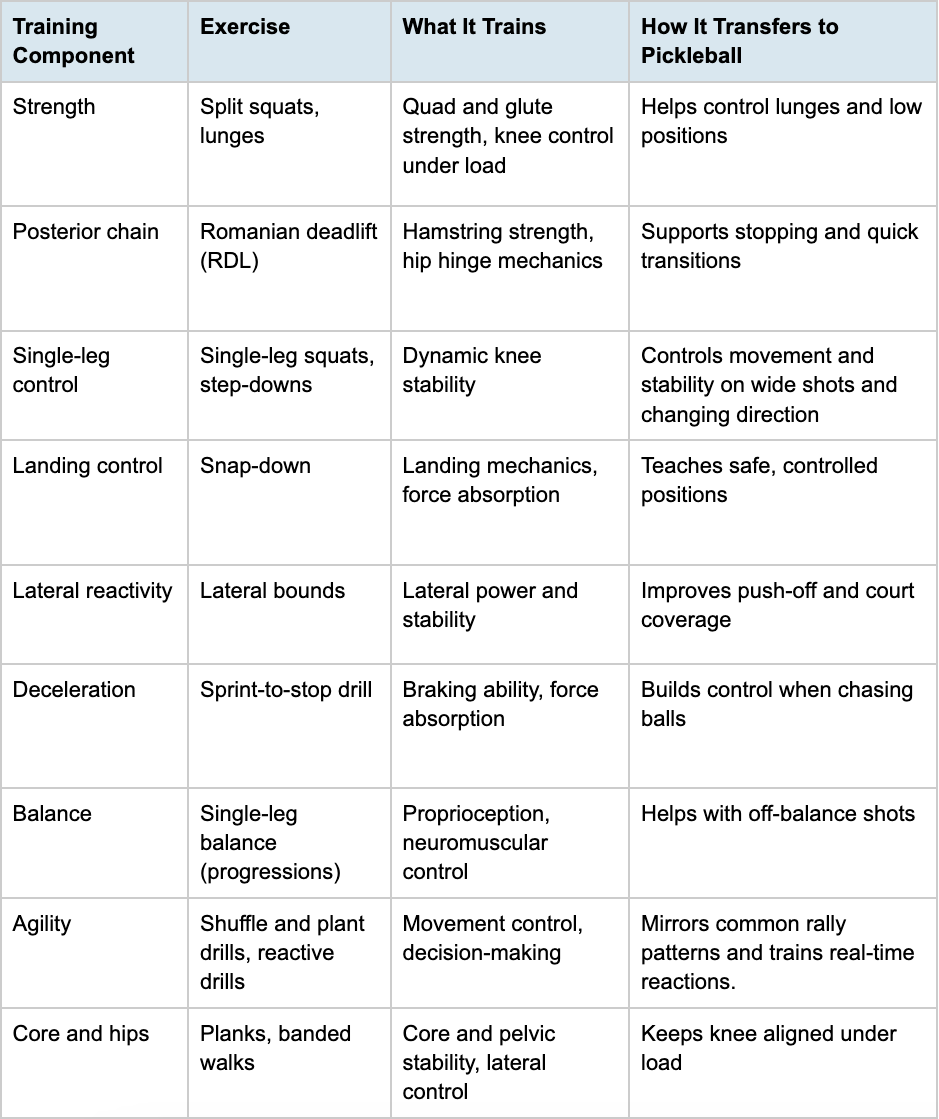
Here’s how each training component maps directly to what happens on the court:
Build a Knee-Resilient Body Without Guessing What to Do
Reading the research is one thing. Putting it into practice consistently, week after week, is another. That's where most players fall off.
AIM7 closes the gap. We turn the science of injury prevention and performance into a daily plan you'll actually follow:
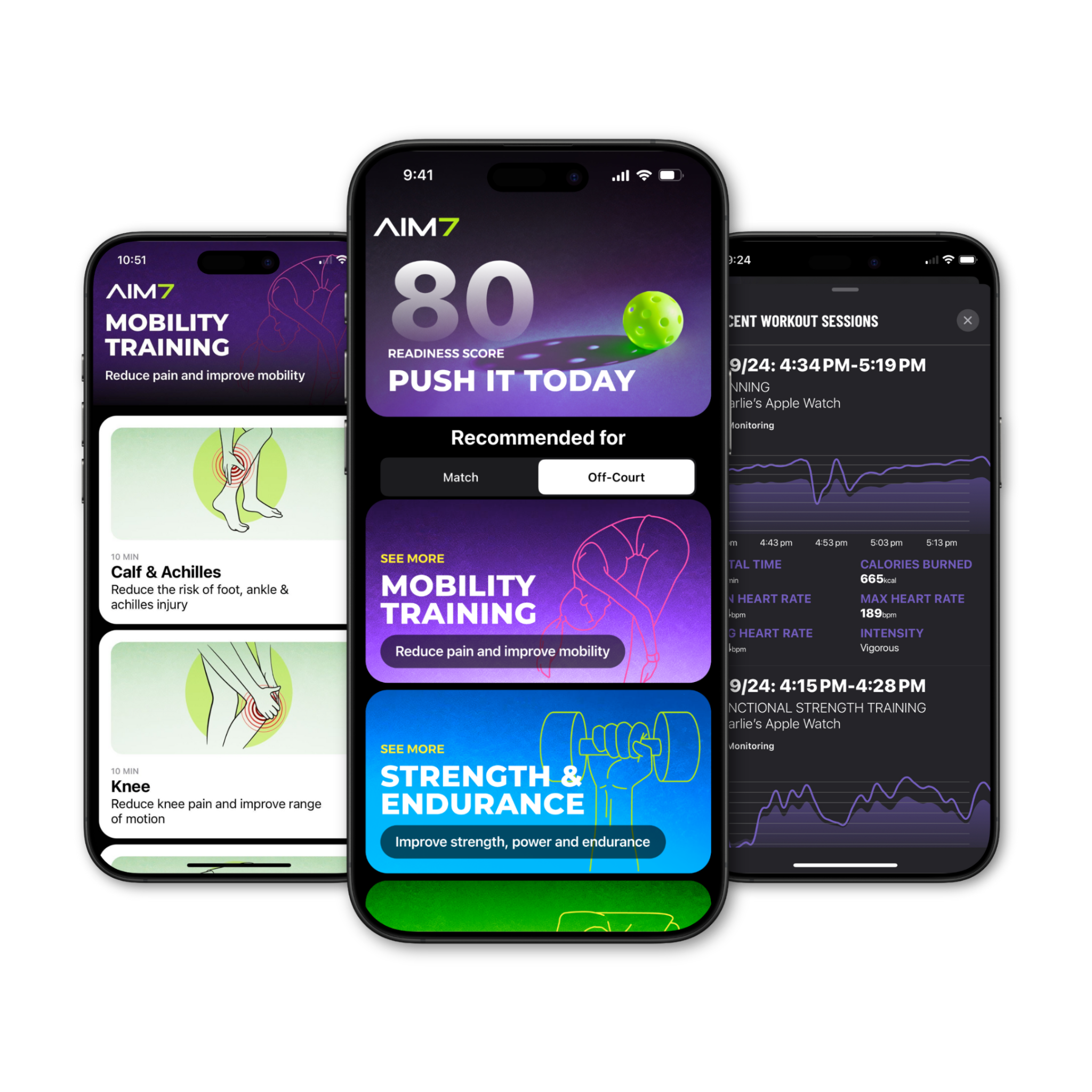
- Personalized pre-play warmup routines with video walkthroughs, designed around the lateral movement, deceleration, and reactive demands of pickleball — to prime your performance and help prevent injury before the first serve.
- Customized strength training programs tailored to your fitness history, time demands, and available equipment — so the program fits your life instead of fighting it.
- Mobility and recovery protocols built around what the research actually supports for injury prevention and on-court performance.
Whether you've got 15 minutes before a match or an hour for a full session, AIM7 meets you where you are and builds you into a more resilient, confident athlete on the court.
Use code DUPRVIP for free lifetime access — a $200 value. Click here to download.
Putting It Into Practice
Here’s the good news: injury prevention doesn’t require long or complicated training sessions. Research shows that short, consistent programs deliver real results (5).
A 10- to 15-minute pre-play routine that combines dynamic movement, strength, landing mechanics, and balance is enough to build the movement quality and physical capacity that pickleball demands. Over time, those sessions raise your ceiling for what your body can tolerate on the court.
Consistency is what compounds. Small, repeated doses of well-structured training add up to meaningful change.
The Bottom Line
Knee injuries don’t usually come out of nowhere. They build over time when the body isn’t prepared for the demands of the game.
When you build strength and improve control, you give yourself a much better chance of staying healthy and playing at a high level. These same qualities raise your performance ceiling so you’ll move more efficiently and stay sharp deep into competitive matches.
You don’t need long workouts or complicated routines. A consistent 10 to 15 minutes focused on the right things goes a long way.
Train smart, and you give yourself the best chance to stay on the court and keep improving.
References
1. Forrester MB. Pickleball-Related Injuries Treated in Emergency Departments. J Emerg Med. 2020;58(2):275-279. doi:10.1016/j.jemermed.2019.09.016
2. McMillan P, Lake LP, Burkhart A, Reddy E, Hale IC, Grawe BM. The Epidemiology of Pickleball Injuries Presenting to US Emergency Departments. Sports Health. Published online July 13, 2025. doi:10.1177/19417381251350671
3. Hewett TE, Myer GD, Ford KR, et al. Biomechanical measures of neuromuscular control and valgus loading of the knee predict anterior cruciate ligament injury risk in female athletes: a prospective study. Am J Sports Med. 2005;33(4):492-501. doi:10.1177/0363546504269591
4. Myer GD, Ford KR, Hewett TE. The effects of gender on quadriceps muscle activation strategies during a maneuver that mimics a high ACL injury risk position. J Electromyogr Kinesiol. 2005;15(2):181-189. doi:10.1016/j.jelekin.2004.08.006
5. Lauersen JB, Bertelsen DM, Andersen LB. The effectiveness of exercise interventions to prevent sports injuries: a systematic review and meta-analysis. Br J Sports Med. 2014;48(11):871-877.
6. Sugimoto D, Myer GD, McKeon JM, Hewett TE. Evaluation of the effectiveness of neuromuscular training to reduce anterior cruciate ligament injury in female athletes: a critical review of relative risk reduction and numbers-needed-to-treat analyses. Br J Sports Med. 2012;46(14):979-988. doi:10.1136/bjsports-2011-090895
7. Taylor JB, Waxman JP, Richter SJ, Shultz SJ. Evaluation of the effectiveness of anterior cruciate ligament injury prevention programme training components: a systematic review and meta-analysis. Br J Sports Med. 2015;49(2):79-87. doi:10.1136/bjsports-2013-092358
8. Aagaard P, Simonsen EB, Andersen JL, Magnusson P, Dyhre-Poulsen P. Increased rate of force development and neural drive of human skeletal muscle following resistance training. J Appl Physiol (1985). 2002;93(4):1318-1326. doi:10.1152/japplphysiol.00283.2002
9. Suchomel TJ, Nimphius S, Stone MH. The Importance of Muscular Strength in Athletic Performance. Sports Med. 2016;46(10):1419-1449. doi:10.1007/s40279-016-0486-0
Community
May 1, 2026
DUPR Impact: See How Every Match Affects your Rating
One of the most useful additions to the latest DUPR app update is DUPR Impact. This feature is located within the Forecast tab and shows how matches affect your rating.
The Forecast feature was rolled out in 2025, allowing players to view predictions on whether they were the underdog or the favored team, as well as the projected outcome of the game.
With the new enhanced features, DUPR just took it one step further.
Before you step onto the court, have you ever wondered how a specific win or loss would impact your actual rating? The DUPR Impact tool provides those answers.
What is DUPR Impact?
DUPR Impact is the specific feature within the forecasting tool that takes the simulation a step further by calculating the predicted rating change for those matchups. While Forecast tells you the likelihood of a win or loss, Impact allows you to adjust the scorelines to see exactly how a specific outcome (such as an 11–2 win vs an 11–9 win) will move your rating. Together, they provide a transparent preview of the stakes before a match even begins, helping players understand how their performance translates into rating movement.
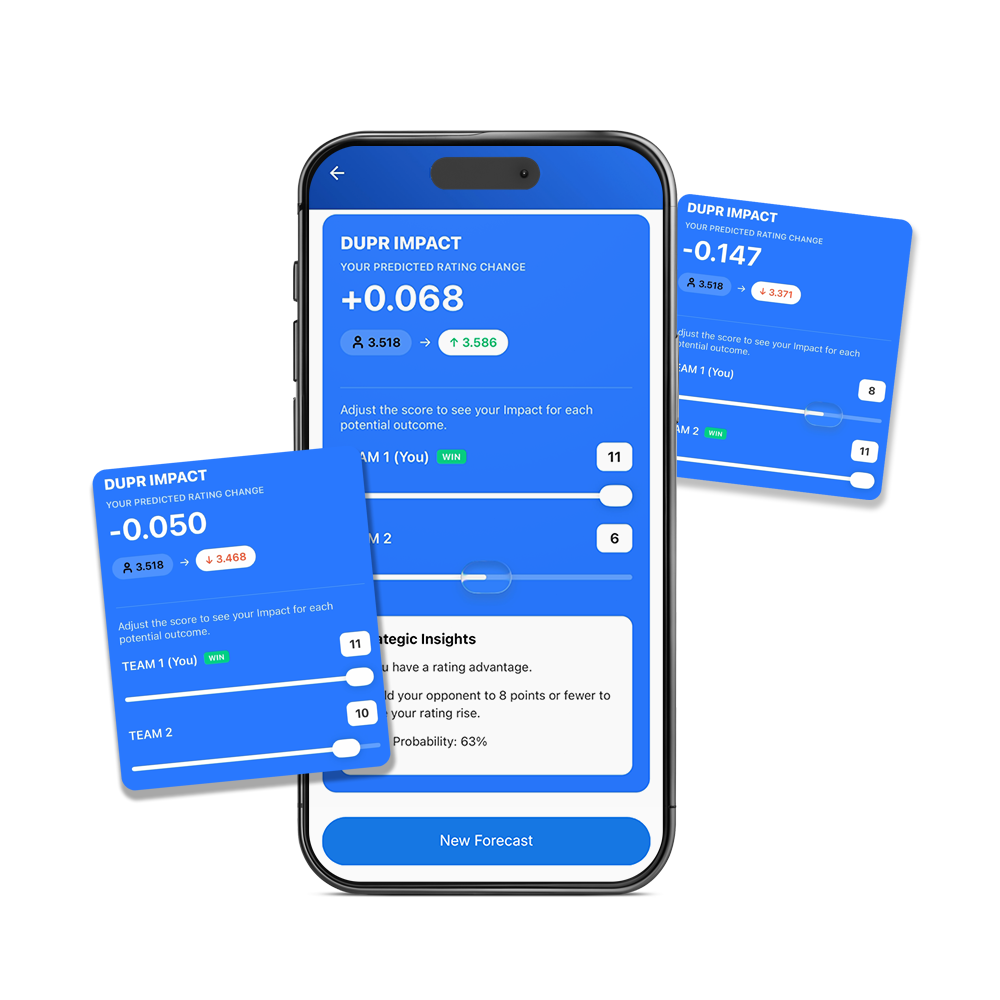
Why This is a Game-Changer
The introduction of DUPR Impact provides a new level of transparency into the dupr algorithm:
- Reduced Rating Anxiety: Go into every match with clarity and confidence, knowing the precise predicted movement of your DUPR rating before you even step on the court.
- Every Point Counts: It proves that your rating isn't just about winning or losing; it’s about the margin of victory.
- Strategic Goal Setting: Whether you're playing a casual rec game or a tournament, you can now see exactly what score is needed to maintain or improve your rating against any specific pairing.
How to Access It
To simulate your next match, ensure you have the latest version of the DUPR mobile app and go to the Forecast tab located on the bottom left of your navigation bar.
Learn more about our enhanced app and new features here!
DUPR Ratings
April 30, 2026
Para Sa Kanya Talaga- “This trip was meant for him” The Pickleball Story of Alva “Thong” Bual
In competitive sports, people often talk about "grit." For 17-year-old Filipino athlete Alva "Thong" Bual, grit was about more than diving for a ball. It was about fighting through a system that was never built for him.
His journey to the PCL Asia Rising Stars Grand Finals in China is a story the staff still tells through tears. It serves as a reminder that the hardest matches are often played off the court.

The Door That Slammed Shut
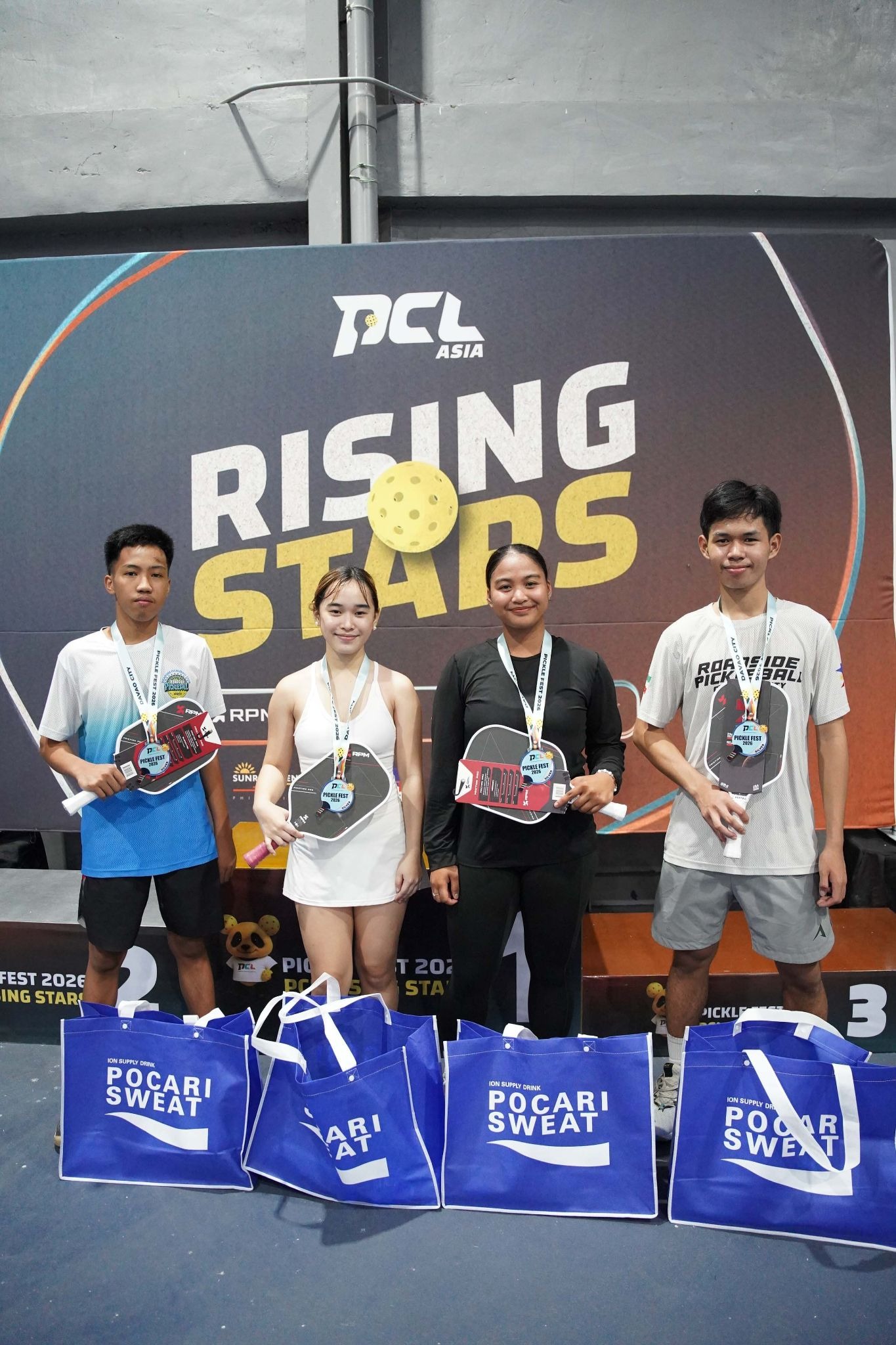
Thong’s road to Hainan began with heartbreak in Davao. His team played their hearts out at the qualifiers, but the tournament math was cruel. They placed on the podium but missed the gold, and only first place earned a ticket to China.
For most players, the dream would have ended there. Thong refused to go home defeated and instead looked for a second chance in Cebu.
Just weeks later, backed by a sponsor who noticed his fire in Davao, Thong tried again. On March 7, 2026, he didn't just play. He dominated. He walked off the court as a champion with a golden ticket to the Grand Finals in his hand.
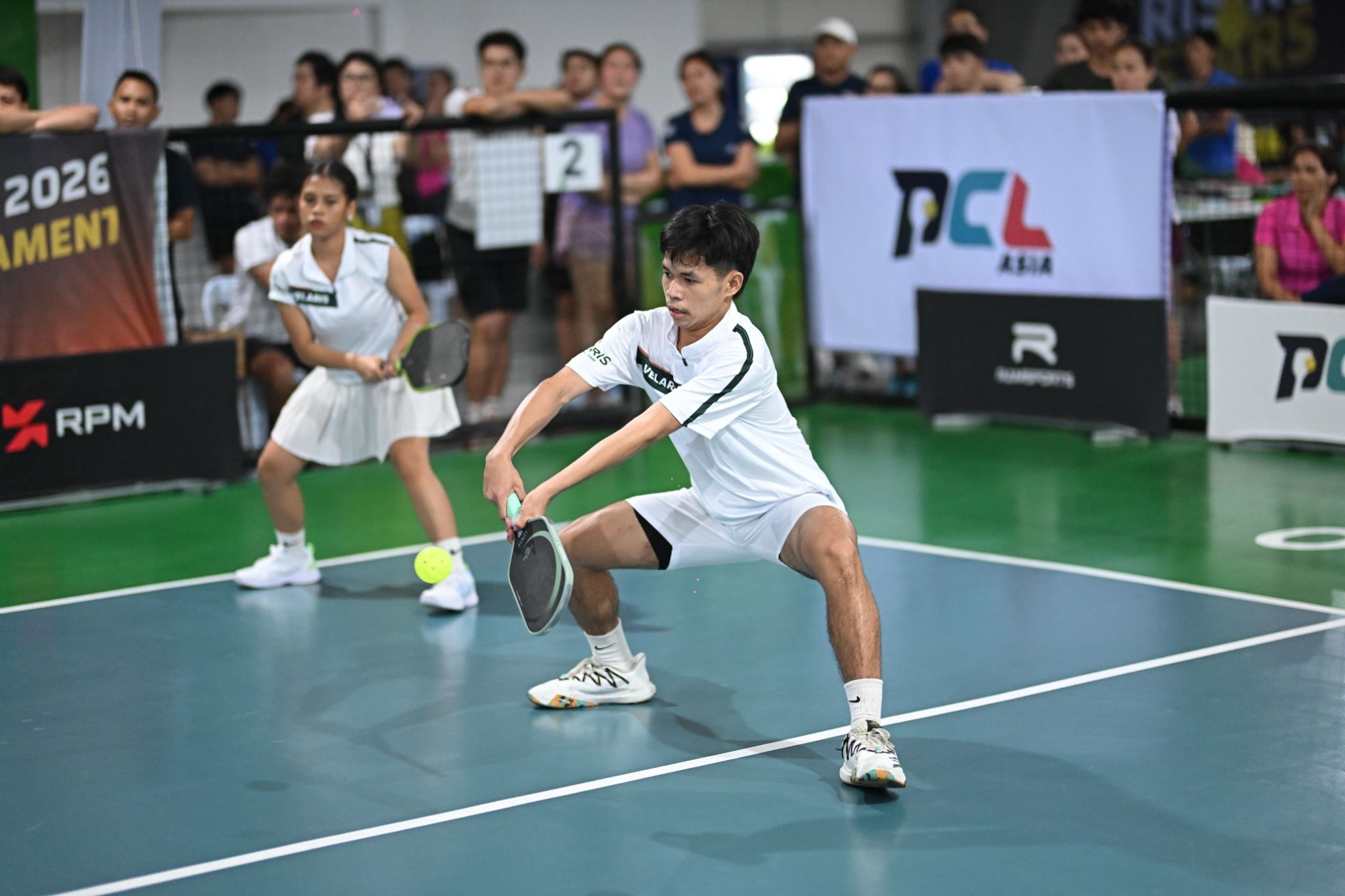
The Paperwork Puzzle
To fly a minor to China, you need a passport and a travel permit. Thong had neither. He grew up in a world where international travel felt like a fantasy, so he never had a reason to apply for them.
As the team scrambled to help him, they hit a devastating reality. Thong’s mother had passed away years ago and his father had been absent since Thong was eight. There were no IDs, no birth records, and no signatures. With less than two weeks before the tournament, Thong had a problem on his hands.
A System with a Heart
Then something rare happened. As the Department of Foreign Affairs (DFA) and DSWD heard Thong’s story, the bureaucracy softened. They saw a kid who had fought his way up with nothing behind him and decided to help.
The DFA worked through weekends to fast-track his passport, while the DSWD moved mountains to process his permit in record time. They were moved by the Filipino concept of naaawa. They simply refused to let his dream die on a desk.
The Only Reason He Saw His Father Again
Thong’s father did not come back into his life for a birthday. He did not come back for a holiday. He did not come back because he missed his son.
The paperwork process for the passport and the DSWD permit required the father’s involvement. His documents. His interview. His signature. That is the only reason they were reunited.
After nearly a decade apart, a son saw his father again because his son needed him to sign a form so he could fly to China to play pickleball. That is the reunion. A passport application. A government interview. A son chasing a dream, and a sport of all things, a sport being the reason a father walked back into his life, even briefly, even just for the papers.
Beyond A Gold Medal
Thong made it to Hainan. He competed against the best from eight countries and trained with world-class pros like James Ignatowich. He also saw his hard work reflected in his official DUPR rating.
While his team didn’t take home the trophy, Thong took home something better. His composure and talent caught the eyes of every scout in the arena. He was named an AEPA Standout Scholar, earning a full scholarship to the Asia Elite Pickleball Academy.
Thong went to China looking for a tournament and came back with a future. For more updates on the league, visit the Pickleball Champions League (PCL) Asia.
Community
April 15, 2026
Sporfie and DUPR Partner to Connect Match Video with Player Ratings
Integration enables players to link their DUPR account, submit scores, and share match video — all from within the Sporfie app — turning every recorded match into a rating opportunity.
Phoenix, AZ —Wednesday, April 15, 2026— Sporfie, the sports technology platform built around video capture, and DUPR (Dynamic Universal Pickleball Rating), the world’s most widely adopted pickleball rating system, today announced a partnership that connects match video with player ratings. The integration will allow Sporfie users to link their DUPR account directly within the Sporfie app, submit match results for official DUPR rating updates, and include match video alongside their score submissions.
For the millions of pickleball players who already rely on DUPR to track their skill level, this partnership removes friction from one of the sport’s most important workflows: getting rated. Instead of toggling between apps and manually entering results, players on Sporfie will be able to play, record, and submit — all in one place.
When players use Sporfie to record a match and enter scores through the in-video scoreboard, they’ll be able to push those results directly to DUPR for an official rating update — with match video attached. No app-switching. No re-entering data. Just one seamless workflow from court to rating.
“DUPR is the standard for how pickleball players measure themselves. What Sporfie adds is video — whether captured using our mobile app or through our installed fixed cameras, match footage can now travel with every submission, turning a score into a complete picture of how that match was played.”
— Sami Karoui, CEO and Founder, Sporfie
Video-backed submissions are a major step forward for the integrity of ratings. By connecting performance directly to real match footage, we’re adding a new layer of trust and transparency to the system. This not only strengthens the accuracy of DUPR, but also opens the door to a more scalable and inclusive future for player ratings worldwide.
— Tito Machado, CEO, DUPR
Availability: The integration will be available to Sporfie users by July 1, 2026.
About Sporfie
Sporfie is a video technology platform built for sports. Compatible with any camera and designed to serve any sport, Sporfie provides recording, live streaming, coaching tools, AI-assisted line calling, in-video scorekeeping, and flexible monetization from free access to pay-per-view. Its open architecture integrates with third-party providers and adapts to the needs of players, facilities, leagues, and broadcasters. For more information, visit sporfie.com.
About DUPR
DUPR (Dynamic Universal Pickleball Rating) is the premier global pickleball rating system and technology platform, trusted by the world's leading clubs, tournaments, leagues, and players. DUPR's dynamic rating system unifies pickleball across age, gender, and location by analyzing match results to accurately evaluate all players across a 2.000 - 8.000 scale. DUPR is the official pickleball rating of leagues, tournaments and clubs around the world, including United Pickleball Association (UPA), Professional Pickleball Association (PPA), Major League Pickleball (MLP), USA Pickleball (USAP), Pickleball.com, Life Time, The Picklr, National Team Pickleball League, and National Pickleball League. It also owns and operates Minor League Pickleball and College Pickleball, two of the biggest amateur leagues in the sport. Players and operators can visit www.dupr.com to sign up and learn more.
Media Contact
Kyrill Hartog
Emily Hays
Partners