
How to Protect Your Knees and Stay on the Court: A Science-Backed Pickleball Training Guide
.jpg)
By: Susie Reiner, PhD
Knee pain can take you out of a match faster than any opponent. If you play pickleball regularly, you’ve probably felt it. A little stiffness after a long session. A tweak during a wide lunge. Maybe something that lingers longer than it should.
The numbers back it up. Nearly 7 in 10 players report some kind of injury over the course of a year, and the knee is the most common area affected, making up about 29 percent of injuries (1,2).
It’s not hard to see why. Pickleball demands rapid deceleration, lateral shuffling, lunging, and reactive direction changes. Every one of those movements puts stress on the knee, especially when your strength and control don’t match what the game demands.
Most of these injuries don’t come from collisions; they happen during normal play. That means your movement quality, strength, and coordination are doing most of the work in protecting your knees (3).
The good news is that you can train for this. When you build the right physical qualities, your body handles those demands better, and you build resilience that translates directly to the court.
Let’s break down what the research says and the exercises you should be doing.
Train Smart, Stay on the Court: What the Research Says About Injury Prevention
The strongest evidence in sports science points to one clear approach. Programs that combine strength, balance, and movement training consistently reduce injury risk.
Otherwise known as neuromuscular training (NMT), or programs that combine strength, balance, and plyometric work into a single integrated approach, can lower risk of injury by 25%-40%, with even larger reductions for ACL injuries in athletic populations (5–7).
The reason? These programs improve how you move: you land with more control, you stop more efficiently, your knee stays in a better position instead of collapsing inward under load.
For pickleball players, the smartest approach to training reflects the actual demands of the sport.
Strength Training: Your Foundation
Strength gives your body the ability to handle force. When the muscles around your knee are strong, they absorb more of the load, so the joint doesn’t take it all on its own (4).
Focus on movements like:
- Split squats
- Reverse lunges
- Step-ups
These build strength in your quads, glutes, and hamstrings, which all help stabilize the knee during play.
Hamstrings play an especially important role. They help keep your lower leg from sliding forward under your knee, which protects your ligaments when you stop or change direction (8).
Stronger athletes also hold their form longer as fatigue sets in (9). That becomes a big advantage late in matches.
Single-Leg Training: Aligning With Sport Demands
Most of pickleball is played on one leg. Lunging to the kitchen, recovering from a wide shot, reacting to a sudden exchange, and all of it demands stability and force production on a single side.
Single-leg exercises include:
- Single-leg squats
- Step-downs
- Lateral lunges
- Single-leg Romanian deadlifts
These movements help you stay balanced and controlled in those moments. Training on one leg also reduces side-to-side differences, which can lower the risk of knee injury (4).
The result: your knee stays stable in the moments that actually matter on the court.
Prime your body. Protect your knees. AIM7 delivers personalized pre-play warm-up routines designed to enhance performance and prevent injury, plus customized strength-training programs tailored to your fitness history, time, and equipment. Use code DUPRVIP for free lifetime access — a $200 value. [Click here to download the app.]
Plyometrics and Deceleration: Train How You Stop
Most knee injuries don’t happen when you’re moving; they happen when you’re stopping. Deceleration and landing put massive force through the joint, and if your body can’t absorb that force in alignment, the knee pays the price.
Plyometric exercises give you a structured way to train these qualities:
- Snap-downs
- Drop landings
- Lateral bounds
With proper coaching and technique feedback, these drills sharpen landing mechanics and lower peak joint loading (3,6).
Adding simple stop drills, like short sprints into a controlled stop, helps mimic what happens during a rally. The goal is to spread force across your hips and legs instead of letting it all hit your knee.
Balance and Proprioception: Control Your Movement
Pickleball is unpredictable. Your balance is constantly tested in ball placement, opponent positioning, and your own court coverage. When you incorporate balance training in your routine, you sharpen your proprioception (your sense of where your body is in space), so you’re ready for whatever the rally throws at you.
Single-leg balance progressions and perturbation drills (in which a partner or band disrupts your stance) build the neuromuscular control at the heart of every effective injury-prevention program (7). When your body knows how to react, your knee doesn’t get put in bad positions.
Agility and Change of Direction: Reacting Quickly
Agility is what bridges the gap between weight-room strength and on-court performance. Lateral movement, change-of-direction work, and reactive drills force you to apply your strength and coordination in real time.
For pickleball, that means lateral shuffle patterns, cone-based directional drills, and reactive movements triggered by visual or verbal cues. The unpredictability exposes control and coordination issues that don’t show up in slower, pre-planned work.
Build these skills, and you’ll move more efficiently and hold your control when the match heats up.
Core and Hip Control: Supporting Knee Alignment
Your knee rarely fails on its own. Weak hips or poor core control can pull your knee out of alignment during movement, placing undue strain on it.
Build core and hip stability with exercises like:
- Glute bridges
- Dead bugs
- Hip abduction work
- Bird dogs
Better hip and trunk control means less knee collapse and more efficient force transfer through your lower body (4). So you can rely on larger, more stable muscles to power your movements rather than let the knee take the brunt of the force.
The entire kinetic chain matters: instead of training your knees in isolation, strengthen the muscles farther up the chain for better stability.
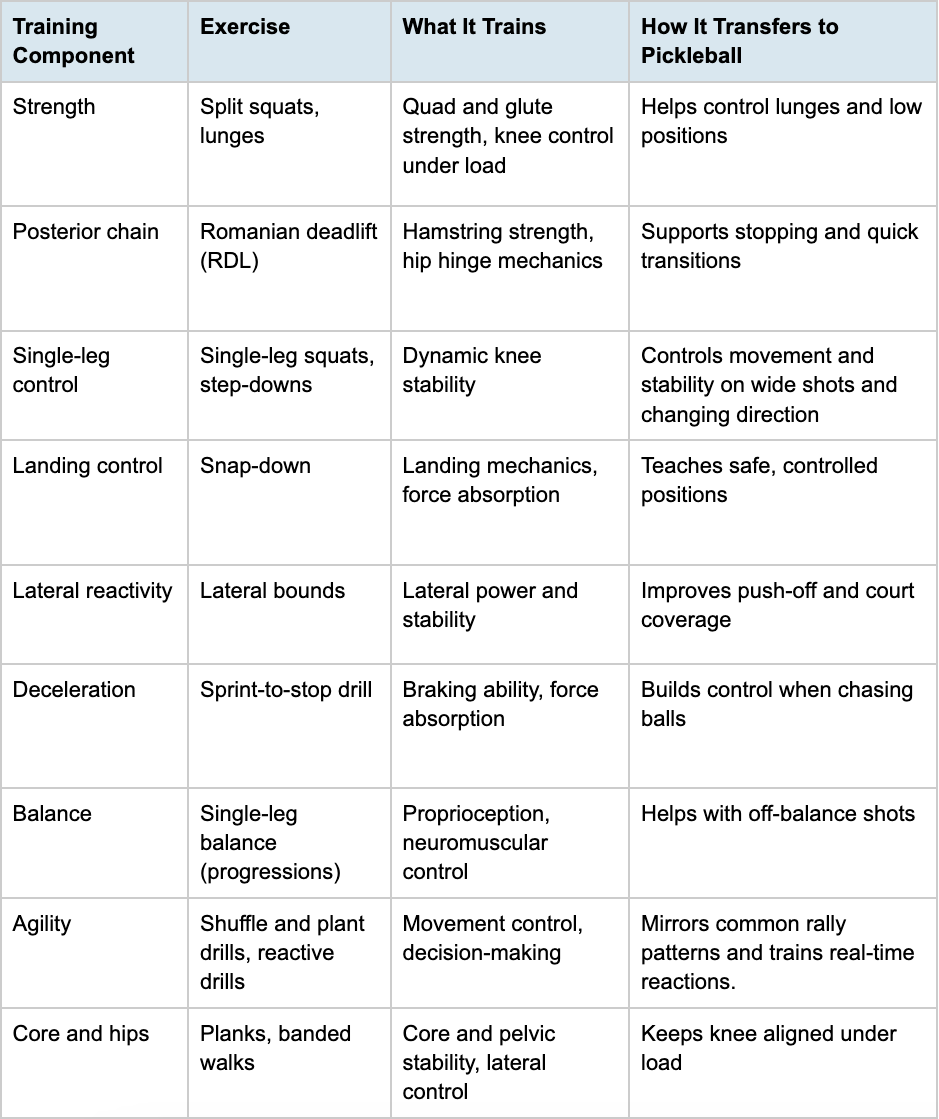
Your Knee-Injury Prevention Toolkit
Here’s how each training component maps directly to what happens on the court:
Build a Knee-Resilient Body Without Guessing What to Do
Reading the research is one thing. Putting it into practice consistently, week after week, is another. That's where most players fall off.
AIM7 closes the gap. We turn the science of injury prevention and performance into a daily plan you'll actually follow:
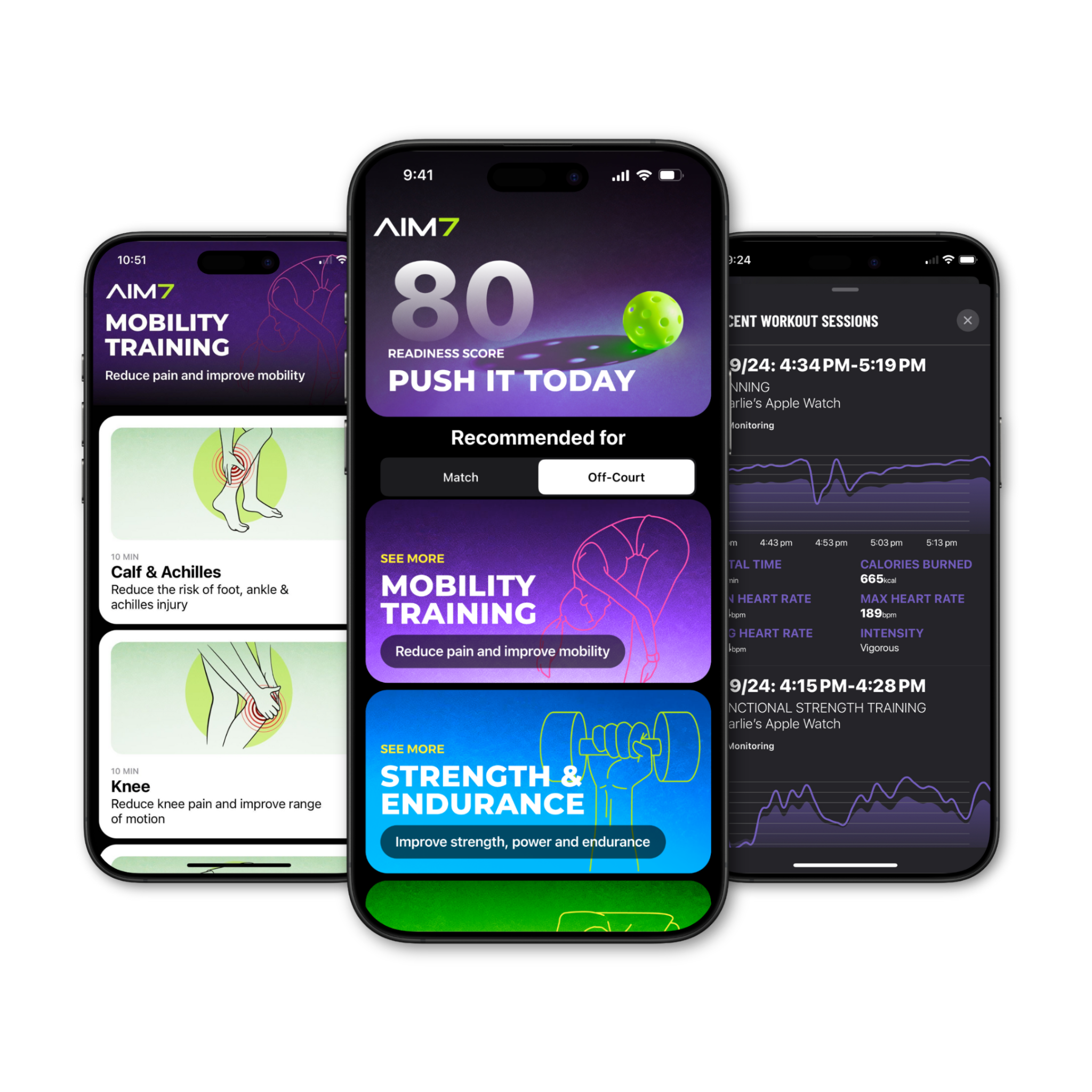
- Personalized pre-play warmup routines with video walkthroughs, designed around the lateral movement, deceleration, and reactive demands of pickleball — to prime your performance and help prevent injury before the first serve.
- Customized strength training programs tailored to your fitness history, time demands, and available equipment — so the program fits your life instead of fighting it.
- Mobility and recovery protocols built around what the research actually supports for injury prevention and on-court performance.
Whether you've got 15 minutes before a match or an hour for a full session, AIM7 meets you where you are and builds you into a more resilient, confident athlete on the court.
Use code DUPRVIP for free lifetime access — a $200 value. Click here to download.
Putting It Into Practice
Here’s the good news: injury prevention doesn’t require long or complicated training sessions. Research shows that short, consistent programs deliver real results (5).
A 10- to 15-minute pre-play routine that combines dynamic movement, strength, landing mechanics, and balance is enough to build the movement quality and physical capacity that pickleball demands. Over time, those sessions raise your ceiling for what your body can tolerate on the court.
Consistency is what compounds. Small, repeated doses of well-structured training add up to meaningful change.
The Bottom Line
Knee injuries don’t usually come out of nowhere. They build over time when the body isn’t prepared for the demands of the game.
When you build strength and improve control, you give yourself a much better chance of staying healthy and playing at a high level. These same qualities raise your performance ceiling so you’ll move more efficiently and stay sharp deep into competitive matches.
You don’t need long workouts or complicated routines. A consistent 10 to 15 minutes focused on the right things goes a long way.
Train smart, and you give yourself the best chance to stay on the court and keep improving.
References
1. Forrester MB. Pickleball-Related Injuries Treated in Emergency Departments. J Emerg Med. 2020;58(2):275-279. doi:10.1016/j.jemermed.2019.09.016
2. McMillan P, Lake LP, Burkhart A, Reddy E, Hale IC, Grawe BM. The Epidemiology of Pickleball Injuries Presenting to US Emergency Departments. Sports Health. Published online July 13, 2025. doi:10.1177/19417381251350671
3. Hewett TE, Myer GD, Ford KR, et al. Biomechanical measures of neuromuscular control and valgus loading of the knee predict anterior cruciate ligament injury risk in female athletes: a prospective study. Am J Sports Med. 2005;33(4):492-501. doi:10.1177/0363546504269591
4. Myer GD, Ford KR, Hewett TE. The effects of gender on quadriceps muscle activation strategies during a maneuver that mimics a high ACL injury risk position. J Electromyogr Kinesiol. 2005;15(2):181-189. doi:10.1016/j.jelekin.2004.08.006
5. Lauersen JB, Bertelsen DM, Andersen LB. The effectiveness of exercise interventions to prevent sports injuries: a systematic review and meta-analysis. Br J Sports Med. 2014;48(11):871-877.
6. Sugimoto D, Myer GD, McKeon JM, Hewett TE. Evaluation of the effectiveness of neuromuscular training to reduce anterior cruciate ligament injury in female athletes: a critical review of relative risk reduction and numbers-needed-to-treat analyses. Br J Sports Med. 2012;46(14):979-988. doi:10.1136/bjsports-2011-090895
7. Taylor JB, Waxman JP, Richter SJ, Shultz SJ. Evaluation of the effectiveness of anterior cruciate ligament injury prevention programme training components: a systematic review and meta-analysis. Br J Sports Med. 2015;49(2):79-87. doi:10.1136/bjsports-2013-092358
8. Aagaard P, Simonsen EB, Andersen JL, Magnusson P, Dyhre-Poulsen P. Increased rate of force development and neural drive of human skeletal muscle following resistance training. J Appl Physiol (1985). 2002;93(4):1318-1326. doi:10.1152/japplphysiol.00283.2002
9. Suchomel TJ, Nimphius S, Stone MH. The Importance of Muscular Strength in Athletic Performance. Sports Med. 2016;46(10):1419-1449. doi:10.1007/s40279-016-0486-0

.jpg)
.jpg)
.jpg)


