
Should I Stretch Before a Pickleball Match?
.jpg)
By Susie Reiner, PhD
What you’ll learn:
- Why the type and timing of stretching matter more than whether you stretch at all
- How static vs. dynamic stretching affects your speed, power, and reaction time differently
- What the research actually says about stretching and injury prevention
- A five-phase warm-up sequence built for pickleball performance
- A free tool to build your personalized warm-up routine — with video walkthroughs
If you’ve spent any time around courts or gyms, you’ve probably heard some version of the same advice: stretch before you play to avoid injury and perform better. It’s a common practice for years, and for a lot of athletes, it’s just part of the routine.
But when you actually look at the research, the picture is more nuanced.
Pickleball demands quick reactions, explosive accelerations, and repeated bursts of effort. Your muscles and tendons need to be primed and ready — not just loosened up. Whether stretching helps or hurts your preparation depends almost entirely on how and when you do it.
Here, you'll learn the safest, most effective way to use stretching in your pre-match routine without compromising your performance on the court.
Should you stretch before a pickleball match?
Most players are trying to solve a practical problem: how to feel ready, move well early in a match, and avoid feeling stiff or sluggish in the first few points.
Stretching can play a role in that — but the type and timing matter more than most players realize. Dynamic, movement-based warm-ups enhance performance, while static stretching has more limited benefits in the immediate pre-activity window (1).
Stretching is one tool in your preparation. Not the whole toolbox.
Is static or dynamic stretching better before playing pickleball?
Understanding the difference between these two approaches is the key to building a smart warm-up.
Static stretching involves holding a muscle in a lengthened position, typically for 30–90 seconds. It's effective for improving range of motion over time and works well in recovery or dedicated mobility sessions.
Dynamic stretching involves controlled, active movements through a range of motion — lunging, rotating, accelerating — patterns that closely resemble what you actually do on the court.
This distinction matters because the two approaches affect performance very differently. A widely cited review by Behm and Chaouachi found that dynamic stretching improves strength, power, and speed, while static stretching has been shown to reduce these qualities when performed immediately before activity (2). More recent meta-analyses support this, confirming that dynamic warm-ups produce better explosive performance outcomes than static protocols (3).
For a sport built on quick positioning and reactive movement, that difference is meaningful.
Does stretching before exercise reduce performance?
Performing static stretching does not universally impair performance, depending on how long stretches are held and whether they are followed by additional warm-up activity.
Across multiple systematic reviews:
- Longer-duration static stretching (greater than 60 seconds per muscle group) is associated with small reductions in strength and power (3)
- Shorter-duration stretching appears to have minimal impact when combined with dynamic movement (4)
The mechanisms are thought to involve changes in muscle-tendon stiffness and neural activation, which can influence how quickly force is produced (2).
In practice, static stretching isn't inherently harmful, but it's not sufficient on its own as a pre-match routine.
Does stretching prevent injuries in sports like pickleball?
Probably less than you think.
Stretching is often associated with injury prevention, but the evidence does not support static stretching as a standalone strategy for reducing injury risk.
A systematic review examining warm-up interventions found no clear evidence that stretching alone reduces injury incidence (5). More recent work examining dynamic stretching and injury outcomes suggests that injury risk is more strongly influenced by factors such as training load, conditioning, and fatigue rather than stretching itself (6).
What does appear to matter is overall preparation. Warm-ups that include progressive movement, activation, and sport-specific rehearsal improve readiness across multiple systems, potentially contributing to safer movement patterns (more detail on this below).
Why dynamic warm-ups improve performance before pickleball
Dynamic warm-ups prepare your body using the exact movement patterns the sport demands. They increase muscle temperature, enhance nerve conduction, and sharpen coordination — all of which support faster, more efficient movement.
Meta-analyses show that dynamic stretching improves sprint speed, jump performance, and overall power production compared to static stretching (3). There’s also evidence that dynamic protocols improve balance and movement control — especially valuable in a multi-directional sport like pickleball (7).
On the court, that translates to:
- Faster reactions to the ball
- More efficient movement between shots
- Better control during quick directional changes
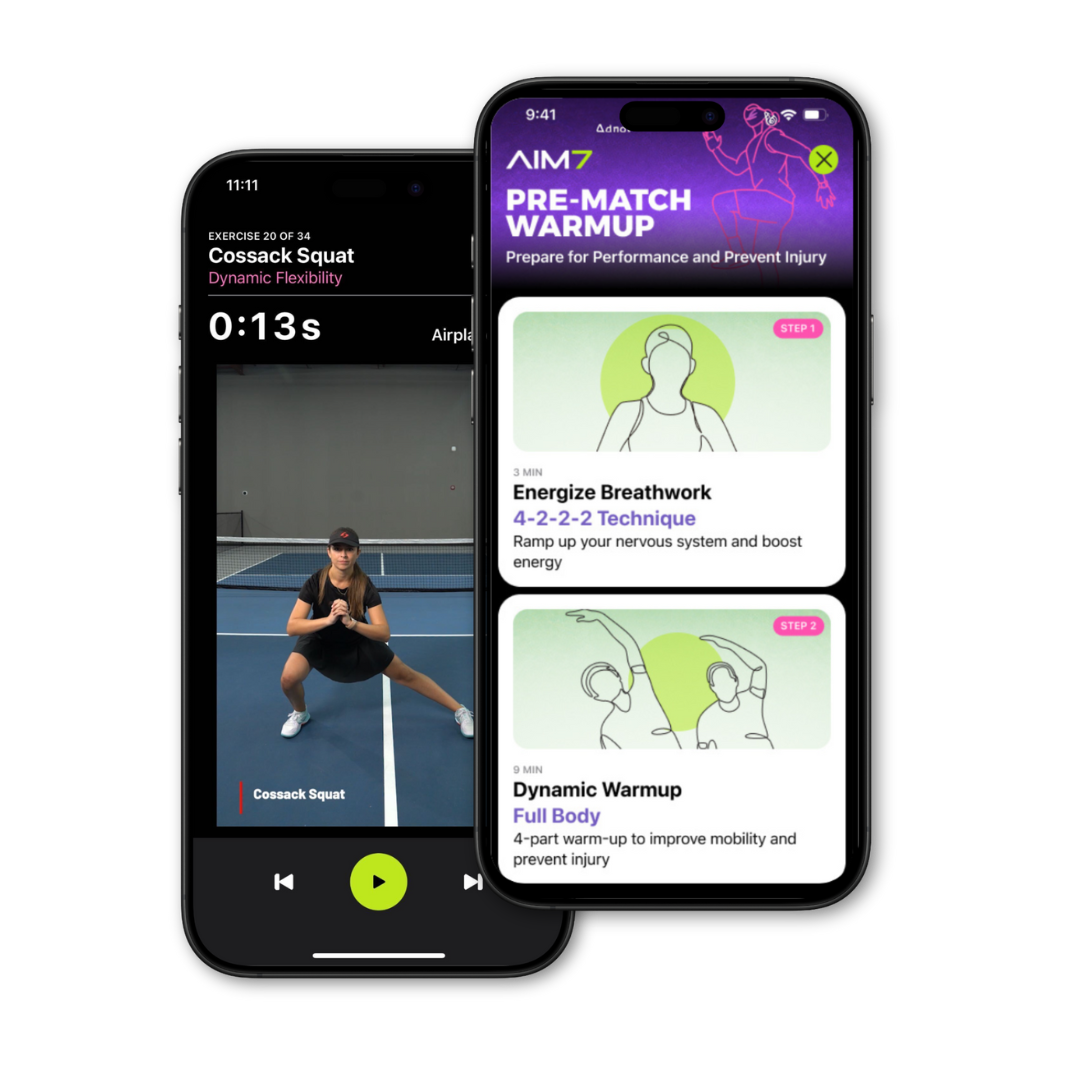
Don’t have a warmup routine? AIM7 gives you comprehensive, personalized warmups, stretching, and mobility routines — with easy video walkthroughs — built around your schedule and skill level. Use code DUPRVIP for free lifetime premium access. 📲 [Download AIM7 Free]
What is the best warm-up before a pickleball match?
An effective pickleball warm-up follows a simple sequence that mirrors how your body performs on court.
Heart Rate Elevation — Start with jumping jacks, skipping, or side-to-side shuffles for 3–5 minutes until you break a light sweat. This gradually raises your heart rate, breathing, and core temperature.
Mobilization — Move your joints through their full range of motion with arm circles, ankle rolls, knee circles, and 90/90 hip rotations. Aim for 5–15 reps per movement, increasing range with each rep.
Dynamic Flexibility — Focus on multi-joint movements like cossack squats, forward, lateral, and reverse lunge variations that challenge your hips, knees, and ankles together. If you’re short on time, prioritize the areas most prone to injury first.
Activation — Prime your nervous system with short bursts of speed or power under 10 seconds — snap downs, lateral bounds, or vertical fast pogos. This sharpens your neural response so you’re reacting from the very first point.
Sport-Specific Patterns — Finish with lateral shuffles, controlled stops, and split-step timing to rehearse the exact movements you’ll face in a match. This layered structure mirrors evidence-based neuromuscular warm-up programs shown to significantly reduce injury rates when performed consistently (4, 5, 6).
If you feel restricted in a specific area, a brief static stretch is fine — just follow it with dynamic movement before you step onto the court.
When should you use static stretching if you play pickleball?
Static stretching still has value — just not as your primary pre-match strategy.
It works well:
- After play, to improve flexibility or reduce perceived stiffness
- In separate mobility sessions targeting long-term range of motion limitations
- Before activity in very targeted situations, always followed by dynamic movement
This approach lets you build flexibility over time without compromising your readiness to perform.
Stop Winging Your Warm-Up
You now know the science behind effective preparation. The next step is actually having a routine you’ll use every time — one that’s built for you, not a generic checklist you found online.
AIM7 gives you personalized warmups, stretching, and mobility programs with easy video walkthroughs, so you always know exactly what to do before you step on the court. But that’s just the start. Inside AIM7, you’ll also find breathwork tools, mindfulness training, and mental performance coaching from world-leading sports psychologists — the same mental preparation strategies the best players use to stay sharp under pressure.
Add in strength and mobility training, post-match recovery protocols, and a private community of competitive players, and you have everything you need to train smarter in one place.
Right now, you can unlock lifetime free premium access — a $200 value — using code DUPRVIP.
📲 Download AIM7 Free — Use Code DUPRVIP
Enter DUPRVIP at download and lock in lifetime access free.
📲 Download AIM7 — Use Code DUPRVIP for Lifetime Premium Access
Bottom line: Should you stretch before playing pickleball?
You don’t need to perform static stretches to feel ready when you hit the pickleball court. A dynamic, movement-based warm-up can easily support performance and readiness. Static stretching is better suited for flexibility development and recovery, or for targeted use within warm-up.
So when you’re preparing to start playing, focus on a warm-up routine that primes your body for movement, not one that keeps you holding the same positions.
References
- McMillian, D. J., Moore, J. H., Hatler, B. S., & Taylor, D. C. (2006). Dynamic vs. static stretching warm-up: the effect on power and agility performance. Journal of strength and conditioning research, 20(3), 492–499. https://doi.org/10.1519/18205.1
- Behm, D. G., & Chaouachi, A. (2011). A review of the acute effects of static and dynamic stretching on performance. European journal of applied physiology, 111(11), 2633–2651. https://doi.org/10.1007/s00421-011-1879-2
- Li, F. Y., Guo, C. G., Li, H. S., Xu, H. R., & Sun, P. (2023). A systematic review and net meta-analysis of the effects of different warm-up methods on the acute effects of lower limb explosive strength. BMC sports science, medicine & rehabilitation, 15(1), 106. https://doi.org/10.1186/s13102-023-00703-6
- Esteban-García, P., Abián-Vicen, J., Sánchez-Infante, J., Ramírez-delaCruz, M., & Rubio-Arias, J. Á. (2024). Does the Inclusion of Static or Dynamic Stretching in the Warm-Up Routine Improve Jump Height and ROM in Physically Active Individuals? A Systematic Review with Meta-Analysis. Applied Sciences, 14(9), 3872. https://doi.org/10.3390/app14093872
- McCrary, J. M., Ackermann, B. J., & Halaki, M. (2015). A systematic review of the effects of upper body warm-up on performance and injury. British journal of sports medicine, 49(14), 935–942. https://doi.org/10.1136/bjsports-2014-094228
- Behm, D. G., Blazevich, A. J., Kay, A. D., & McHugh, M. (2016). Acute effects of muscle stretching on physical performance, range of motion, and injury incidence in healthy active individuals: a systematic review. Applied physiology, nutrition, and metabolism = Physiologie appliquee, nutrition et metabolisme, 41(1), 1–11. https://doi.org/10.1139/apnm-2015-0235
- Guo, W., Kim, Y., Wu, C., & Kim, S. (2025). A systematic review and meta-analysis of the impact of stretching techniques on balance performance. Annals of human biology, 52(1), 2500974. https://doi.org/10.1080/03014460.2025.2500974

OTHER TOP STORIES
Check out our other stories that may interest you
%20Clubs%20Insider-%20Visuals%20(1).jpg)

.jpg)


