DUPR career high rating: what it means and how to find it
Every player remembers their best stretch. The tournament where every drop landed, every reset held, and your rating hit a number you'd never seen before.
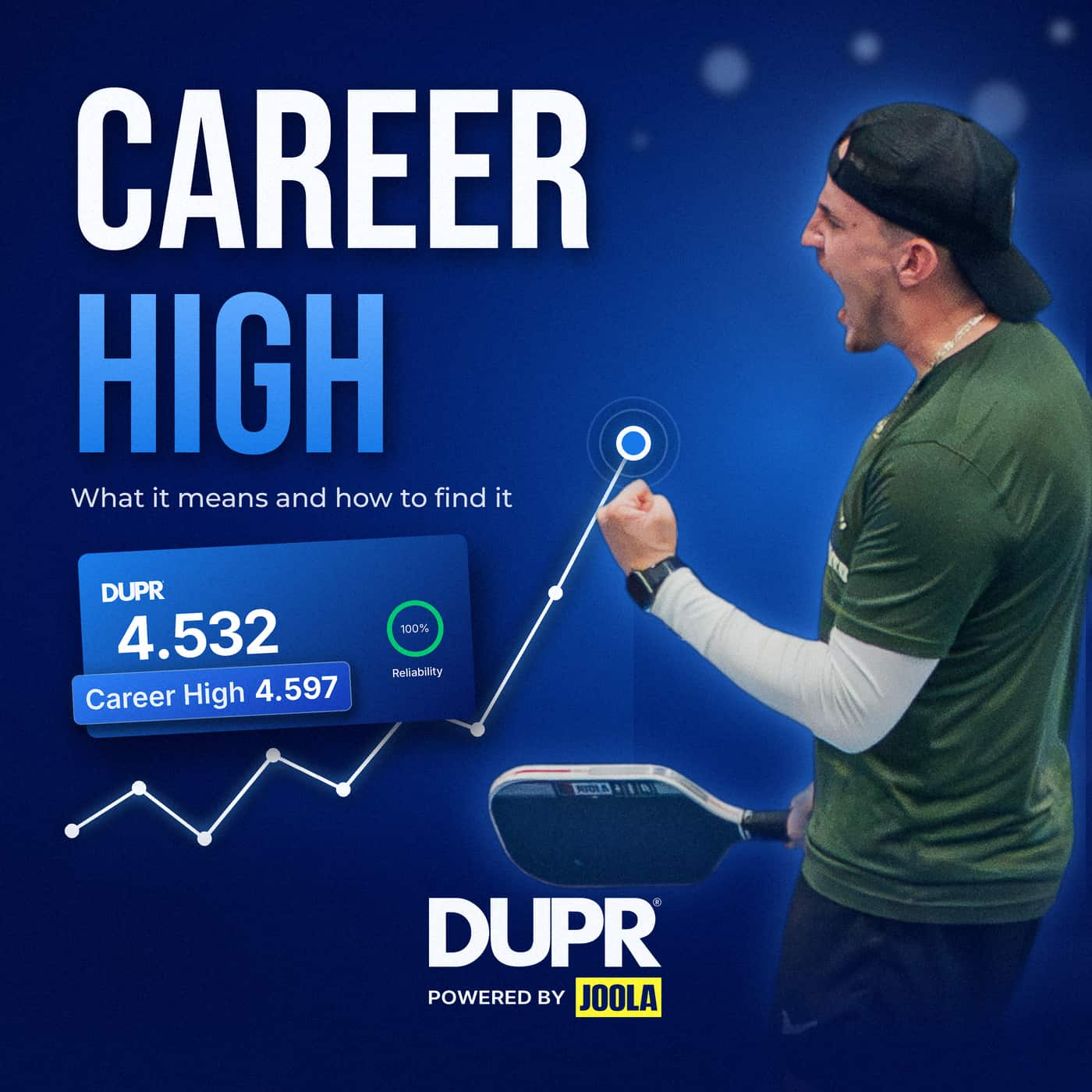
Your DUPR career high rating puts a number on that moment. It's the highest DUPR rating you've ever reached, saved on your profile even when your current rating moves. In this post, you'll learn what Career High tracks, why your current rating might sit below it, where to find it, and how to use it to set real goals.
What is a DUPR career high rating?
Your DUPR career high rating is the highest rating you’ve earned once your rating has had time to settle. Your first few matches, when your rating moves the most, don’t count toward it, so your Career High reflects a level you actually held. Your current DUPR can move with each verified match. Your Career High only changes when you set a new peak. Career high vs. your current DUPR rating.
These two numbers tell you different things.
- Current rating: where your game stands right now, based on your recent results
- Career high: the best level you've proven on the court at any point
Your current rating is the one that places you in brackets, matches you with partners, and shows up when other players search for you. Your Career High is context. It shows what you've already done and gives you a clear target to chase.
If you've ever looked at your rating after a rough weekend and thought, "But I was a 4.2 in the spring," your Career High is the proof.
Why your current rating can sit below your career high
Seeing your current rating below your Career High is normal. It doesn't mean you got worse at pickleball. Here's why it happens.
DUPR measures performance against expectation. Every match has an expected score based on the ratings involved. Win by less than expected, and your rating can dip, even on a win. A few close calls in a row can pull you below your peak.
Recent matches carry more weight. DUPR weighs your latest results more heavily than older ones. A hot streak can push you to a new Career High fast. A cold stretch can pull your current rating down just as quickly.
Life happens. Injuries, time off, a new partner, or a new paddle can all shift your results for a while.
The good news: the same system that moved you down will move you back up once your results improve. To see exactly how this works, read our breakdown of how your DUPR rating is calculated.
How to find your DUPR career high rating
Checking your Career High takes a few seconds.
- Open the DUPR app or log in at dupr.com
- Go to your player profile
- Find Career High in your stats, next to your current singles and doubles ratings
Not seeing it yet? You need verified matches on your profile first. If you're new to DUPR, log your first match to get rated.
How to use your career high to improve your game
Your Career High is more than a number to screenshot. Here's how to put it to work.
Set it as your next goal
If your current rating sits below your Career High, you already have a target. You've played at that level before, so you know it's within reach.
Already at your Career High? Set your next goal a little above it. Small jumps are easier to track and easier to celebrate.
Look back at your peak
Scroll through your match history around the time you hit your Career High. Ask yourself:
- Who were you playing with?
- What types of events were you entering?
- How often were you playing?
Patterns from your best stretch can show you what to repeat.
Play up and play rated events
Competing against higher-rated opponents is one of the fastest ways to raise your rating. You don't have to win. You just have to beat the expected score. Club and tournament matches also carry more weight than self-posted rec games, so they move your rating more.
Preview the stakes with DUPR Impact
Before your next match, use DUPR Impact in the Forecast tab to see how different scores would move your rating. It shows you exactly what you need to close the gap to your Career High.
Should you worry about your Career High?
No. Rating anxiety is real, and plenty of players feel it. But your Career High is a record of progress, not a test you have to keep passing.
Most players don't climb in a straight line. You'll hit a peak, dip, rebuild, and climb past it. That cycle is a normal part of getting better. The players who improve most are the ones who keep showing up, keep playing up, and keep logging matches.
Want deeper insights into your trends? DUPR+ adds Rating Trend, Clutch Record, and Upset Wins so you can see how you got to your peak.
Find your career high today
Your DUPR career high rating is proof of the best pickleball you've played so far, and a clear target for what's next. Open the DUPR app, check your Career High, and see how close you are to your next personal best. Not on DUPR yet? Create your free account and start building your rating.
Frequently asked questions
What is a DUPR career high rating?
It’s the highest DUPR rating you’ve reached after your first few verified matches. It stays on your profile even if your current rating goes down.
Is Career High free on DUPR?
Yes. Career High is one of the free insights on your DUPR profile. You don't need DUPR+ to see it.
Why is my current DUPR lower than my career high?
DUPR measures performance against expectation and weighs recent matches more heavily. A few results below expectation can lower your current rating without changing your Career High.
Does my career high ever go down?
No. Your Career High only changes when you reach a new peak rating.
Do I have separate career highs for singles and doubles?
Yes.
How can I beat my DUPR career high?
Play rated club and tournament matches, compete against higher-rated opponents, and play consistently. Use DUPR Impact to preview how each score would affect your rating.
What is a good DUPR rating?
It depends on your experience. DUPR ratings run from 2.000 to 8.000, and the best rating is the one that places you in competitive matches at your level.

OTHER TOP STORIES
Check out our other stories that may interest you