
How to master the pickleball transition zone in 3 steps: Richard Livornese
How to master the pickleball transition zone in 3 steps with pro pickleball player Richard Livornese
You hit a solid third, take a few steps forward, and a ball comes flying at your hip. You don't know whether to block it, duck it, or let it go. By the time you decide, the point is over.
The pickleball transition zone gives more players trouble than any other part of the court, from 3.0s to pros. The fix isn't more hand speed. It's a simpler map of the court. Below, we break down three keys from a pro-level coaching session: better footwork on your third shot, splitting the transition zone into two smaller zones, and knowing exactly what to do in each one. It's a simpler map of the court, from the baseline to the kitchen line.
Why the pickleball transition zone feels so hard
The transition zone is everything between the baseline and the kitchen line. It's where you move forward after your third shot, and where your opponents try to catch you.
The problem is decision overload. When you're stuck in the middle of the court, your opponent can hit at your feet or at your chest, and both balls might land in. You have to cover everything, so you end up covering nothing well.
The solution is to spend as little time as possible in that middle section. Before we get there, though, it starts with the shot that sends you forward.
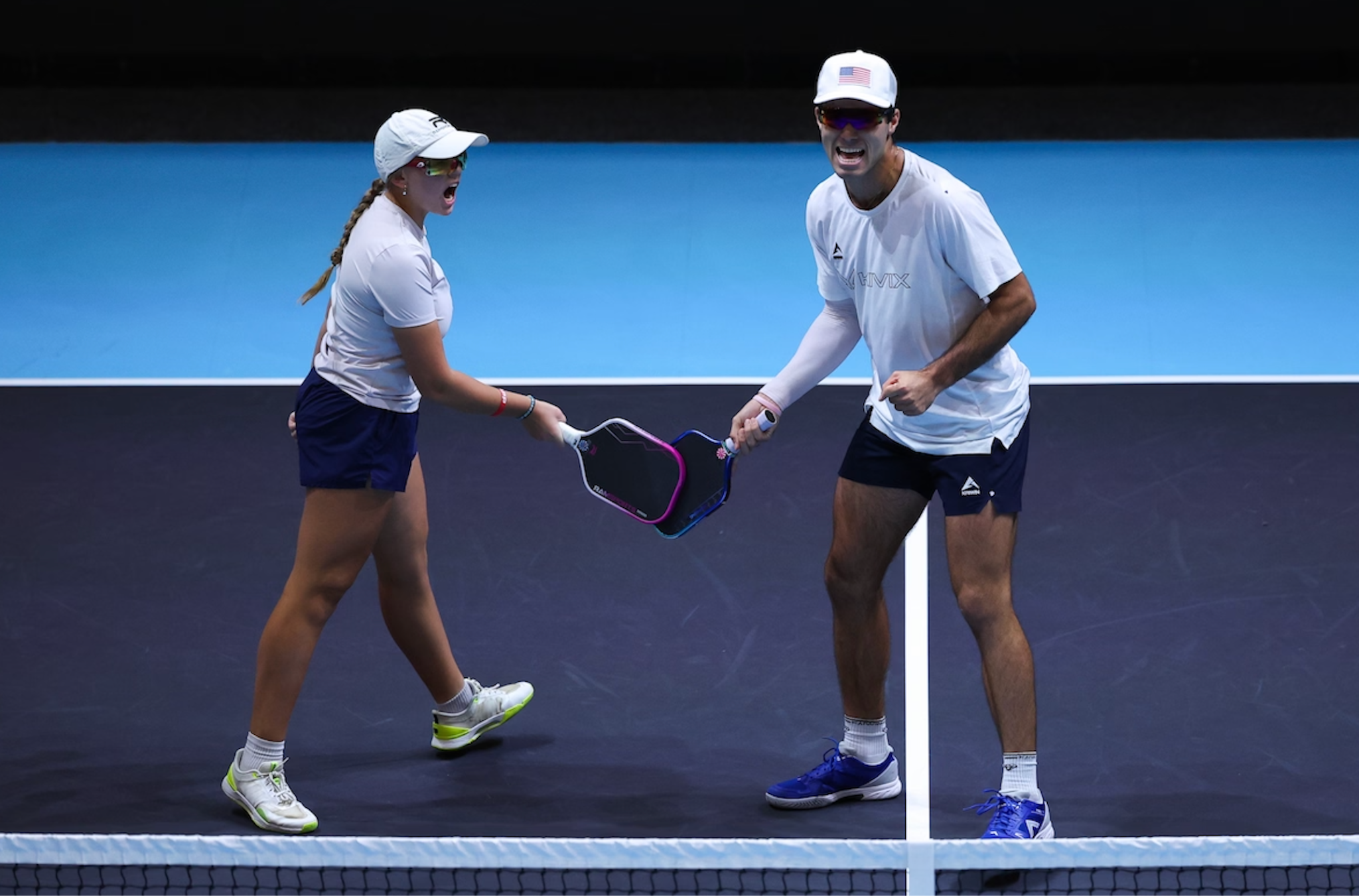
Step 1: Set up your third shot with better footwork
A good transition starts before you take a single step. Most third shot problems come from footwork, not the paddle.
Focus on three things:
- Give yourself space. Crowding the baseline puts you on your heels when the return comes deep. Start a little farther back so you can move into the ball instead of away from it.
- Get low and stay low. Keep your weight forward through contact, but don't jump through the shot. Popping up as you swing is one of the most common ways a good third turns into a floater.
- Use a long follow-through. A long swing doesn't mean a fast one. It means holding the ball on your paddle a little longer, which gives you more feel, more spin, and more control.
As the coach puts it, "Long and slow is a skill that you need to develop." A short, slappy stroke is hard to aim. A long stroke works whether you're slicing, rolling, or driving.
What about short returns?
Starting deeper raises an obvious question: what if the return lands short? That comes down to anticipation. Watch your opponent's swing on the return. If it looks slow, you know it won't reach the baseline, so take one step in right away. You're not sprinting forward, just adjusting early enough that short balls never catch you.

Step 2: Break the transition zone into T1 and T2
Here's the idea that simplifies everything. Picture the space from the baseline to the kitchen line as roughly six steps.
- T1: the first two steps inside the baseline
- No man's land: the middle two steps
- T2: the last two steps before the kitchen line
The goal is to hit your resets from T1 or T2 and move through the middle as quickly as possible. In no man's land, you have to cover high balls and low balls at full pace. In T1 and T2, you only have to cover one area. That cuts your decision-making in half.
Step 3: Know your job in each zone
T1 is the short hop zone
Back near the baseline, any ball above your belly button is going out. In fact, even a ball at your knees is usually out from here. So your paddle can start low and stay low.
Your job in T1 is simple: short hop everything. If the ball isn't bouncing at your feet, let it go.
After each short hop, you have four options based on how good your shot was:
- Great short hop: move all the way to the kitchen.
- Decent short hop (your opponent takes it below the net): move up to T2.
- So-so short hop: stay in T1 and defend until you get a better ball.
- Pop-up: take one step back and reset.
If you're getting pressured, you can also push the ball deep from T1. It won't win the point, but from this far back, your opponent has a hard time doing much with it. And if they drop you, you have plenty of time to come forward.
T2 is where your feet disappear
Once you're one to two steps off the kitchen line, the logic flips. Your opponent can still hit at your feet, but not with any pace. From that distance, a ball at your feet is basically a dink, and you have time to handle it.
That means your paddle sits high. Speed-ups in T2 almost always come above your waist, so you're ready to reset or counter. Many players favor the backhand here because it covers more of the body.
One-handed players tend to reset softer. Two-handed players often "bump" the ball back, like a rebound net, until a better ball shows up. Both work. And because you know the ball can't come fast at your feet, you can play offense too, countering anything that comes in high.
Why T2 beats rushing the line
It's tempting to sprint straight to the kitchen. But if you get there on a fast ball you weren't ready for, you have almost no time to reset. T2 gives you just enough space to react, while still taking the pace out of low balls. Next time you watch players from the top of the DUPR rankings, notice how often they pause in T2 before closing in.
Two drills to practice the transition zone
You don't need a complicated setup. Grab a partner and work on:
- T1 short hop drill: Stand one to two steps inside the baseline. Your partner feeds balls at your feet. Short hop every ball, and let anything above your knees go.
- T2 reset drill: Stand one step off the kitchen line. Your partner hits speed-ups and dinks. Keep your paddle high, reset the fast balls, and handle anything low with a soft block.
A few minutes of each, done regularly, will make your transition decisions automatic. If you're chasing the next level, pair these drills with our 5 pro tips to become a 5.0 player.
Turn better resets into better results
Mastering the pickleball transition zone comes down to three things: a low, balanced third shot, a clear plan for T1 and T2, and spending as little time as possible in no man's land. Once those become a habit, you'll win more points you used to give away. That matters for your rating too, since DUPR rewards how many points you score against expectation, not just wins. Learn more in How Is Your DUPR Calculated?. Then take your new transition game to a rated event near you and watch your DUPR respond.

%20(1).jpg)
)%20(1).jpg)
.jpg)


