
Why Sleep Is the Most Underrated Pickleball Strategy to Improve Your DUPR Rating: Track the Right Metrics to Stay Injury-Free and Compete at Your Highest Level
.jpg)
By: Susie Reiner, PhD
You've drilled your third-shot drop. You've worked on your dink consistency. You've even added a weekly strength session to protect your joints.
But there's one performance variable you are completely overlooking, and it might be the single biggest factor standing between where your DUPR is now and where it could be.
That variable is sleep.
Not just getting some sleep. The right amount, at the right time, with the right consistency.
The research is clear: players who prioritize sleep perform better on the metrics that directly drive their rating, stay healthier across a full season, and recover faster between matches.
Here's what the science says, and exactly what you should be tracking to boost performance.
Sleep Affects Your Skill, Not Just Your Energy
Most pickleball players think about sleep the same way they think about stretching: something nice to do after a hard session, but not really an essential tool. Sleep, however, has a profound effect on performance.
Think about the shots that cost you points in your last match.
The dink that floated up for a put-away. The reset that came off the edge of your paddle. The moment you second-guessed a speed-up and let a ball go. When you don’t get enough sleep, these mistakes get measurably worse.
In a landmark study of college basketball players, simply spending more time in bed each night led to faster sprint times, better shooting accuracy, and improved reaction time, with no changes to training at all (Mah et al., 2011). The effect was significant enough that sleep scientists started describing it as an "ergogenic supplement," meaning a legal, zero-cost performance booster (Bartkowska et al., 2026).
Tennis provides the most direct evidence of the impact of sleep on racquet sports.
When college tennis players extended their sleep to about nine hours per night for one week, their serving accuracy jumped from 35.7% to 41.8%, a nearly 18% improvement with zero additional court time (Schwartz & Simon, 2015). Conversely, when players were restricted to five hours in a single night, serving accuracy declined by 4x, and crosscourt groundstroke accuracy fell by up to 24% (Reyner & Horne, 2013; Vitale et al., 2021).
What breaks down is the precision and timing of how you use them.
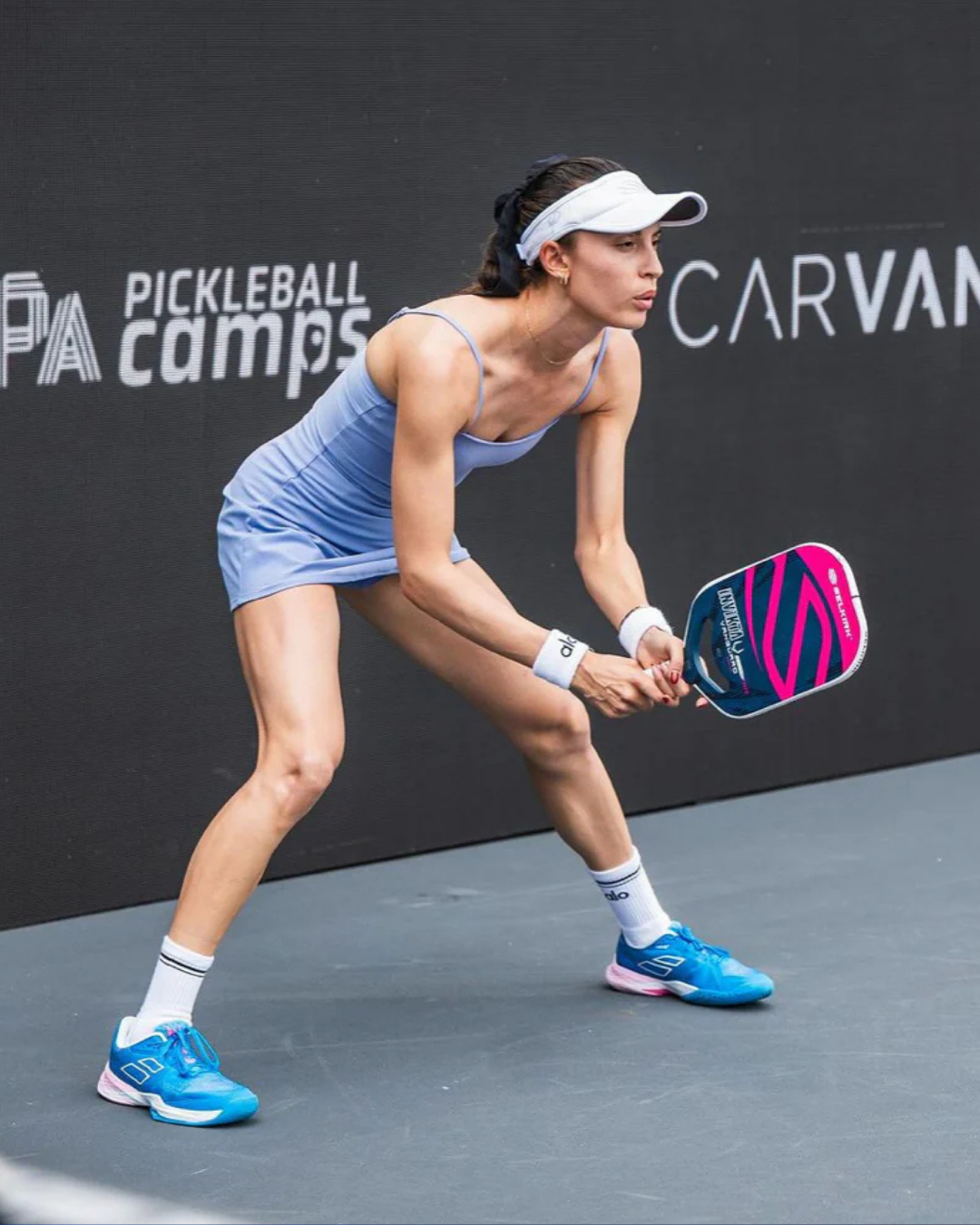
Pickleball is a game decided by shot quality, not just raw athleticism. Your DUPR rating is built on whether you hit the ball where you intend to, make smart decisions under pressure, and limit unforced errors when it counts. Sleep protects all of those things, and poor sleep quietly erodes them.
Fewer Hours Means More Injuries
Improved shot-making is a compelling reason to prioritize sleep. But the injury research on sleep might be the most important benefit for your long-term rating trajectory.
A 2026 systematic review analyzing 31 studies across diverse athlete populations found strong, consistent evidence that sleeping less than 8 hours per night is directly linked to higher injury rates (Bartkowska et al., 2026).
Here's what that looks like in practice:
- Athletes sleeping less than eight hours were 1.7 times more likely to get injured compared to those who slept eight or more hours (Milewski et al., 2014).
- Endurance athletes averaging less than seven hours per night had a 51% higher risk of a new injury in the two weeks that followed (O'Sullivan et al., 2021).
- Student-athletes with poor sleep quality had more than double the injury risk of those with good sleep quality, even when training load was the same (Owoeye et al., 2024).
- Professional soccer players who didn't get adequate sleep in the off-season were 5.64 times more likely to get injured once the competitive season started (Yabroudi et al., 2022).
Why does this happen?
During deep sleep, your body releases the hormones it needs to repair muscles, rebuild connective tissue, and strengthen bone (Bartkowska et al., 2026). Poor sleep also makes it harder for your body to control joint position and stabilize during quick movements, exactly the kind of movements pickleball demands: fast direction changes, low reaches at the kitchen line, and explosive lateral steps. On top of that, chronically poor sleep elevates cortisol, a stress hormone that breaks down tissue faster than your body can repair it (Bartkowska et al., 2026).
Every time you're injured, your DUPR stalls. Every match you miss is a match you can't win.
Building your rating over time requires staying on the court, and that requires treating sleep as a real part of your training, not an afterthought.
Why Going to Sleep and Waking Up at the Same Time May Change Your Game
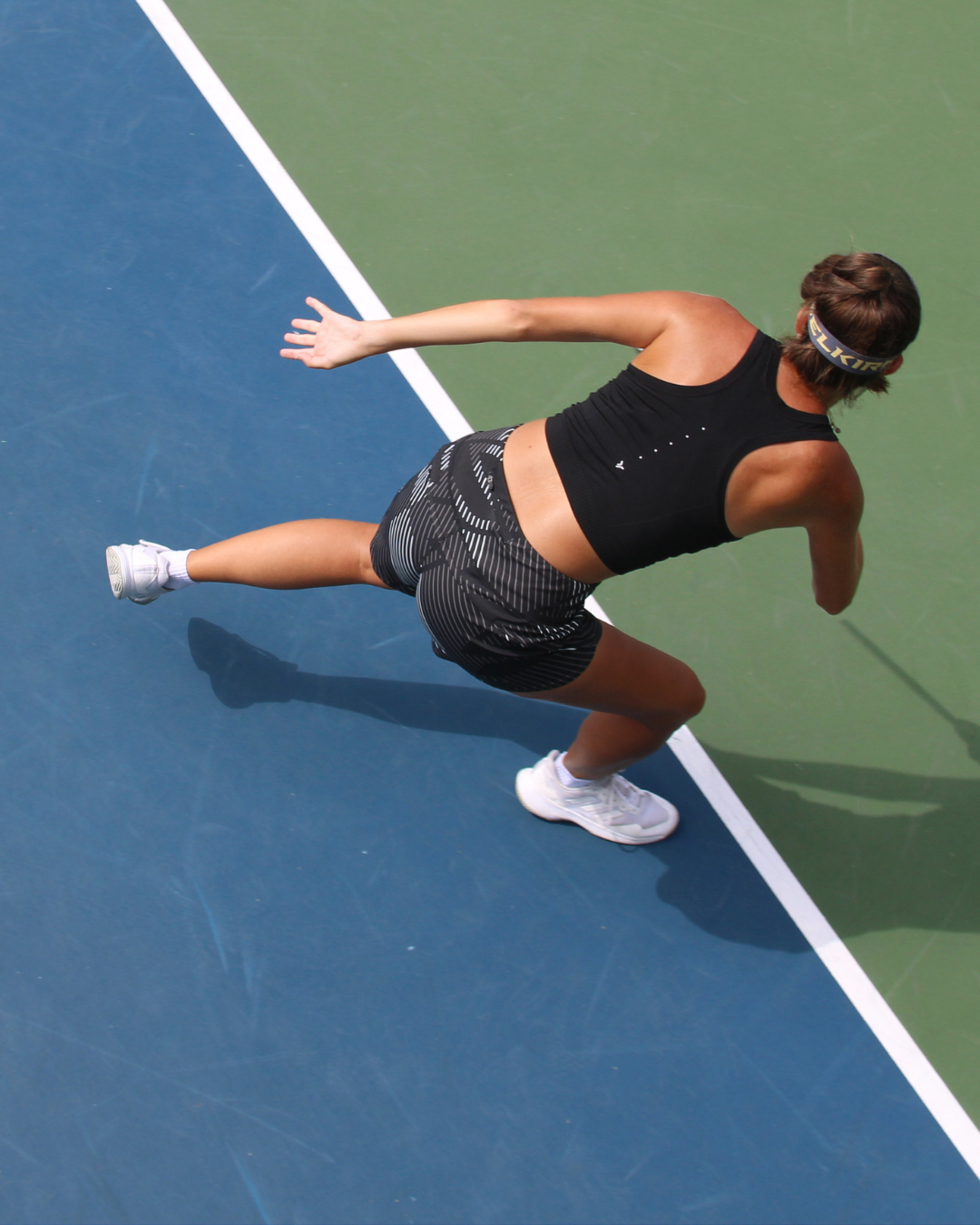
Several studies show that the consistency of your sleep schedule may matter more than how long you sleep.
In a 50-day study of college tennis players, average nightly sleep duration was not associated with serve accuracy. But the players whose sleep schedule was all over the place, seven hours one night, five hours the next, performed significantly worse than players who kept a consistent routine, even if that routine wasn't perfect (Han et al., 2022). The connection between erratic sleep and lower serve accuracy was strong.
A separate study with junior tennis players found that higher sleep fragmentation, meaning more tossing and turning and middle-of-the-night wake-ups, was more closely linked to match losses than total sleep time was (Turner et al., 2023). Interestingly, the night before a match, sleep continuity dropped by nearly 20% below baseline, suggesting that pre-competition nerves worsen sleep on the nights it matters most (Turner et al., 2023).
What does this mean for pickleball players?
Staying up late and getting up early during the week while sleeping in on weekends may be hurting your game. Your body's internal clock doesn't know the difference between a Tuesday rec session and a Saturday tournament. Inconsistent schedules chip away at sleep quality across the board, not just on the nights you go to bed late.
What Sleep Metrics to Track
Here are the four metrics worth paying attention to, and what each one means for your game:
1. How Many Hours You Sleep (Sleep Duration)
Target eight or more hours per night as your baseline, and nine or more in the week before a tournament. Sports injury research consistently identifies the 7- to 8-hour range as the threshold at which injury risk begins to climb and performance measurably declines (Bartkowska et al., 2026; Milewski et al., 2014; Schwartz & Simon, 2015). A basic sleep tracker, or even just noting your bedtime and wake time on your phone, is enough to start seeing the real picture.
2. Whether Your Schedule is Consistent (Sleep Consistency)
Look at your bedtimes and wake times across the whole week, including weekends. If they vary by more than an hour, your body's internal clock is constantly trying to recalibrate, similar to the way you feel after traveling across time zones, just without the flight. This is one of the easiest patterns to spot once you start tracking, and one of the most common causes of poor sleep quality, even when total hours look fine (Han et al., 2022).
AIM7's sleep coach does exactly this for you. It connects to your wearable, tracks your sleep duration, onset, consistency, and morning restedness, and delivers personalized recommendations based on your data — not a generic checklist. No guesswork. Just a clear picture of what your sleep is doing to your game.
DUPR players get a free lifetime premium membership (valued at over $200) using code DUPRVIP in the App Store.
3. How Rested You Feel When You Wake Up
In a study of 36 junior tennis players, how refreshed players felt in the morning predicted their reaction time performance better than raw hours of sleep did (Turner et al., 2022). A simple 1-to-10 restedness score when you wake up takes about five seconds and provides useful insight over time. Patterns across a week or two matter more than any single morning.
4. When You Go to Bed (Sleep Onset)
Yes, when you go to bed matters. Sleeping from 10 pm to 6 am is NOT the same as sleeping from 1 am to 9 am. The time of day you sleep can significantly impact the quality of your sleep and its benefits.
For pickleball players, this also connects directly to mood and mental readiness on the court: a robust study involving over 800,000 people in the UK Biobank found that going to bed earlier and waking up 1 hour earlier can reduce the risk of major depression by 23% (Daghlas et al., 2021). Shifting the midpoint of sleep 1 hour early decreased the risk of major depression by 23%, and another hour was about 40%.
The most likely reason for this finding is that early risers get more exposure to natural sunlight, which helps anchor their internal clocks and supports better mood regulation. When you feel mentally sharp and emotionally steady, you make better decisions under pressure, manage frustration between points more effectively, and stay focused deep into a long match.
The two weeks before a big tournament
One of the most specific findings in the research is that sleep deprivation in the 14 days before an injury shows the strongest connection to that injury, even stronger than the night immediately before (O'Sullivan et al., 2021). The two weeks leading into a major event are the highest-leverage window for protecting both your health and your performance. Don't just think about the night before. Build a runway.
A Sleep Playbook for Every DUPR Level
3.0 to 3.9: Start with Consistency
At the intermediate level, the single most impactful sleep change you can make is keeping a consistent schedule. Pick a bedtime and a wake time, and stick to them seven days a week, including weekends. Within two to three weeks, most people notice that it takes less time to fall asleep, they wake up less during the night, and they have more energy in the third game, when fatigue usually sets in.
Start tracking how much you're actually sleeping. The number will probably be lower than you think, and seeing it clearly is the first step to changing it.
4.0 to 4.9: Build a Pre-Tournament Protocol
Think about how you approach your training load the week before a tournament. Most competitive players ease off a bit to let their body arrive fresh. Sleep deserves the same deliberate planning.
One week before a major event, start moving your bedtime 15 to 30 minutes earlier and aim for nine or more hours in bed. Based on tennis research, even one week of this approach is associated with roughly a 6 percentage-point improvement in serving accuracy (Schwartz & Simon, 2015). In close 4.0+ matches, that kind of edge on your third shot or reset shows up in the score.
One more practical note: don't schedule your hardest drilling sessions the day after travel or a short night of sleep. Research shows that learning and refining new skills are among the first things to suffer when sleep is cut short (Vitale et al., 2021). Your conditioning drills can absorb a bad night. Skill work mostly can't.
5.0 and above: Track and Adjust in Real Time
At the high-performance level, daily monitoring of your sleep and readiness metrics becomes paramount. Leverage AIM7 to help you track key sleep metrics (duration, onset, consistency, and how you feel) alongside your pickleball training data and HRV (a measure of your nervous system recovery), providing daily recommendations and a personalized daily readiness score. Use the code DUPRVIP in the App Store to get a free lifetime premium membership for AIM7.
If your HRV has been suppressed and your sleep has been inconsistent for five or more days, that's a signal to pull back on high-intensity skill sessions and prioritize getting your sleep back before competing.
If you're regularly scheduled for evening matches, it's worth noting that research with competitive tennis players found that late-night match play led to more unforced errors and less court coverage than afternoon play, regardless of whether the player was naturally a morning or evening person (Turner et al., 2023). If you know you're playing late, gradually shifting your sleep schedule slightly later in the two to three days leading up to game time can help your body be better ready at game time.
Two Common Methods to Combat Poor Sleep
Caffeine. A randomized study tested whether 80 mg of caffeine, roughly the amount in a standard pre-workout, could offset the drop in serving accuracy from a single short night of sleep. It helped a little, but players were still about 3 times worse than when rested (Reyner & Horne, 2013). Caffeine is genuinely useful for alertness. It is not a fix for skill degradation from poor sleep.
Napping. A 20-minute nap in the early afternoon can meaningfully reduce fatigue, improve alertness, and help you feel more ready for afternoon play, especially over the course of a multi-day tournament (Lastella et al., 2021). Naps are a solid tool in the right context. They just work best as a supplement to solid nighttime sleep, not a replacement for it.
Simple Habits That Improve Your Sleep
Knowing you need more sleep is one thing. Actually getting it is another, especially when you're balancing training, work, family, and a packed tournament schedule. The good news is that a few consistent habits make a bigger difference than most people expect.
- Get outside in the morning: Your body has a built-in clock that runs on light. When you get natural light exposure in the first hour after waking, it kicks off a hormonal response that boosts energy and focus during the day, and also helps you fall asleep more easily that night. You don't need to be outside for long. Even 10 minutes on a cloudy morning is enough to anchor your internal rhythm. If you play early morning sessions, this is already working in your favor. If not, make it a habit to do so before you check your phone.
- Keep your bedroom cool, dark, and quiet: Your core body temperature naturally drops when you fall asleep, and a cool room helps that process along. Aim for somewhere between 60 and 67 degrees Fahrenheit. Blackout curtains or a sleep mask can make a surprising difference if there's ambient light in your room, and even small amounts of light during sleep can reduce the quality of your rest. White noise or earplugs help if your environment is inconsistent.
- Watch your caffeine timing: Caffeine has a half-life of about five hours in most people, which means if you have a coffee or pre-workout at 3 PM, half of that caffeine is still in your system at 8 PM. If you're sensitive to caffeine, it can noticeably affect how quickly you fall asleep and how deeply you sleep. A simple rule: try to cut off caffeine by early afternoon and see if your sleep improves.
- Go easy on alcohol the night before you play: A drink might help you feel relaxed and fall asleep faster, but alcohol disrupts the second half of your sleep cycle, leading to more wake-ups and lighter sleep overall. Research comparing different levels of alcohol consumption found that even moderate drinking decreased sleep quality by 24%, and higher amounts by nearly 40% (Pietila et al., 2018). Before a big match or tournament day, it's worth skipping it entirely.
- Build a wind-down routine: Your nervous system doesn't switch off the moment you climb into bed. If you go straight from a high-intensity match, a stressful work call, or scrolling your phone to trying to sleep, your body is still in "go" mode. Even a 20-minute routine helps: dimming the lights, putting the phone down, doing some light stretching, or breathing. It doesn't have to be elaborate. It just has to be consistent enough for your brain to start associating it with the transition to sleep.
- Try to go to bed at roughly the same time every night: This is the simplest and most impactful habit on this list. Your internal clock thrives on predictability. When you go to bed and wake up at consistent times, falling asleep becomes easier, sleep quality improves, and you wake up feeling more rested, even if the total hours stay the same. Pick a bedtime that lets you get eight or more hours before you need to be up, and protect it the same way you'd protect a training session.
Knowing what to track is one thing. Having a system that tracks it for you — and actually tells you what to do about it — is something else entirely.
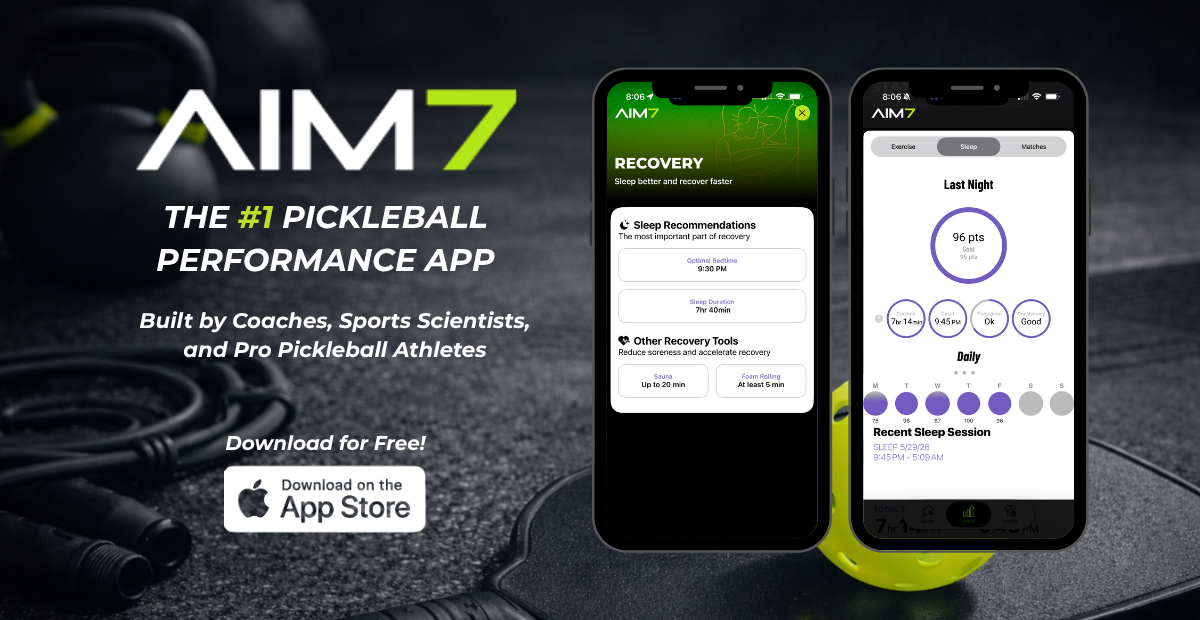
That's what AIM7 was built for.
AIM7's sleep coach connects to your wearable and monitors the four metrics that matter most for your performance: how long you sleep, when you go to bed, how consistent your schedule is, and how rested you actually feel. Based on that data, it delivers personalized sleep recommendations tailored to your body — not a one-size-fits-all protocol that ignores your schedule, your training load, or where you are in your season.
But sleep data doesn't exist in a vacuum.
AIM7 combines your sleep and recovery metrics to generate a personalized daily readiness score — a single number that tells you how hard to push in training, when to dial it back, and when your body is primed to perform. It then builds your on- and off-court training around that score, so your strength work, mobility sessions, and recovery protocols are always matched to what your body can actually handle that day.
As a member of the DUPR community, you can get a free lifetime premium membership to AIM7 — a $200+ value — completely free. Use code DUPRVIP in the App Store.
The Bottom Line
Your DUPR rating is built point by point. It goes up when you execute well under pressure and down when small errors stack up over the course of a match. Sleep is one of the most direct levers for controlling how well you execute, how quickly you recover between matches, and how long you stay healthy enough to keep competing.
The research in tennis and across sports is consistent: even one rough night can erode the shot-making precision that decides competitive points. A week of better sleep can measurably improve it.
Start tracking your sleep with the same intention as your training, and give yourself a real advantage that most of your opponents are completely ignoring.
References
Bartkowska, O., Banatkiewicz, J., Deka, E., Dominczak, J., Czarnecka, S., Luczynska, G. E., Dobosz, A., Wojnowski, A., Babik, K., & Bojanowska, H. M. (2026). Sleep as an 'ergogenic supplement': The role of sleep quality, duration and patterns in preventing sports injuries: A systematic review. Journal of Education, Health and Sport, 89, 69824. https://doi.org/10.12775/JEHS.2026.89.69824
Daghlas, I., Lane, J. M., Saxena, R., & Vetter, C. (2021). Genetically proxied diurnal preference, sleep timing, and risk of major depressive disorder. JAMA Psychiatry, 78(8), 903–910. https://doi.org/10.1001/jamapsychiatry.2021.0959
Han, T., Wang, W., Kuroda, Y., & Mizuno, M. (2022). The relationships of sleep duration and inconsistency with the athletic performance of collegiate soft tennis players. Frontiers in Psychology, 13, 791805. https://doi.org/10.3389/fpsyg.2022.791805
Lastella, M., Halson, S. L., Vitale, J. A., Memon, A. R., & Vincent, G. E. (2021). To nap or not to nap? A systematic review evaluating napping behavior in athletes and the impact on various measures of athletic performance. Nature and Science of Sleep, 13, 841-862. https://doi.org/10.2147/NSS.S315556
Mah, C. D., Mah, K. E., Kezirian, E. J., & Dement, W. C. (2011). The effects of sleep extension on the athletic performance of collegiate basketball players. Sleep, 34(7), 943-950. https://doi.org/10.5665/SLEEP.1132
Milewski, M. D., Skaggs, D. L., Bishop, G. A., Pace, J. L., Ibrahim, D. A., Wren, T. A., & Barzdukas, A. (2014). Chronic lack of sleep is associated with increased sports injuries in adolescent athletes. Journal of Pediatric Orthopaedics, 34(2), 129-133. https://doi.org/10.1097/BPO.0000000000000151
O'Sullivan, K., Johnston, R., Cahalan, R., et al. (2021). Sleep and general health predict higher injury rates in endurance athletes: A prospective study. British Journal of Sports Medicine, 55(Suppl 1), A24.1. https://doi.org/10.1136/bjsports-2021-IOC.54
Owoeye, O. B. A., Palacios-Derflingher, L., & Emery, C. A. (2024). Snooze it or lose it: Understanding sleep disturbance and injuries in soccer and basketball student-athletes. Clinical Journal of Sport Medicine, 34(6), 610-614. https://doi.org/10.1097/jsm.0000000000001250
Pietila, J., Heliste, M., Kaisti, M., Numminen, H., & Tuomilehto, H. (2018). Acute effect of alcohol intake on cardiovascular autonomic regulation during the first hours of sleep in a large real-world sample of Finnish employees: Observational study. JMIR Mental Health, 5(1), e9519. https://doi.org/10.2196/mental.9519
Plews, D. J., Laursen, P. B., Stanley, J., Buchheit, M., & Kilding, A. E. (2013). Training adaptation and heart rate variability in elite endurance athletes: Opening the door to effective monitoring. Sports Medicine, 43(9), 773-781. https://doi.org/10.1007/s40279-013-0071-8
Reyner, L. A., & Horne, J. A. (2013). Sleep restriction and serving accuracy in performance tennis players, and effects of caffeine. Physiology & Behavior, 120, 93-96. https://doi.org/10.1016/j.physbeh.2013.07.002
Schwartz, J., & Simon, R. D., Jr. (2015). Sleep extension improves serving accuracy: A study with college varsity tennis players. Physiology & Behavior, 151, 541-544. https://doi.org/10.1016/j.physbeh.2015.08.035
Turner, M., Beranek, P., Dunican, I. C., & Cruickshank, T. (2023). The impact of sleep-wake behaviour on tennis match performance in junior state grade tennis players. Journal of Science in Sport and Exercise, 5(2), 156-166. https://doi.org/10.1007/s42978-022-00177-x
Turner, M., Beranek, P., Sahrom, S., Lo, J., Ferrauti, A., Dunican, I. C., & Cruickshank, T. (2023). The impact of sleep behaviours, chronotype and time of match on the internal and external outcomes of a tennis match. International Journal of Sports Science & Coaching, 18(6), 2057-2068. https://doi.org/10.1177/17479541221130443
Turner, M., Lo, J., Beranek, P., Dunican, I. C., & Cruickshank, T. (2022). The influence of self-reported total sleep time and sleep quality on physical performance in junior tennis players. International Journal of Racket Sports Science, 4(1), 32-40. https://doi.org/10.30827/Digibug.77269
Vitale, J. A., Bonato, M., Petrucci, L., Zucca, G., La Torre, A., & Banfi, G. (2021). Acute sleep restriction affects sport-specific but not athletic performance in junior tennis players. International Journal of Sports Physiology and Performance, 16(8), 1154-1159. https://doi.org/10.1123/ijspp.2020-0390
Yabroudi, M. A., Nawasreh, Z. H., Debes, W. A., Al-Sharman, A. J., Darwish, A. A., Samaneh, H. A., et al. (2022). The influence of sleep quality and quantity on soccer injuries in professional teams. Journal of Sports Medicine and Physical Fitness, 62(10), 1375-1382. https://doi.org/10.23736/s0022-4707.21.13016-6

.jpg)
%20(1).jpg)
%20(1).jpg)


