
Why You Can't Stop Playing Pickleball — And Why That's Actually Good for You
.jpg)
By Susie Reiner, PhD
Physical health is often what we think of first when we talk about longevity: heart health, strength, and endurance. Pickleball delivers on all of those fronts. But research increasingly shows that another factor, one built right into the way pickleball is played, is also crucial to long-term health: social connection.
There is something energizing about walking onto a court, greeting familiar faces, tapping paddles, and settling into a game where effort and enjoyment are shared. Between rallies, there are quick conversations, laughter after missed shots, and encouragement after long points. Over time, those small moments add up to real relationships. That sense of connection may be one of the most overlooked pieces of health, and one of the most powerful.
In this article, we will explore why the social fabric of pickleball is more than a bonus feature of the sport. It may be a central reason why players stay engaged, feel better, and build habits that support long-term health.
Social Connection Is a Health Advantage
Studies across large populations have found that people with stronger social connections tend to live longer and have lower risks of chronic disease than those who are socially isolated (7). Loneliness and social isolation have even been linked with increased risk for cardiovascular disease and cognitive decline (8, 3). In other words, the people you interact with and the strength of your social ties can influence health outcomes in ways that are comparable to lifestyle and biological risk factors.
This does not mean that friendships alone make you healthier, but rather that consistent, meaningful interaction helps support stress regulation, emotional resilience, and healthy behavior patterns. Pickleball creates that connection by design: court rotations, doubles play, shared drills, and post-game conversations bring players together repeatedly and reliably.
Why Pickleball Is “Sticky”: The Motivation Science
Unlike solo workouts, where you can “tune out,” pickleball requires engagement. Doubles play demands communication and coordination with a partner. Rotational open play brings you face-to-face with people of different ages, backgrounds, and skill levels. The courts are close, points are quick, and there’s almost always a social moment between games.
This setup is not accidental. The structure of the sport fosters short bursts of shared focus followed by interaction. You celebrate points, laugh off errors, and find yourself talking about shots, strategies, and life beyond the court. Over time, those repeated interactions strengthen a sense of community.
Pickleball’s Social Environment Boosts Motivation
There is a reason why you start planning your next pickleball match as the current one winds down. Research in motivation science helps explain why the social aspect of pickleball matters for long-term engagement. According to Self-Determination Theory, sustained participation in any activity depends on fulfilling three psychological needs: autonomy, competence, and relatedness (6).
Pickleball satisfies all three: you typically choose when to play, you see measurable improvement on the court, and you interact meaningfully with others.
Of these, relatedness—feeling connected and part of a group—is one of the strongest predictors of intrinsic motivation (11, 9). When players feel socially supported and connected within the sport, they are more likely to return to the court not because they feel they have to, but because they want to. That shift from obligation to intrinsic motivation is what keeps many players coming back year after year.
Playing With Others Improves Consistency
Consistency is central to health benefits. Group-based and socially embedded physical activity programs generally show higher long-term participation than solitary exercise routines (5, 2). Pickleball’s social environment creates accountability: it’s easier to show up when someone is expecting you, and you’re less likely to skip a session when your group is counting on you.
Enjoyment also matters. Positive emotions experienced during social play are linked with future participation (10). Players often talk about how much fun they have with teammates and opponents alike, and that fun, combined with fitness, creates a powerful incentive to come back.
Quality of Life Beyond Metrics
Regular participation in socially engaging physical activity is associated with improved psychological well-being, lower depressive symptoms, and greater life satisfaction (8, 3).
Players often describe:
- Having somewhere to go regularly
- Seeing familiar faces
- Friendly competition
- Post-game conversations
- Intergenerational interaction
These elements support identity and purpose. Purpose itself has been associated with reduced mortality risk and improved resilience (1). For many players, pickleball becomes part of who they are. That identity reinforces continued participation.
Social Interaction Supports Physiological Health Too
Social interactions affect more than mood and motivation; they also influence biological systems related to stress and inflammation. Long-term loneliness has been associated with dysregulated stress responses and elevated markers of inflammation (4, 12). By contrast, supportive social environments are associated with better cardiovascular regulation and stress buffering.
When moderate-intensity physical activity like pickleball is paired with supportive social engagement, multiple pathways known to influence long-term health are activated simultaneously: improved heart health, enhanced mood, better stress management, and continued behavioral engagement.
Prove You're the Most Committed Player in Your Group
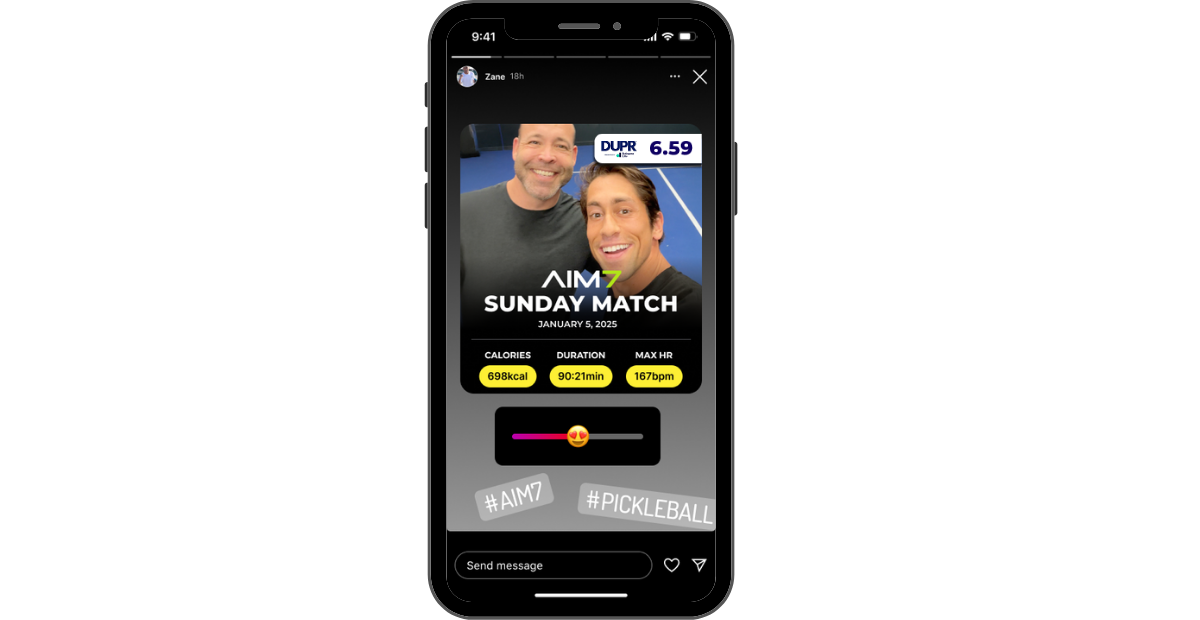
AIM7 tracks your game and lets you share the receipts — your DUPR rating, calories burned, time on court, and a photo — all in one shareable card your crew will actually want to see.
Post your session. Watch your group chat explode.
Think your doubles partner trains harder than you? Now there's proof either way.
Download AIM7, and enter the code DUPRVIP for lifetime free premium access — and start sharing your first session today.
Because the research is clear: players who stay connected to a community, stay on the court the longest. Be that player. Bring your people with you.
What This Means for Pickleball Players
If you’re thinking about your long-term health, embrace both sides of pickleball: physical and social. Prioritize consistent play with groups, rotate partners, join local leagues or clubs, and engage in social outings centered around the sport.
Competitive goals, including improving your DUPR rating and skill development, are important—but so is the community that supports them.
Pickleball’s growth reflects more than a desire for physical activity; it reflects the human need for connection, challenge, and shared experience. When physical movement is enjoyable and social, participation becomes sustainable.
The Bottom Line
Pickleball strengthens your cardiovascular system, develops coordination and agility, and sharpens tactical thinking. At the same time, it keeps you connected to a community in a consistent, meaningful way. That combination may be one of its greatest advantages for long-term health and well-being.
Health is shaped by behaviors that are repeated over years, and pickleball encourages you to return to the court—for the rally and the relationships. That may be one of the most powerful longevity advantages the sport offers.
References
- Alimujiang, A., Wiensch, A., Boss, J., Fleischer, N. L., Mondul, A. M., McLean, K., & Mukherjee, B. (2019). Association between life purpose and mortality among US adults older than 50 years. JAMA Network Open, 2(5), e194270. https://doi.org/10.1001/jamanetworkopen.2019.4270
- Burke, S. M., Carron, A. V., & Eys, M. A. (2006). Physical activity context and social influence. International Review of Sport and Exercise Psychology, 1(1), 87–103. https://doi.org/10.1080/17509840701827437
- Cacioppo, J.T., & Cacioppo, S. (2018). Loneliness in the Modern Age: An Evolutionary Theory of Loneliness (ETL). doi:10.1016/BS.AESP.2018.03.003
- Cacioppo, J. T., & Hawkley, L. C. (2009). Perceived social isolation and cognition. Trends in Cognitive Sciences, 13(10), 447–454. https://doi.org/10.1016/j.tics.2009.06.005
- Carron, A. V., Hausenblas, H. A., & Mack, D. (1996). Social influence and exercise adherence. Journal of Sport & Exercise Psychology, 18(1), 1–16. https://doi.org/10.1123/jsep.18.1.1
- Deci, E. L., & Ryan, R. M. (2000). The “what” and “why” of goal pursuits: Human needs and the self-determination of behavior. Psychological Inquiry, 11(4), 227–268. https://doi.org/10.1207/S15327965PLI1104_01
- Holt-Lunstad, J., Smith, T. B., & Layton, J. B. (2010). Social relationships and mortality risk: A meta-analytic review. PLoS Medicine, 7(7), e1000316. https://doi.org/10.1371/journal.pmed.1000316
- Holt-Lunstad, J., Smith, T. B., Baker, M., Harris, T., & Stephenson, D. (2015). Loneliness and social isolation as risk factors for mortality: A meta-analytic review. Perspectives on Psychological Science, 10(2), 227–237. https://doi.org/10.1177/1745691614568352
- Ntoumanis, N., Ng, J. Y. Y., Prestwich, A., Quested, E., Hancox, J., Thøgersen-Ntoumani, C., … Williams, G. C. (2021). A meta-analysis of need-supportive interventions in health contexts. Health Psychology Review, 15(2), 214–244. https://doi.org/10.1080/17437199.2020.1718529
- Rhodes, R. E., & Kates, A. (2015). Can the affective response to exercise predict future motives and physical activity behavior? Annals of Behavioral Medicine, 49(5), 715–732. https://doi.org/10.1007/s12160-015-9704-5
- Teixeira, P. J., Carraça, E. V., Markland, D., Silva, M. N., & Ryan, R. M. (2012). Exercise, physical activity, and self-determination theory: A systematic review. International Journal of Behavioral Nutrition and Physical Activity, 9, 78. https://doi.org/10.1186/1479-5868-9-78
- Uchino, B. N. (2006). Social support and health: A review of physiological processes potentially underlying links to disease outcomes. Journal of Behavioral Medicine, 29(4), 377–387. https://doi.org/10.1007/s10865-006-9056-5

OTHER TOP STORIES
Check out our other stories that may interest you
%20(2).jpg)

%20(1).jpg)


