No matching results.
Search results
November 4, 2026
Top 5 ways to improve your DUPR rating, ranked by impact
Your DUPR has been sitting at 3.5 for two months. You play three times a week, you bought a new paddle, and the number won't budge.
We ranked five ways to improve your DUPR rating, starting with the one that matters least and ending with the one we think matters most. Here's how each one helps your game and ultimately your rating.
What actually moves your DUPR rating
DUPR measures how you perform against expectation, based on everyone's ratings on the court. Score more points than expected and your rating can rise, even in a loss. Underperform and it can drop, even in a win.
Club and tournament results also carry more weight than self-posted rec games, while recent matches count more than older ones.
5. New gear
The right paddle can improve comfort, control, and confidence. But it won't fix a bad third shot drop or dinks that keep finding the net.
Upgrade when your paddle is worn out or doesn't suit your game, not because you're chasing a higher rating.
Not sure what to buy? Check out our top 10 pickleball paddle recommendations, backed by independent reviewer John Kew's testing data. Eligible DUPR+ members can also use their $30 JOOLA gift card toward an upgrade.
4. Watch the pros live
Watching professional pickleball in person shows you what highlight reels miss: positioning, resets, and how partners move together.
Focus on one player for a few games. Watch their third shot choices, positioning when receiving, and how they recover after getting pushed back into transition.
PPA Tour and Major League Pickleball matches are great places to observe. Then bring one technique into your next practice session.
For ideas worth trying, check out Ashley Griffith's four pickleball tips.
3. Play regular open play
Open play gives you more reps, different opponents, and opportunities to improve without tournament pressure.
Playing the same foursome every week teaches you their tendencies. Rotating opponents exposes you to different speeds, spins, and strategies, preparing you for competitive matches.
Log eligible games in DUPR when possible. Self-posted rec games count, although they carry less weight than verified club or tournament results.
DUPR also recommends recording at least 10–15 matches before fully trusting your rating. Want to see where you stand? Explore our DUPR rating percentiles breakdown.
2. Play official matches and tournaments
Tournament pressure reveals weaknesses that recreational games might hide. That backhand you get away with in open play becomes a problem at 9-9 with a medal on the line.
Verified club and tournament results also carry more weight in DUPR, making strong performances particularly valuable.
Before competing, use Forecast in the DUPR app to see whether you're favored or the underdog. DUPR Impact also shows how different scorelines could affect your rating.
The takeaway? Every point matters, not just winning.
1. Get a coach
A coach identifies problems you might not notice, whether it's kitchen-line footwork, an inconsistent third shot drop, or poor decisions in transition.
That's why coaching takes our top spot. Gear, watching pros, open play, and tournaments offer equipment, knowledge, repetitions, and experience. A coach helps you turn all of those into a focused improvement plan.
Use the DUPR Coach directory to find qualified coaches near you.
Don't have a rating yet? A credentialed DUPR Coach can provide a Coach-Assigned DUPR Rating through an assessment, giving eligible unrated players a starting point.
Eligible DUPR+ members in the US and Canada may also choose a coaching lesson at a participating location instead of their $20 Club Cash benefit.
Where to start if you want to improve your DUPR rating
All five approaches have value, but coaching, rated competition, and consistent practice give you the strongest opportunities to turn improvement into results.
This week, choose one: find a coach, register for a rated event, or log your next open play session through DUPR.
Track your progress over several matches, not just one. Want to understand why your number changes? Read how your DUPR rating is calculated.
Have another tip? Share it with the DUPR community on Instagram.
Frequently asked questions
What is the fastest way to improve your DUPR rating?
Improve your weaknesses through practice or coaching, then apply those skills in rated matches. Performing above expectations, especially in verified competition, can raise your rating.
Why did my DUPR go down after a win?
DUPR measures performance against expectations. If you were expected to win 11-3 but won 11-8, your rating can decrease because you scored fewer points than expected.
Do rec games count toward my DUPR rating?
Yes. Eligible self-posted recreational games count, although verified club and tournament results generally carry more weight.
How many matches do I need for an accurate DUPR rating?
DUPR recommends at least 10–15 recorded matches before fully trusting your rating. More results generally improve its reliability.
Can a DUPR Coach change my rating?
Credentialed coaches can provide Coach-Assigned DUPR Ratings to eligible unrated players. For established players, coaching helps improve skills, but lessons don't automatically raise your rating.
Will a new paddle improve my DUPR?
Not directly. A paddle may improve your comfort or consistency, but your rating changes based on eligible match performance.
Pickleball Tips
DUPR Ratings
Data
November 4, 2026
DUPR and National Pediatric Cancer Foundation Join Forces to Rally Pickleball Community Around Pediatric Cancer Research
DUPR CEO Tito Machado to take on IRONMAN Lanzarote as the launchpad for a broader fundraising movement powered by the global pickleball community
TAMPA, FL - November 4, 2026 - DUPR (Dynamic Universal Pickleball Rating) and the National Pediatric Cancer Foundation (NPCF) today announced a new partnership aimed at mobilizing the global pickleball community to raise critical funds and awareness for pediatric cancer research.
At the center of the partnership is NPCF’s Pickleball Funds the Cure initiative. DUPR will help expand its reach by activating its community of more than 2 million players and users, along with clubs, coaches, pros, creators and industry partners.
“Pickleball has an extraordinary ability to bring people together, and this partnership gives us an opportunity to turn that community connection into meaningful impact for children facing cancer,” said Dawn Zachman, Chief Growth and Impact Officer at the National Pediatric Cancer Foundation. “With DUPR's reach across the sport and Tito's commitment to this mission, we can build something that keeps making a difference for years to come.”
As part of the launch, DUPR CEO Tito Machado will take on an IRONMAN Lanzarote in May of 2027. This 140.6-mile race is one of endurance racing's most demanding challenges, consisting of a 2.4-mile swim, 112-mile bike and 26.2-mile run. Machado is competing in support of the National Pediatric Cancer Foundation, championing its mission to help children battling cancer.
Throughout the journey, training milestones will provide opportunities to bring the community back to the cause, share fundraising progress, spotlight participating clubs and players, and highlight the pediatric cancer research being advanced through NPCF.
Every mile matters, but Machado's journey is only the beginning.
“Our community has always been at its best when it comes together, and this partnership gives everyone in pickleball a way to show up for something bigger than the sport,” said Tito Machado, CEO of DUPR. “Whether it’s a club hosting an event or a player making a donation, every contribution counts. I’m proud to do my part in Lanzarote, but the real impact will come from all of us together.”
Beyond Lanzarote, the organizations intend to explore how DUPR's national and global pickleball network can help expand Pickleball Funds the Cure and create repeatable opportunities for players, clubs, coaches, partners and communities to support pediatric cancer research.
Join the Mission
Players, clubs, coaches, partners and members of the pickleball community are invited to join DUPR and the National Pediatric Cancer Foundation in donating to support pediatric cancer research.
To donate, please visit: https://nationalpcf.org/programs/pickleball-funds-the-cure/dupr/
About DUPR
DUPR (Dynamic Universal Pickleball Rating) is the premier global pickleball rating system and technology platform, trusted by the world’s leading clubs, tournaments, leagues, and players. DUPR’s dynamic rating system unifies pickleball across age, gender, and location by analyzing match results to accurately evaluate all players across a 2.000 - 8.000 scale. DUPR is the official pickleball rating of leagues, tournaments and clubs around the world, including Global Pickleball Federation (GPF), USA Pickleball (USAP), United Pickleball Association (UPA), Professional Pickleball Association (PPA), Major League Pickleball (MLP), Pickleball.com, Life Time, The Picklr, National Team Pickleball League, National Pickleball League. It also owns and operates Minor League Pickleball and Collegiate Pickleball, two of the biggest amateur leagues in the sport. Players and operators can visit www.dupr.com to sign up and learn more.
About the National Pediatric Cancer Foundation
Since 1991, National Pediatric Cancer Foundation® (NPCF™) has been dedicated to funding clinical trials by collaborating with a network of more than 40 cutting-edge hospitals across the nation to fast-track less toxic and more targeted treatments to end childhood cancer. Since its inception, NPCF has donated over $50 million to research and has funded over 28 project initiatives. NPCF is a top-rated charity with a 100% score for financial transparency and responsibility and has received 4 stars for the past 14 years from Charity Navigator. By partnering with the National Pediatric Cancer Foundation, you’ll amplify your community impact and join our team to find less toxic, more targeted treatments for childhood cancer. To learn more, visit www.Nationalpcf.org
Partners
November 4, 2026
How to grow your pickleball coaching business with DUPR
Your calendar is full, but your income has stopped growing. That’s the ceiling most pickleball coaches hit. There are only so many hours you can spend on court feeding balls.
If you want to grow your pickleball coaching business, you need more ways to earn from the time you already have and an easier way for new players to find you. DUPR Coach gives you both. Here’s how it works and how to build it into your business.
Why most pickleball coaching businesses stall
Talk to enough coaches and you hear the same three problems:
- Time: Your income is tied to lesson hours, and you can only teach so many.
- Discovery: New students come from word of mouth at one or two facilities.
- Proof: It’s hard to show a student their progress beyond “you look sharper out there.”
Each of these has a fix, and they all connect to something players already care about: their rating.
How to grow your pickleball coaching business with DUPR Coach
1. Offer Coach-Assigned DUPR Ratings
Almost every new player asks the same question: what’s my level? As a credentialed DUPR Coach, you can answer it officially. You assess unrated players and assign their first DUPR rating, called a Coach-Assigned DUPR Rating.
That’s a paid service only credentialed DUPR Coaches can offer, and you set your own price. Rates vary based on your location, experience, and the services you include. Most coaches recover the $250 annual fee after just a few rating sessions.
2. Get found on the DUPR Coach Map
Once you’re credentialed, you’re listed on the global DUPR Coach Map. Players search the map by location and contact you directly through your coach profile.
That puts you in front of players who are actively looking for a rating or a coach, instead of waiting for referrals.
3. Turn one-time assessments into ongoing students
A rating session is a first impression. A player who just got their first rating usually wants to know one thing next: how do I move it?
That’s your opening for lessons, clinics, and packages. Try bundling a rating session with a short lesson series. Once a player is rated, their DUPR updates as they log matches, so you both get an objective way to track progress over time.
4. Coach players outside your city
You don’t have to be on the same court to assess a player. DUPR Coaches can run remote evaluations by reviewing match footage that meets program requirements, specifically clear doubles match video.
Remote sessions let you reach players in other cities and fill open spots in your schedule without driving anywhere.
What you need to become a DUPR Coach
Getting credentialed is straightforward. Here’s what it takes:
- A current coaching certification from a recognized organization, such as PPR, RSPA, RPO, RPPk, IPTPA, PCI, or another approved program. DUPR Coach adds to your certification. It doesn’t replace it.
- An active, established DUPR rating built from logged matches.
- The annual subscription, which is $250 USD and renews automatically.
- The online credential, which is self-paced and fully remote. Plan for about 6 to 8 hours on a laptop, desktop, or iPad.
Your subscription includes the DUPR Coach credential, access to the DUPR Coach Rating Platform, your official certificate, a Coach Map listing, marketing assets, product updates, and future educational resources. Use those marketing assets on your website and social channels so players know you’re credentialed.
For the full step-by-step process, read how to become a DUPR Coach.
Running a club? Credential your coaching staff
Clubs can credential multiple coaches, so your whole staff can offer Coach-Assigned DUPR Ratings. Members get a consistent rating experience no matter who they book.
Rated members are also easier to place in the right leagues, clinics, and ladders, which keeps play competitive and keeps members coming back.
Build a coaching business players can find
Growing your pickleball coaching business comes down to three things: more services, more visibility, and a clear way to show progress. DUPR Coach covers all three without adding more hours on court. If you already hold a certification, you can finish your credential on your own schedule and start offering rating sessions soon after.
Frequently asked questions
What is a DUPR Coach?
A DUPR Coach is a certified pickleball coach who holds DUPR’s official coach credential. DUPR Coaches can assign Coach-Assigned DUPR Ratings to unrated players.
How much does it cost to become a DUPR Coach?
The standard annual subscription is $250 USD and renews automatically.
How long does the DUPR Coach credential take?
The credential is self-paced and fully online. Most coaches need about 6 to 8 hours to complete it.
Do I need a coaching certification first?
Yes. You need a current certification from a recognized pickleball coaching education organization, such as PPR, RSPA, RPO, RPPk, IPTPA, or PCI.
Can I set my own prices for rating sessions?
Yes. DUPR Coaches set their own pricing based on location, experience, and the services they provide.
Can I assess players remotely?
Yes. DUPR Coaches can evaluate players remotely by reviewing clear doubles match video that meets program requirements.
What happens after a player gets a Coach-Assigned DUPR Rating?
It becomes their first DUPR rating. From there, their rating updates as they log matches.
Can a club credential more than one coach?
Yes. Clubs can credential multiple coaches so staff can provide Coach-Assigned DUPR Ratings across the facility.
Is DUPR Coach available outside the US?
Yes. DUPR Coach is available in countries around the world where the program is supported.
Who do I contact with questions about my credential?
Email support@duprcoach.com for help with your credential, Coach-Assigned DUPR Ratings, your account, or technical support.
DUPR Ratings
November 3, 2026
College World Championship 2026 recap: Utah Tech repeats
FAU was one point from the world title. The Owls led 2-0 in games and 20-11 in the DreamBreaker. Then Utah Tech 1 erased the nine-point deficit and took the title.
That comeback closed the College World Championship 2026, the second edition of college pickleball’s world title event. A total of 250 players from 28 schools spent three days at Brookhaven Country Club in Farmers Branch, Texas. Here’s how Utah Tech repeated, every open division medal, and the six teams that earned bids to The Nationals 2027.
Utah Tech’s comeback in the College World Championship 2026 final
Top-seeded FAU 1 won women’s doubles and men’s doubles to go up 2-0. No. 3 Utah Tech 1 answered with both mixed doubles games to force a DreamBreaker, a rotating singles tiebreaker played to 21.
FAU built a 20-11 lead. Utah Tech 1 won the DreamBreaker anyway, finishing a 3-2 win and the largest comeback in College Pickleball Tour history.
The result flipped the last big meeting between the two programs. FAU beat Utah Tech 3-1 at The Nationals earlier this year. On paper, the final was a coin flip. Utah Tech 1 brought an average team DUPR of 5.350 and FAU 1 averaged 5.342, a gap of 0.008.
How the team bracket played out
FAU 1 had already survived one Utah Tech DreamBreaker to reach the final. In the semifinals, Utah Tech 2 came back from 2-1 down before FAU won the DreamBreaker 21-18. On the other side, Utah Tech 1 swept Alabama 3-0.
The bracket mostly held to seed. Only two matches went against it: No. 10 Texas 1 over No. 7 Alabama 1, 3-1, and Utah Tech 1 over FAU 1 in the final. Wisconsin, Texas, UVA and Arizona State reached the quarterfinals.
Newer programs had a strong weekend too. Oklahoma State and Texas State both reached a College Pickleball Tour playoff bracket for the first time. Texas A&M 1, TCU 1 and Oklahoma State 1 all outperformed their seeds in group play, which in DUPR terms means performing above expectation.
“Seeing all the colleges here competing and making memories is the best feeling,” said Adrian Hall.
College World Championship 2026 open division results
Utah Tech players won gold in four of the five open divisions. Alabama’s Emma Roberts won the fifth.
Men’s doubles: Gold, Liam Duffin and Clayton Boydston. Silver, Benson Parry and Hunter Merritt. Bronze, Kyle Morris and Jaden Lam.
Women’s doubles: Gold, Lauren Mercado and Ella Boydston. Silver, Emma Roberts and Kiki Onyeagocha. Bronze, Ashlee Peterson and Abigail OKelley.
Mixed doubles: Gold, Ella Boydston and Clayton Boydston. Silver, Abigail OKelley and Hunter Merritt. Bronze, Lauren Mercado and Liam Duffin.
Men’s singles: Gold, Liam Duffin. Silver, Noah Hlavac (Wisconsin). Bronze, Hunter Merritt.
Women’s singles: Gold, Emma Roberts (Alabama). Silver, Gianna Jarman. Bronze, Rachel Garff.
Duffin left Texas with two golds and a bronze. The Boydston siblings won mixed doubles together, then each added a doubles gold with a different partner. Full results are on the winners circle page.
Six teams earn bids to The Nationals 2027
Domestic teams competed for six bids to The Nationals 2027. These programs earned them:
- Arizona State
- Texas
- Alabama
- Purdue
- Florida
- Miami (FL)
What’s next on the College Pickleball Tour
The Opendoor Pickleball World Championships run at Brookhaven through Nov. 8. On the college side, the Arizona Super Regional 300 comes next at Center Court Glendale, Nov. 21 and 22.
Utah Tech now owns two straight world titles, and FAU still owns this year’s Nationals win. Every match in Farmers Branch counted toward player ratings, so check the
FAQ
Who won the College World Championship 2026?
Utah Tech 1 beat FAU 1, 3-2, in the final. Utah Tech came back from 0-2 in games and 11-20 in the DreamBreaker to repeat as champions.
Where was the 2026 College World Championship held?
Brookhaven Country Club in Farmers Branch, Texas, from Oct. 30 to Nov. 1, 2026.
How does the College World Championship team format work?
Each school fields two women and two men, all enrolled full-time at the same university. Schools can enter more than one team.
What is a DreamBreaker in college pickleball?
A DreamBreaker is a rotating singles tiebreaker played to 21. It decides a match when the two teams split the regular games.
Does the College World Championship count toward DUPR ratings?
Yes. Every match counts toward each player’s DUPR rating. Tournament results carry more weight than self-posted recreational games.
College
November 3, 2026
Free printable pickleball brackets + how they work
You’ve got eight teams, two courts and a Saturday morning. You need a bracket before the first serve.
Below you’ll find free printable pickleball brackets for single elimination, double elimination and round robin play. You’ll also find a quick guide to how each format works, how to seed teams by DUPR rating and how to make every bracket match count toward players’ ratings.
Download your free printable pickleball brackets
Pick the format that fits your group size and court time:
- 4-team single elimination bracket
- 8-team single elimination bracket
- 16-team single elimination bracket
- 8-team double elimination bracket
- 4, 5 and 6-team round robin sheets
Each sheet has space for team names, each player’s DUPR rating and the full score of every game, so you can log results when play wraps up.
How pickleball brackets work
A bracket is the map of who plays whom and in what order. Most pickleball events use one of three formats. Each one trades off speed against how much play every team gets.
Single elimination
Lose once and you’re out. Winners advance until one team is left.
This is the fastest format. A single elimination bracket always takes one fewer match than the number of teams, so 8 teams play 7 matches. It works well when court time is tight. The downside is that half the field goes home after one match.
Double elimination
Teams are out after two losses. Your first loss drops you into the back draw, a second bracket where you keep playing. The winners bracket champion meets the back draw champion in the final.
An 8-team double elimination bracket runs 14 or 15 matches, depending on whether the final needs a rematch. Some events play a second final if the back draw team wins the first one, so both teams have two losses. Decide this before play starts and write it on the sheet.
Round robin
Everyone plays everyone. Teams are ranked by wins, then by point differential if there’s a tie.
Round robins guarantee the most play, which is why clubs use them for league nights and tournaments use them for pool play before a playoff bracket. The game count climbs fast, though:
For a 4-team round robin on two courts, use this rotation:
- Round 1: Team 1 vs. Team 4, Team 2 vs. Team 3
- Round 2: Team 1 vs. Team 3, Team 4 vs. Team 2
- Round 3: Team 1 vs. Team 2, Team 3 vs. Team 4
How to seed a pickleball bracket
Seeding decides where each team starts in the bracket. Good seeding keeps the strongest teams apart until the later rounds, so the early matches stay competitive.
DUPR ratings give you an objective way to seed. Rank teams from highest to lowest. For doubles, a simple approach is to add the two partners’ doubles ratings together. Then place them in the standard 8-team order:
- 1 vs. 8 and 4 vs. 5 (top half)
- 3 vs. 6 and 2 vs. 7 (bottom half)
If the 1 and 2 seeds both win out, they meet in the final.
What to do with an odd number of teams
Fill the bracket up to the next size (4, 8 or 16) and give the extra spots to the top seeds as byes. A bye means that team skips the first round and advances automatically. With 6 teams in an 8-team bracket, seeds 1 and 2 get byes.
For bigger groups, split players into divisions by DUPR rating range. A 3.0 to 3.49 division and a 3.5 to 3.99 division will give everyone closer matches than one big draw. That’s also how many DUPR events set up their brackets.
Make your bracket matches count toward DUPR
The bracket sheet shows who advanced. The score shows how they played.
DUPR measures performance against expectation, so the margin matters. An 11–9 win against a lower-rated team tells a different story than an 11–2 win, and ratings move based on that difference. Write down the full score for every game.
After the event, log each match in the DUPR app. Results from matches run through a DUPR club carry more weight than self-posted rec games because they’re verified.
Looking for a tournament bracket instead?
If you searched for brackets because you’re playing in an event, you can find DUPR events near you by location and skill level. Most divisions are grouped by DUPR rating, so you’ll know where you fit before you register.
Tips for running a smooth bracket
- Set the scoring before play starts. Games to 11, win by 2, is standard. Announce any changes for medal matches.
- Announce tiebreakers up front. For round robins, use head-to-head first, then point differential.
- Post the bracket where everyone can see it. Tape a copy to the fence and keep a second copy at the desk as the master.
- Assign courts in advance. Write the court number next to each match so teams know where to go.
- Collect scores right after each match. Matches you can’t remember the score of can’t go into DUPR accurately.
A printed bracket and a pen can run a great event. Download the template that fits your group, seed teams by DUPR rating and record every score. If you run regular events, start a DUPR club so your results count as verified club matches.
FAQ
How many matches are in an 8-team pickleball bracket?
A single elimination bracket has 7 matches. A double elimination bracket has 14 or 15, depending on whether the final needs a rematch. An 8-team round robin has 28 games.
How does a round robin work in pickleball?
Every team plays every other team once. Standings are based on wins, with point differential used to break ties.
What is a bye in a pickleball bracket?
A bye lets a team skip a round and advance automatically. Byes usually go to the top seeds when the number of teams doesn’t fill the bracket.
How are pickleball tournament brackets seeded?
Many events seed by DUPR rating, placing the highest-rated teams so they don’t meet until the later rounds. Divisions are often grouped by rating range.
Do bracket matches count toward my DUPR rating?
Yes, when they’re logged in DUPR. Matches run through a DUPR club or tournament carry more weight than self-posted rec games.
Is DUPR free?
Yes. Your DUPR rating, match history and access to DUPR clubs, leagues and tournaments are free. DUPR+ is an optional membership with extra features.
Pickleball Tournaments
November 3, 2026
DUPR and InBody Announce Official Body Composition Technology Partnership
DELRAY BEACH, Fla. — November 3, 2026 — DUPR, the global rating system for pickleball, today announced a new partnership with InBody, one of the global leaders in body composition technology, naming InBody the Official Body Composition Technology Partner of DUPR.
The partnership brings together two organizations focused on helping people better understand their performance and make more informed decisions about their health and fitness. Through the collaboration, InBody will engage with the DUPR community through digital content, event activations and special product offers for DUPR players, clubs and coaches.
As part of the partnership, InBody will have a presence across DUPR’s digital ecosystem, including the DUPR app, website, email communications and social media channels. InBody will also activate at select DUPR-owned events, giving players and attendees opportunities to interact with InBody products and participate in experiences such as grip-strength testing with InBody’s InGrip.
“Pickleball is increasingly becoming part of how people stay active, competitive and connected, and that makes understanding your body and performance increasingly important,” said Gilberto Machado, CEO of DUPR. “InBody brings trusted technology and meaningful insights to that conversation. We’re excited to introduce our community to tools that can help them better understand their health and fitness both on and off the court.”
The partnership will also provide opportunities for DUPR players and the broader DUPR ecosystem to access InBody products, including special offers for DUPR Clubs and DUPR Certified Coaches.
“We’re excited to partner with DUPR and connect InBody’s technology with a growing community of active players who are invested in their health and performance,” said Jeremy Choo, E-Commerce Business Development Manager at InBody USA. “Pickleball is a sport that brings together people of all ages and fitness levels, and we see a natural fit between InBody’s mission to simplify the understanding of health and wellness and DUPR’s commitment to helping players better understand their game.”
The collaboration will also extend to DUPR’s competitive events, with InBody product prizes and promotional activations planned around select regional and national competitions.
Together, DUPR and InBody aim to give players more ways to understand the relationship between their performance, fitness and overall well-being.
About InBody
InBody is an innovation-focused company that develops biomedical technologies designed to simplify the understanding of health and wellness. InBody's award-winning, medical-grade devices are currently used by more than ten million professionals and consumers across medical, fitness, research, and corporate wellness settings worldwide. The company delivers technologies and services in more than 110 countries, supported by thirteen global branch offices and a global network of distributors. To learn more about InBody and its mission, visit www.inbody.com.
About DUPR
DUPR (Dynamic Universal Pickleball Rating) is the premier global pickleball rating system and technology platform, trusted by the world's leading clubs, tournaments, leagues, and players. DUPR's dynamic rating system unifies pickleball across age, gender, and location by analyzing match results to accurately evaluate all players across a 2.000 - 8.000 scale. DUPR is the official pickleball rating of leagues, tournaments and clubs around the world, including USA Pickleball, Global Pickleball Federation (GPF), United Pickleball Association (UPA), Professional Pickleball Association (PPA), Major League Pickleball (MLP), Pickleball.com, Life Time, The Picklr, National Team Pickleball League, National Pickleball League. It also owns and operates Minor League Pickleball and Collegiate Pickleball, two of the biggest amateur leagues in the sport. Players and operators can visit www.dupr.com to sign up and learn more.
Partners
November 2, 2026
Liv and Kyle's pickleball proposal at their home court
Liv's mom spotted her daughter's future fiancé at Shaw Park long before Liv did. She started sneaking photos of him mid-game and texting them over. They were almost always blurry, but Liv could make out one detail. He was playing in a bandana.
This pickleball proposal story starts with a matchmaking mom and ends on those same courts, lit up with flowers and string lights. Here's how Liv and Kyle went from a family scouting report to engaged, with a lot of open play in between.
Meet Liv and Kyle
Liv grew up in Georgia. Kyle is from Connecticut and moved to Georgia about three and a half years ago. They moved in together after eight months of dating and now own a house in Downtown Woodstock.
They share a workplace, too. Liv's family owns HVACBee, an HVAC company, and Kyle bought a franchise from them, so he owns part of the family business. Liv splits her week between HVACBee and her job as a speech-language pathologist at a middle school.
"We truly eat, sleep, work, and play together," Liv said. "So much chaos but so much fun!"
Friends call Liv the laid-back, more introverted half and Kyle the outgoing one who gets things done. On weekends, their house is where everyone ends up to watch college football or PPA matches. "Mostly PPA," Liv said.
Two paths to the same pickleball courts
Liv picked up a paddle during COVID, when her parents' neighborhood got new courts. "It was really the only thing we could do to get out of the house, and my family is super competitive, so it was perfect," she said.
She had played beach volleyball in college and was burned out on it. Pickleball gave her a new sport that still fed her competitive side.
Kyle started playing with family friends in Connecticut. After the move, he found Shaw Park and played four to five hours a day, almost every day.
He is an open play regular who loves meeting people as much as competing with them. He is also known for asking older players, or anyone standing by themselves, to be his partner. Liv says he still does it.

A pickleball love story that started with mom
Liv's parents and brother played at Shaw Park nearly every day. They kept coming home with news about "a cute boy named Kyle" she had to meet. They also mentioned that he was always the one inviting people to join his game.
Then came the photos. "My mom would try to sneak pictures of him while he was playing and send them to me," Liv said. "They were pretty much always blurry, but I could very clearly see he was playing in a bandana. HARD NO."
Her mom handed over his number anyway. Liv and Kyle went to Your 3rd Spot, an adult arcade with a bar, for their first date. "We have pretty much been inseparable every day since," Liv said. "Bandana and all."
Partners on the court, some of the time
They used to play every match as partners. "We have found the house is much more peaceful when we don't," Liv said.
Kyle has his own theory about her game. He says Liv plays like a 3.5 when they are on the same side and a 5.5 when she is across the net. As for who wins more, Liv says she does, and Kyle agrees. "He is learning that is just easier," she said.
These days, they play on an Alta team with friends on Mondays and set up one or two more groups during the week. They also play at the Dill Dinkers West End and Kennesaw locations, where many of their friends are members. "They have the best vibe and courts," Liv said.
Competition is part of the fun for both of them. They have played in many DUPR-rated tournaments, and Liv says the rating raises the stakes. "I love DUPR! It adds another level of competition to the sport, which I love coming from such competitive beach volleyball," she said.
The pickleball proposal at Shaw Park
Kyle picked Shaw Park for a reason. It's where he first met Liv's family, and it's where the two of them met up to play after work when they started dating.
Liv knew a proposal was coming at some point. She guessed it would happen in Aruba, since they were flying out the next morning for a week-long trip. That night, Kyle took her to dinner near Shaw Park.
During dinner, a few pickleball friends texted Kyle a photo of shoes he had supposedly left at the courts that morning. He showed Liv and said they should grab them on the way home before the trip. She had no idea.
"I didn't know it was coming until we pulled around to the bottom courts and I saw all the flowers and lights set up," Liv said. "I immediately started bawling and refused to get out of the car."
Their close friends Emma Cook and Jordon Carswell helped plan the surprise. Emma spent a couple of hours at the courts setting up the flowers and lights while the couple was at dinner, then photographed the proposal. Jordon helped with setup and filmed the moment with his drone.
As for what either of them said, Liv has no memory of it. "I blacked out," she said.
The night had one more surprise. They stopped at her parents' house so Liv could say goodbye before the trip. When she walked upstairs, 20 of their closest friends were waiting to celebrate.
What's next for this pickleball couple
For Kyle, the sport has always been about people. "Kyle would say that pickleball is the best thing that ever happened to him," Liv said. "He always says the people at Shaw Park are like family to him."
They don't have as much time to train as they used to, but they still love to travel. Next spring, they hope to pick a PPA Tour stop in a city they haven't explored and play the mixed doubles event together.
Liv and Kyle met because a mom paid attention at open play, and Kyle proposed on the courts where it started. Your next partner, rival or best friend might be waiting at your local courts, too!
Community
November 2, 2026
A wheelchair pickleball clinic built on a comeback
Before the first ball was hit, Valerie Simon sat down in a wheelchair. She wanted to feel what her players were about to feel, so she could coach them better.
That small decision set the tone for the Serve for Strength Wheelchair & Adaptive Pickleball Clinic at Wesley Chapel District Park in Florida. Valerie and her sister Victoria, both PPA pros, brought wheelchair pickleball to players of all abilities. Here’s what happened, why it mattered, and how you can get involved.
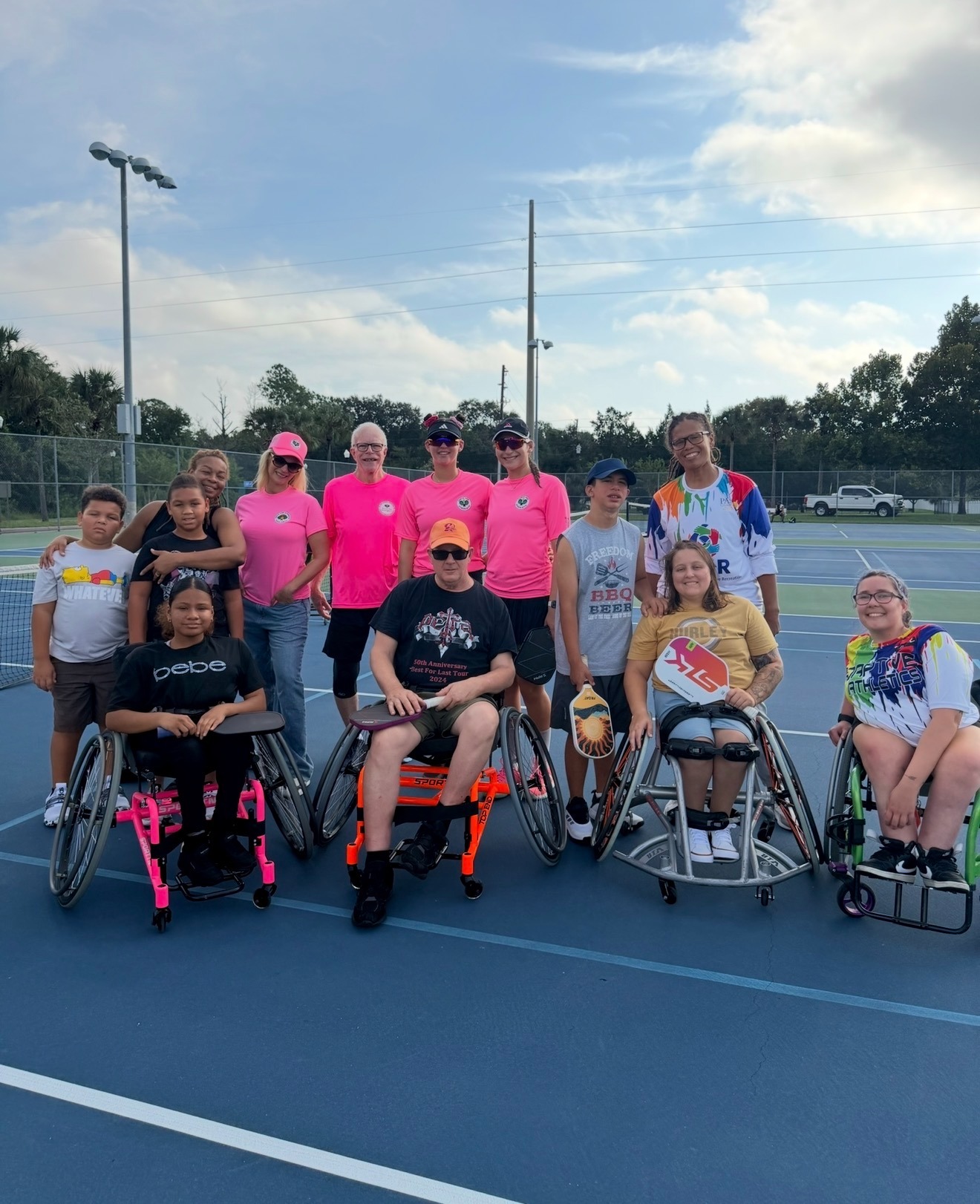
Inside the wheelchair pickleball clinic
Serve for Strength hosted the clinic with Pasco County Parks, Recreation & Natural Resources through its Adaptive & Inclusive Program. Participants included wheelchair players and Special Olympics athletes.
The goal was simple. Give everyone a chance to learn the game, build some skills, meet new people, and have fun.
Wheelchair pickleball uses the same court and most of the same rules as the standing game. The biggest difference: a wheelchair player can let the ball bounce twice before hitting it. That one adjustment opens the game up to a lot more people.
“There were no barriers to belonging, no expectations of perfection, and no pressure to win,” said the sisters’ mother. “It was just people coming together, playing, laughing, and supporting one another.”
The comeback that started it all
Serve for Strength exists because of Valerie’s own recovery. After serious injuries and multiple surgeries, her family wasn’t sure what came next.
“There was a time when we didn’t know if Valerie would walk again nor what her athletic future would look like,” Daniella Simon, her mother said. “Sports had always been such a huge part of her identity, and having that itaken away was devastating.”
Pickleball became part of Valerie’s road back. Eventually, it became a second shot at competing, this time as a pro.
“After everything I went through with my injuries and surgeries, I know what it feels like when your body won’t let you do what you love,” Valerie said. “Pickleball gave me a second chance at sports, and being able to share that opportunity with others means more to me than any medal or tournament victory.”
That’s why sitting in the wheelchair before the clinic mattered to her. She wasn’t just teaching. She was meeting players where they were.
What the players took away
For the participants, the clinic was a chance to compete, move, and learn from pros who wanted them there.
“The professional players were very encouraging and kind as they taught us some of the important parts of the game,” said participant Jimmy Turner. “Anything that allows me to exercise and use my athletic ability is always fun and very appreciated.”
Victoria spent much of her time with Special Olympics athletes getting ready for competition. She focused on the small technical details that pros rely on every day.
“I loved being able to share some of the technical skills and strategies I’ve learned playing professionally, especially the little adjustments that can make a big difference,” Victoria said. “Seeing their excitement when something clicked was such a rewarding feeling!”
For their mom, watching both daughters on the court brought everything full circle.
“Sometimes the biggest victories have absolutely nothing to do with the scoreboard,” Daniella said.
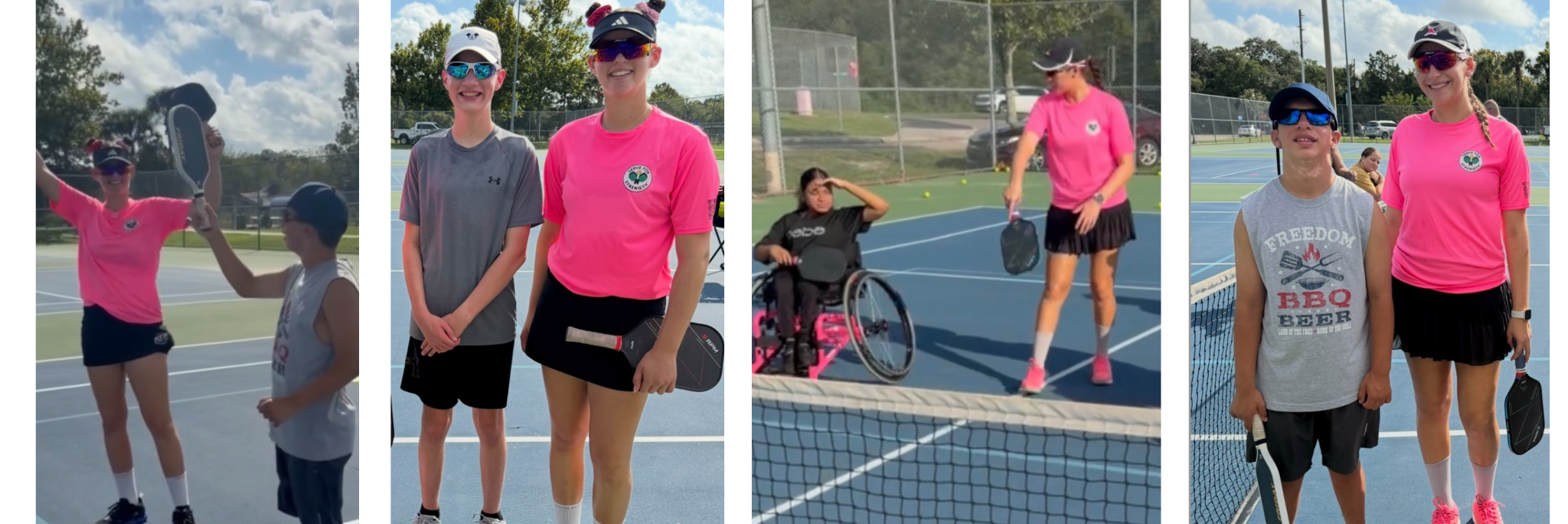
Why adaptive pickleball needs more than one day
Serve for Strength doesn’t want this to be a one-time event. The foundation plans to keep building wheelchair and adaptive pickleball opportunities in the community.
“Inclusivity shouldn’t be a one-day event,” Daniella said. “It should be something we work toward every day.”
The partnership with Pasco County is already continuing. Serve for Strength is co-hosting a training session to help Pasco County athletes prepare for the Special Olympics pickleball division on November 5th. The foundation also has a Health & Wellness Pickleball event planned for May 22, 2027, supporting Pasco County Adaptive Services.
How to get involved with Serve for Strength
There are plenty of ways to support the work, whether you live in Florida or not:
- Attend an event. Clinics and community programs are planned for the coming months, and are listed on their website: serveforstrength.org.
- Volunteer. Extra hands make adaptive clinics possible.
- Sponsor or donate on their website. Funds support the foundation, medical research, and new community programs.
- Spread the word. Share their work and connect them with your club or local parks department.
The next event is Swing for Strength, a charity golf fundraiser on Sunday, November 1, 2026, at Saddlebrook Resort in Wesley Chapel. It’s open to experienced golfers and first-timers alike, with raffles, giveaways, and a BBQ lunch.
Visit serveforstrength.org or follow @serveforstrength on Instagram, Facebook or Youtube to learn more.
Pickleball grew because anyone can pick up a paddle and play. Clinics like this one push that idea a little further. If you want to bring more people into the game, start by checking out adaptive programs near you, or find a DUPR club where every player has a place on the court.
Community
Partners