
How to Master the Two-to-One in Pickleball with Richard Livornese
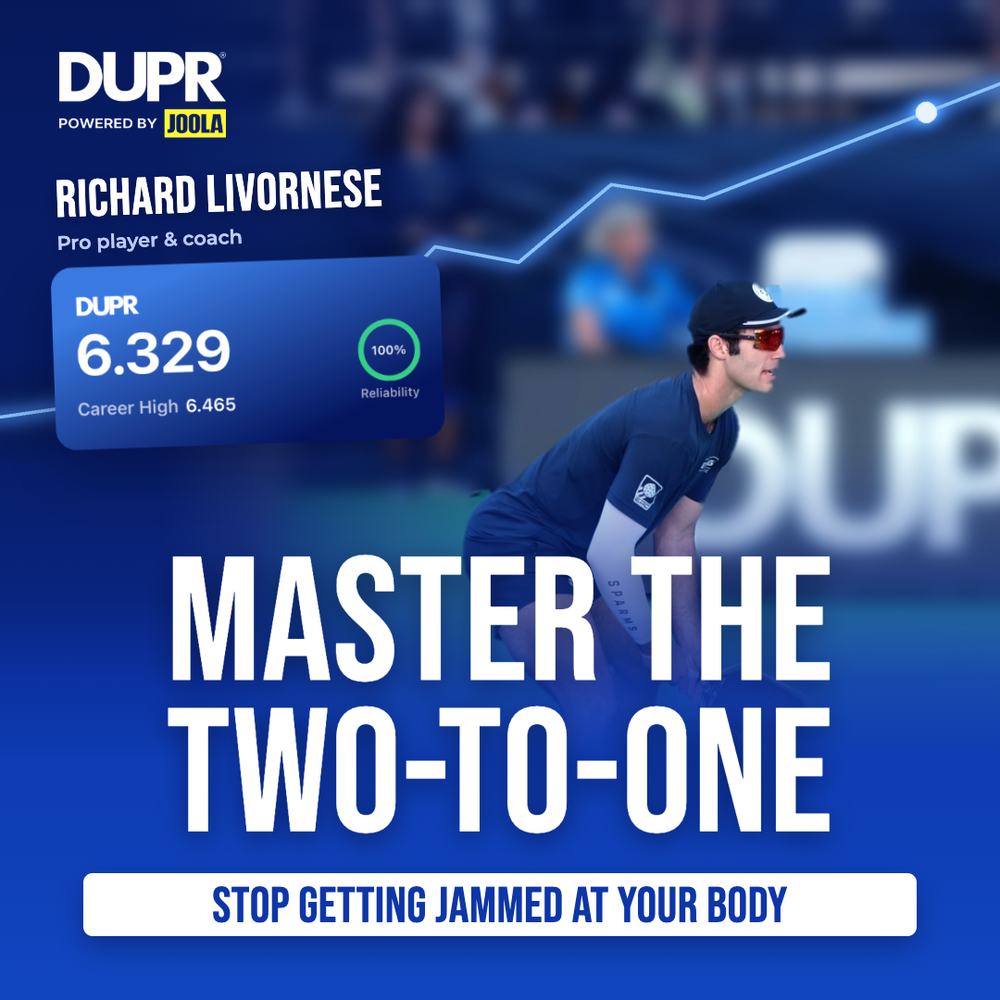
You've got your two-handed backhand ready, your opponent speeds up, and the ball comes straight at your chest. Both hands are locked on the paddle, you can't get it out of the way, and the ball handcuffs you.
It's one of the most common questions two-handed players have: how do you handle balls at your body? Pro player and coach Richard Livornese answers it in his video "Two To One! Stop Getting Jammed At Your Body" on YouTube with a concept high-level players use all the time, called the two-to-one. Whether you're a 3.5 or chasing a 5.0 pickleball rating, his approach will help you counter with two hands and one hand without getting caught in between.
And read to the end. There's one catch that decides whether this works for you at all.
What Is the Two-to-One?
The two-to-one means you prep with two hands on the paddle, then go to one hand to counter a ball at your body.
You keep the power and stability of a two-handed backhand for wide balls, but you're never stuck when the ball comes right at you. As your paddle moves, your off hand simply comes off and your dominant hand finishes the shot alone.
Richard says this matters most in two spots:
- On the left side, when you need your two-hander to cover the line.
- On the right side, when you're covering the middle.
Here's how to make it work in both.
The Secret: Don't Grab the Paddle
This is the key to the whole shot. In your ready position, keep your off hand on the paddle, but don't squeeze it. If you're gripping tightly with both hands when a ball comes at your chest, you'll almost always be late, and a lot of the time you can't even let go.
Instead, your dominant hand holds the paddle and your off hand just touches it. Then let the paddle's direction decide:
- Paddle moves to your backhand side? Grab with your off hand and hit a two-handed counter.
- Paddle moves forward or toward your forehand side? Leave your off hand where it is and counter with one hand.
You're not actively doing anything with your off hand. It just stays behind while your paddle slides away from it.
Pro insight: Think "my paddle goes away from my hand," not "I let go." Richard sees no advantage in taking your off hand off the paddle entirely, but a big disadvantage: your line ball gets super weak. Hands on, but loose, gives you both shots.
On the Left: Cover the Line
If you're a righty on the left side, a wide speed-up means you have to cover the line. That's where your two-hander earns its keep.
From the same loose ready position:
- Ball goes wide down the line: your paddle moves left, your off hand grabs, and you attack with two hands.
- Ball comes at your chest or hip: your paddle moves forward, your off hand stays put, and you counter with one.
Richard notes this is a little less critical on the left. Against a player with a strong wide speed-up, you can sometimes back up and buy space instead.
Pro move: The two-handed line cover has become one of the most important shots for left-side players. Learn the two-to-one so that line ball doesn't leave your body open.
On the Right: Own the Middle
For righties on the right side, Richard calls this shot "so important." You're responsible for the middle, and you can't cover it with one hand. You need two hands for the middle ball, and one hand for anything at your body.
When you do go two-to-one from the right:
- Hit down the line. It sets up a combo with your partner and is much easier than going back across your body.
- Keep sliding. If they get to it, stay on your backhand and slide into position for the next ball.
This also matters on fourth shots. Once the ball crosses the midline, the right-side player has to cover the middle, and your left-side partner can't get to that body ball.
Pro insight: Lefties, flip it. If you're a lefty playing the right, the left-side line cover above is your version of this shot.
The Catch: You Need a Continental Grip
Here's the catch: the two-to-one works best in a continental grip. Richard thinks it's almost impossible in an eastern grip.
Why? Grip changes how many steps the shot takes:
- Continental: release and go.
- Eastern: release, go, then turn your wrist to fix an open paddle face.
That extra motion is too much when a ball is coming at your chest.
Pro move: If you play with a different grip, backing up may be the better answer for now. But if you're already continental, Richard says the two-to-one is actually very easy to learn.

Ready to Win More Hands Battles?
The two-to-one isn't about hitting harder. It's about not grabbing. Keep your off hand loose, let the paddle leave it, cover the line on the left and the middle on the right, and stay in a continental grip. Do that and you'll counter with two hands or one without thinking about it, and your DUPR rating will show it.
Put it to work. Use the DUPR app to find players at your level, then sign up for a pickleball tournament and see how your counters hold up. Want to finish the point once you win the exchange? Check out Ava Ignatowich's tips to put the ball away.
Want more from Richard? Follow him on YouTube and Instagram for regular coaching tips. And for the latest on ratings, tournaments, and the pickleball community, follow DUPR on Instagram.

OTHER TOP STORIES
Check out our other stories that may interest you


