
PickleQ Streamlines Open Play and DUPR Match Reporting
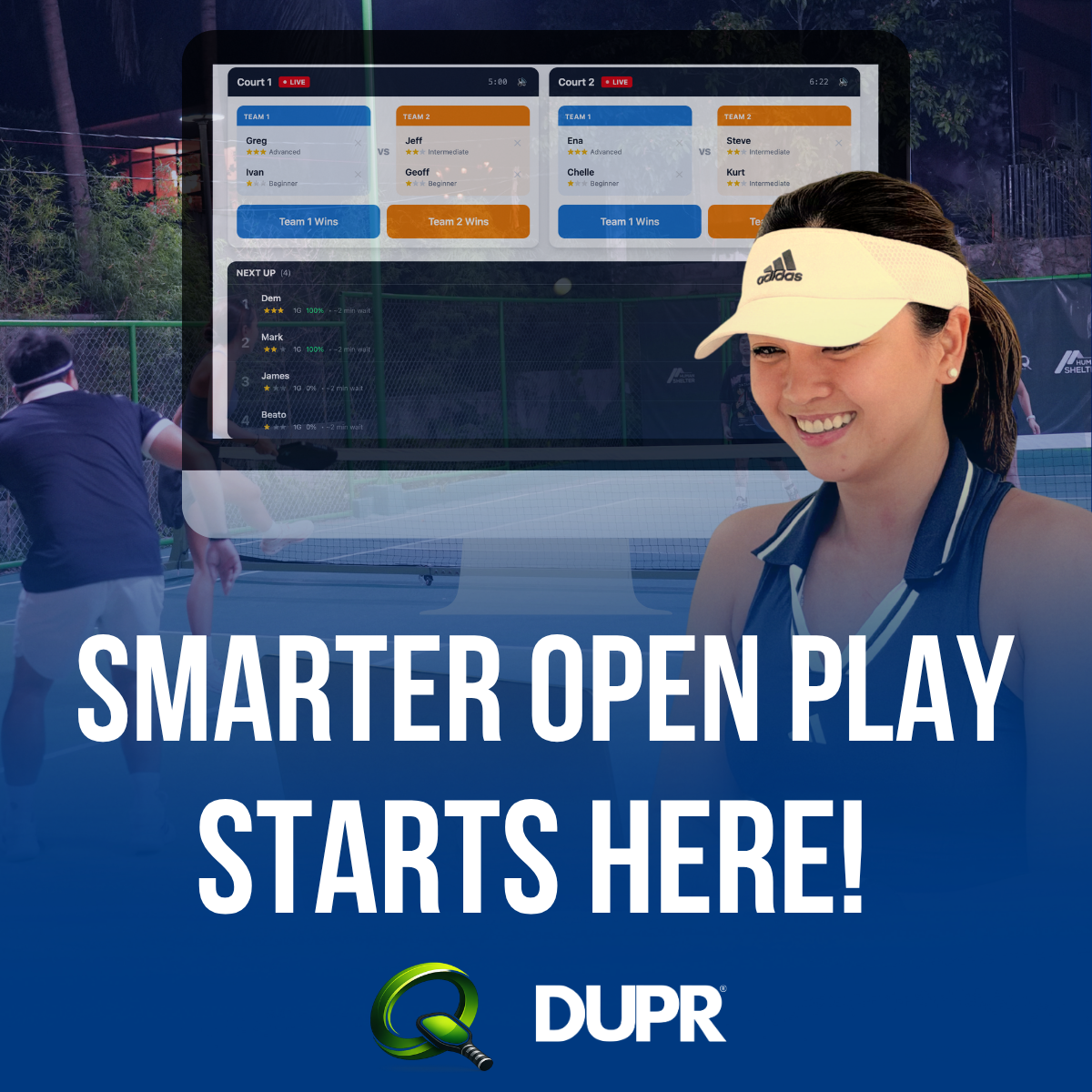
PickleQ is a browser-based platform designed to help pickleball clubs, recreation centers, and community organizers manage open-play sessions from check-in through final results.
The platform was created after its founders experienced a common challenge in open play: traditional paddle-stack systems often produced uneven matchups, unclear rotations, and unnecessary delays.
As newer players, the founders regularly participated in games with significant skill gaps. As they improved, they encountered the same issue from the opposite perspective. These experiences reinforced a simple idea: strong open-play sessions require more than selecting the next four players in line. Organizers must also consider skill balance, waiting time, partner variety, and fairness.
Making Open Play Easier to Manage
The challenge is especially visible in the Philippines, where pickleball participation has grown faster than the available court supply. During a busy open-play session in Metro Manila, ten or twelve players may be waiting to use a single court, sometimes for thirty or forty minutes.
Many communities still rely on paddle stacks to manage rotations. Although this system can work, it depends heavily on the person running the session. Players may be skipped accidentally, the same groups may repeatedly play together, and courts may remain unused while organizers determine who should play next.
PickleQ brings the full session into one platform. Organizers can create a session, add players and available courts, form matches, record scores, and manage rotations without using a separate spreadsheet.
Players can check in through a reusable QR code or shared kiosk. From their phones, they can follow the queue, view upcoming matches and court assignments, and track standings and results.
Many of these capabilities came directly from organizers running real open plays. Locked partners, dedicated skill courts, and safeguards against drawing the same opponent repeatedly were all added in response to their feedback.
Since PickleQ began in January 2026, more than 16,000 clubs have been created. Organizers have completed over 107,000 sessions, representing more than 1.5 million player appearances and nearly two million games.
Although PickleQ cannot create additional courts, it can help organizers use existing courts more efficiently by improving transparency, reducing delays, and keeping rotations moving.
Organizers can learn more about setting up and managing sessions through the PickleQ user guide.
Connecting Open Play With DUPR
As PickleQ’s founders became more involved in competitive pickleball, they also identified challenges in the process of reporting match results to DUPR.
At rated sessions, players often wrote their DUPR IDs on paper, while staff manually entered scores after the event. Results could take several days to appear, and manual entry created opportunities for incorrect scores, reversed winners, or matches being assigned to the wrong players.
These issues were not caused by the DUPR rating system. Instead, they came from the manual workflow between activity on the court and the submission of results.
To simplify this process, PickleQ introduced DUPR Mode through its paid Venue Pro toolkit.
PickleQ's DUPR reporting tools allow organizers to collect player DUPR IDs with the session roster, record winners and scores immediately after each match, keep results connected to the correct session, and generate a DUPR-ready bulk export using the current 27-column format.
Organizers have already recorded more than 23,000 games through DUPR Mode. PickleQ has also generated over 550 DUPR-ready exports covering more than 22,000 matches.
By reducing manual entry, PickleQ helps organizers submit more accurate results while spending less time on post-session administration.
More Than a Digital Paddle Stack
PickleQ is designed to manage the entire open-play experience rather than simply digitizing a traditional rotation system.
The platform considers factors such as skill balance, waiting time, partner and opponent variety, locked partnerships, court availability, and fairness to players near the front of the queue. Forming a balanced four-player match sometimes means looking past the next person in line, so PickleQ caps it: no player waits through more than two rotations before being moved to the front.
Potential matchmaking changes are tested across simulated games using the same logic as the live platform. If an update creates more balanced matches but also leads to longer waits or unequal participation, it is not implemented. In repeated runs of a busy five-court scenario, courts stayed in play about 95% of the time and every player got at least three games.
This reflects how the team approaches the problem: open-play rotation is treated as an optimization problem rather than a scheduling convenience.
The result is better match quality without giving up the fairness and flexibility that make open play appealing.
Supporting Better Open Play
PickleQ helps organizers manage queues, courts, matchups, and results in one place. For players, it creates more consistent opportunities to compete in appropriately matched games and build a reliable DUPR record.
Whether a club is running a casual open-play session or a competitive DUPR-rated event, PickleQ provides the tools to keep courts active, improve match quality, and simplify result reporting.
Create a free club and start managing an open-play session with PickleQ.

OTHER TOP STORIES
Check out our other stories that may interest you
.jpg)

.jpg)


