
Power vs control paddles: which pickleball paddle fits you?
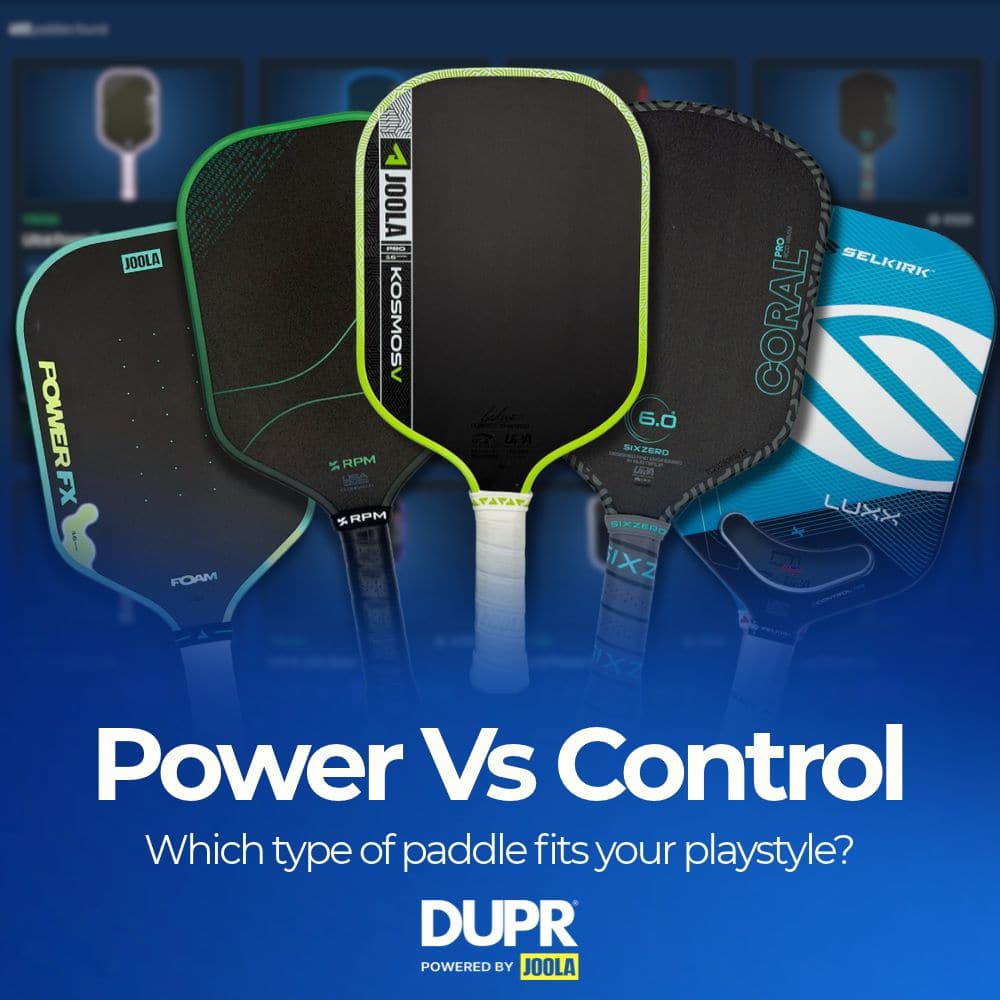
Twelve shots into a dink rally, your opponent floats one up and you load up for the putaway. It sails a foot long. Two points later, your reset pops up and gets slammed at your feet.
A paddle won't fix every miss, but it shapes how the ball comes off the face on every shot. This guide breaks down power vs control paddles, why most players land in the middle, and how to find the right pickleball paddle for your game.
If you're already comparing models, check out our top 10 pickleball paddle recommendations, backed by independent reviewer John Kew's testing data.
Power vs control paddles: what each one does
Every paddle sits on a spectrum. Power paddles send the ball off the face faster with less effort. Control paddles generally offer a more manageable response, making soft shots easier to place. All-court paddles sit in between.
Two terms come up in every paddle conversation:
Power is how hard the ball comes off your paddle on full swings: serves, returns, drives and overheads.
Pop is how fast the ball comes off on short swings: counters, punch volleys and resets.
Power paddles often have plenty of both, which helps you end points faster at the kitchen line. The cost is margin on soft shots, where extra pop can turn a reset into a sitter.
Power paddles: more pace, less margin
Power paddles often feature characteristics that support offensive play:
Elongated shape. A longer face adds reach and leverage on drives and serves. It also trades width for length, potentially making off-center contact less forgiving.
Livelier construction. Thinner cores and certain foam or thermoformed designs can produce faster ball speeds, although construction alone doesn't guarantee power.
More weight or swingweight. Additional mass can improve stability and drive through contact, but may slow your hands in fast exchanges.
The tradeoff shows up in the soft game. Drops, dinks and resets may require more precise touch, and blocked speed-ups can sail long. Expect an adjustment period before the pop feels predictable.
Control paddles: more forgiveness, less firepower
Control paddles offer a more predictable response, helping players manage pace on resets, drops and dinks.
Many use thicker cores or wider shapes that emphasize forgiveness. A wider face can help with off-center contact when you're stretched wide or jammed at your body.
The downside is firepower. Putaways may require more effort, and counters can lack the pace needed to pressure an opponent. Against players with livelier paddles, it can feel like you're always defending.
Still, control isn't just about equipment. Learning how to hit a consistent third shot drop can make a bigger difference than switching paddles alone.
All-court paddles: where most players land
All-court paddles, sometimes called hybrid paddles, blend both sides. A good all-court paddle gives you enough control to reset and drop, plus enough pop to finish when your opponent leaves a ball up.
If you're unsure where your game sits, start here.
These labels also shift over time. A paddle that counted as top-tier power a few years ago might rate as all-court today. Advancements in textured faces, foam construction and stability have expanded what's possible.
Long-term performance matters too. Some textured surfaces lose spin as they wear, so it's worth considering durability alongside power and control.
How you play points to your paddle
Your play style is the best starting point:
The attacker drives third shots and speeds up early. A power or high-end all-court paddle fits, as long as you can still drop when the drive isn't there.
The patient player wins long dink rallies by waiting for the pop-up. A control or low-power all-court paddle supports that game.
The all-court player is as comfortable resetting as speeding it up. An all-court paddle lets you do both.
Weight matters too. Lighter or lower-swingweight paddles can help players prioritize quick hands at the kitchen line. More substantial paddles may offer additional stability and depth on drives.
Then be honest with yourself. If your resets keep popping up, blocked speed-ups fly long, or your dinks float high, drilling will help, but a paddle with a little less pop might help too.
The goal is to find the most powerful paddle you can still play your best with.
Technique closes part of the gap. With a softer paddle, you can use a compact motion and let it absorb pace. With a power paddle, loosen your grip and adjust your paddle angle.
Not sure if it's the paddle or the shot? A credentialed DUPR Coach can watch you play and help identify the issue.
Does your paddle affect your DUPR rating?
Your paddle isn't part of the rating calculation. DUPR calculates your rating using match results, comparing how you scored against what was expected based on everyone's ratings.
Club and tournament matches carry more weight than self-posted rec games. Here's how your DUPR rating is calculated.
A paddle can still change how you perform in those matches. Break in a new paddle during rec play before bringing it to a league or tournament.
DUPR+ members can also use Rating Trend in DUPR Insights to monitor their performance over time. While it won't tell you whether a paddle caused a rating change, it can help you track results before and after switching.
How to test a paddle before you buy
Ask your club or local shop about demo paddles, or borrow a friend's. Then:
1. Dink crosscourt for five minutes. Floating balls may mean the paddle has more pop than you're comfortable controlling.
2. Hit resets from the transition zone while a partner drives at your feet.
3. Block speed-ups at the net and see whether counters stay in.
4. Drive and serve from the baseline to check your pace without overswinging.
5. Play a full rec game. Games reveal how a paddle performs under pressure.
Want a more structured practice session? Try our 10 pickleball drills for 4.0+ players, including resets, dinks and fast hands exchanges.
Shopping for a new paddle? DUPR+ members in eligible countries can receive a $30 JOOLA gift card with their $19.99 annual membership. See what's included in DUPR+.
Pick the paddle that fits how you win
The power vs control question comes down to how you win points.
Start with your play style, test honestly, and choose the most power you can handle without giving away easy errors.
Then put your paddle to work in competitive play and see how your results develop. When you're ready, explore our guide on finding pickleball tournaments and leagues.
Frequently asked questions
What is the difference between a power paddle and a control paddle?
Power paddles generally produce faster ball speeds, which helps on drives, serves and putaways. Control paddles offer a more manageable response, making it easier to place dinks, drops and resets.
What's the difference between power and pop?
Power describes how hard the ball comes off the paddle on full swings like serves and drives. Pop describes how fast it comes off on short swings like counters and punch volleys.
What is an all-court pickleball paddle?
An all-court, or hybrid, paddle sits between power and control. It combines touch for the soft game with enough pace for offensive shots.
Should beginners use a power or control paddle?
Control and all-court paddles are often more forgiving while you're building consistency. Many newer players do well with an all-court paddle, but demo a few before buying.
Will switching paddles change my DUPR rating?
Your paddle isn't directly factored into the match-based rating calculation. A new paddle can influence how you play while you adjust, so break it in during rec play first.
Does DUPR+ include anything for buying a paddle?
Eligible DUPR+ members in the USA, Canada, Australia, Brazil, Germany, Japan and India can receive a $30 JOOLA gift card toward JOOLA products. Terms and membership eligibility conditions apply.

OTHER TOP STORIES
Check out our other stories that may interest you


